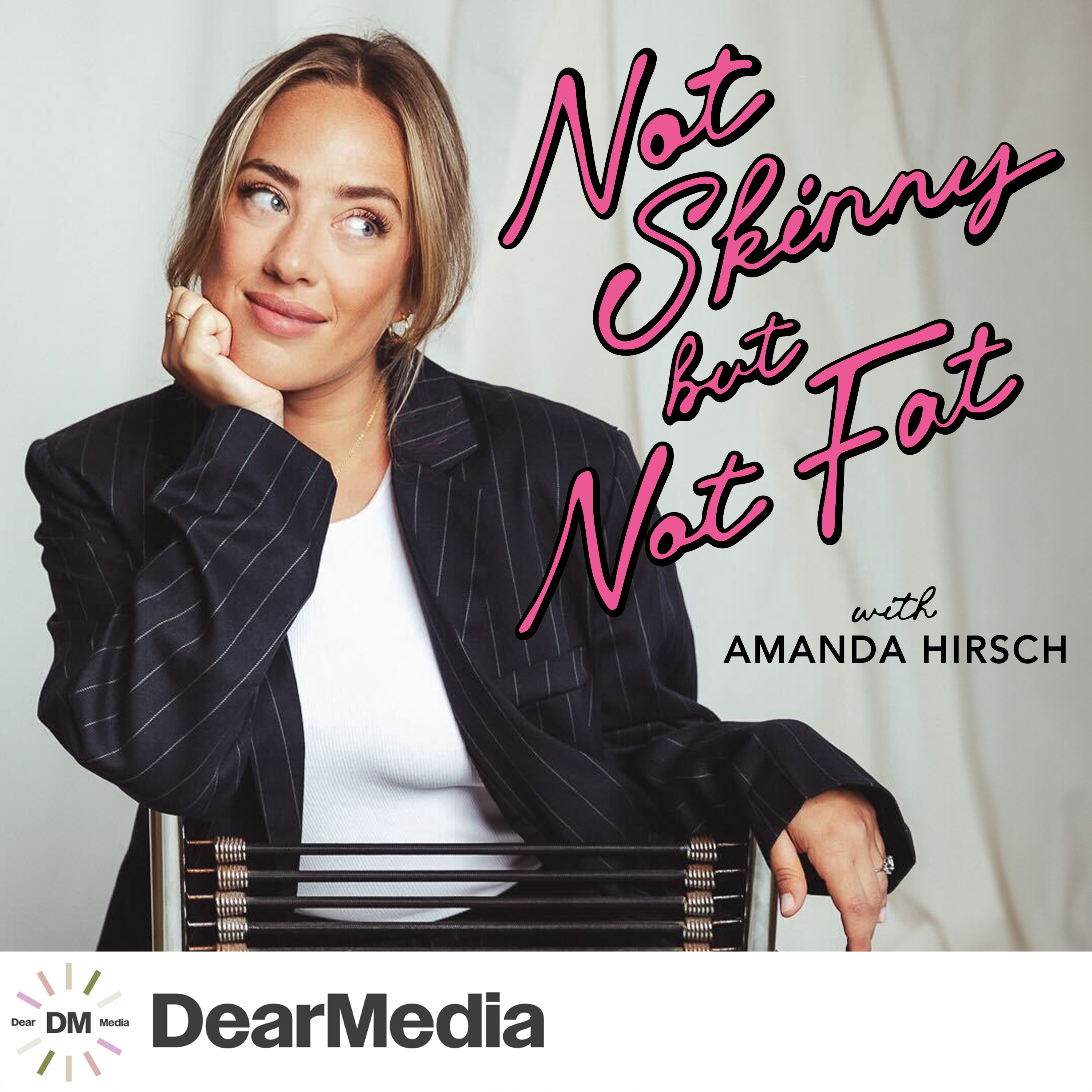
Overview of Not Skinny But Not Fat (Episode: Penn Badgley — "Seriously Unserious")
Amanda Hirsch interviews actor/writer/podcaster Penn Badgley in a wide-ranging conversation that covers his family life (recently welcoming identical twin boys, plus two older sons), career choices (child acting, Gossip Girl, You, nearly auditioning for Breaking Bad), creative work (his podcast Podcrushed and new essay collection Crush More), and cultural views (fame, astrology, social media, and what it means to be “serious” vs. “unserious”). The episode mixes personal anecdotes, parenting realities, industry observations, and Penn’s contrarian takes.
Guest context & promo
- Guest: Penn Badgley — actor (Dan Humphrey on Gossip Girl; Joe Goldberg on You), host of the podcast Podcrushed, author of the essay collection Crush More (referred to as a bestseller in the episode).
- Personal life: Recently had identical twin boys (spontaneous), bringing his total to four sons (including a stepson, age ~17). Discusses hands-on parenting, hiring a night nurse part-time, and postpartum realities.
- Promotions woven into the episode: Penn’s book Crush More and his podcast Podcrushed.
Main topics covered
- Parenting and family life
- Life with newborn twins: physical and logistical intensity compared with parenting one child; hiring childcare/night nurse as partial relief; challenges finding trusted in-home support.
- Parenting philosophy: experiential value of actually being present; “whatever makes the mother happiest is best for the children”; managing expectations and the altered mental state of newborn care.
- Stepfamily dynamics: being a step-parent to a nearly 17‑year‑old and the natural cringe/gap between generations.
- Career beginnings and choices
- Started acting professionally as a preteen; homeschooled and did not finish middle school; briefly attended one month of high school.
- Moved to LA with his mother amid family upheaval; early passion for music and dance.
- Nearly auditioned/tested for Jesse Pinkman (Breaking Bad) — Aaron Paul ultimately cast.
- Initially reluctant to take Gossip Girl (felt he’d “done” the sensitive nice-guy thing, wanted to pursue music and other work), later convinced by his team when the show’s scale became clear.
- Reflections on long-running TV series: how soap-opera-like mechanisms (escalating conflict/resolution) can create “bad habits” for actors and erode realism.
- On reboots and legacy: not very enthusiastic — prefers narratives that properly end rather than endless continuations.
- Fame, cameras, and culture
- Relationship with the camera: examines how cameras changed culture (Gossip Girl as a pre-selfie phenomenon that exposed people rather than people exposing themselves).
- Social media and content: leans into content creation recently (Podcrushed, TikTok), but emphasizes a measured online presence aided by collaborators and co-hosts.
- Views on astrology and meaning-making
- Skeptical of modern astrology’s popularity: calls it reductive and inconsistent as a system, warns of its becoming a “secular religion.”
- Argues the practice/user understanding is often shallow, and that human qualities attributed to signs are better explained without resorting to fixed astrological categories.
- Creative life, play, and healing
- Dance and play: sees dance as a “North Star” — a sign of health and a path back to play and authentic expression.
- Essays in Crush More use personal moments (e.g., reclaiming dance, an “in-camera” sex scene, childhood memories) to explore identity, fame, and creativity.
Notable quotes & insights
- “What seemed serious 20 years ago…has become unserious.” (On how public expectations and authenticity have shifted.)
- “There was nothing that prepares you for parenthood.” (On the reality of being a parent.)
- “Astrology has become the new secular religion.” (His critique of astrology’s rise and the superficial way people use it.)
- “Dance is a sign of health.” (Arguing for play and embodiment as markers of wellbeing.)
- “Whatever makes the mother happiest is best for the children.” (On family logistics and parental wellbeing.)
Key takeaways
- Penn values authenticity over performative media training; his public persona blends seriousness and ironic “unseriousness.”
- Parenthood (especially twins) is physically and emotionally exhaustive; even experienced parents find new challenges and rely on painful trade-offs when hiring help.
- He’s skeptical of simple systems that try to categorize human complexity (e.g., mainstream astrology) and encourages deeper study rather than surface-level labels.
- Creative life for him is cyclical: music and dance were early passions he returned to amid acting; writing (Crush More) and podcasting (Podcrushed) are extensions of that exploration.
- Big pop shows can provide huge platforms but also limit actors if the work becomes formulaic; ending a character arc at the right time is artistically important.
Recommended listening / segments to jump to (themes rather than timestamps)
- Parenting + twins: practical realities, night nurse, differences between one child vs twins.
- Career origin stories: moving to LA, homeschooling, nearly landing Breaking Bad, initial reluctance to join Gossip Girl.
- Fame & camera culture: essay about “in camera” sex scene; how Gossip Girl prefigured selfie culture.
- Astrology critique: Penn’s skeptical, reasoned take on why astrology’s modern practice is problematic.
- Creative/therapeutic role of dance and play: why he considers dance a health marker.
Action items / where to follow up
- Listen to Podcrushed for more interviews and cultural conversations (co-hosted with Nava and Sophie).
- Read Crush More (essay collection) for the personal pieces Penn discusses — includes essays about dance, fame, and camera culture.
- If interested in parenting takes from a celebrity perspective: this episode offers candid, practical reflections on hiring help, postpartum states, and family logistics.
Credits: Episode hosted by Amanda Hirsch on the Not Skinny But Not Fat podcast (Dear Media).