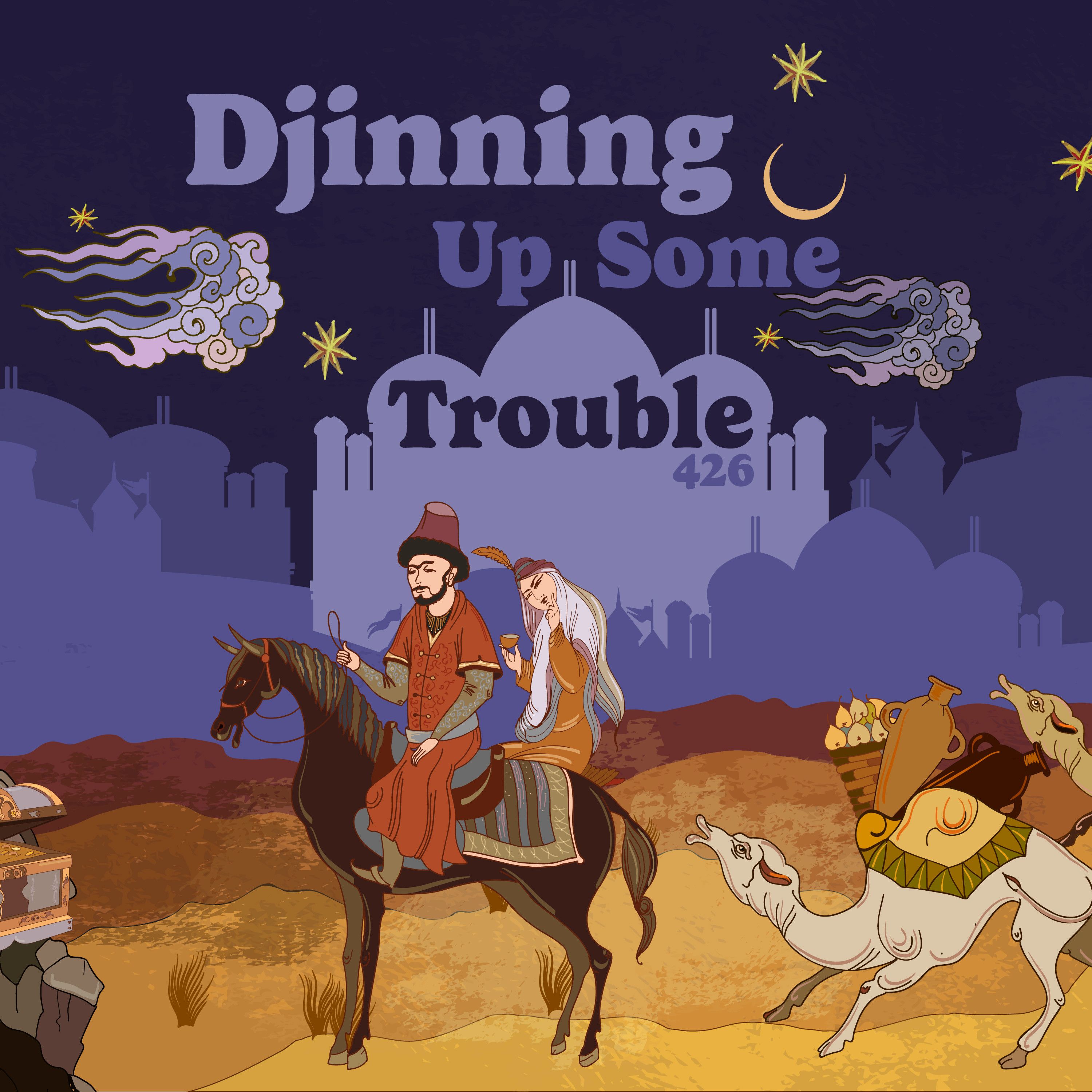
Overview of Myths and Legends — Episode 426: "1001 Nights: Djinning Up Some Trouble"
This episode retells a long, nested tale from the 1001 Nights (the Kamar and Budur cycle) about a sultan’s overprotective son, a defiant princess, djinn politics, love-at-first-sight, trickery, and a string of imprisonments and tests. The hosts present the plot with humor and modern asides, framing it inside the Scheherazade storytelling device. The episode also includes a Creature of the Week (Ebu Gogo) and carries a trigger warning for a threat of sexual assault late in the episode.
Story summary
Setup — the sultan and his son Kamar
- The sultan prays and stages a public charitable feast; a son (Kamar) is born and the sultan obsessively refuses to be parted from him.
- At 15, Kamar publicly declares he will never marry, arguing women are deceitful and untrustworthy. The sultan and vizier try to correct him.
- As punishment/discipline the sultan has Kamar confined to an opulent tower “prison” (silk mattresses, leather couches) to shame and soften him.
Djinn princess Mamuna spies a prince
- A djinn/princess named Mamuna (genia) living in a well spots Kamar through the tower and becomes instantly enamored.
- Mamuna and an Ifrit (Dinashe/Dinash) argue over who is more beautiful—the princess or the prince—so they bring in a marid judge.
- The djinns stage a contest: each will awaken the sleeper (by flea-bite metamorphosis) and whoever’s awakened sleeper is more enamored “loses.” Both Kamar and the princess fall in love at first sight.
- They exchange small tokens (each secretly takes the other’s ring) and briefly consummate/embrace before being separated; ambiguity remains about the depth of their change.
Parallel: Princess Budur and her father
- In another kingdom the equally beautiful Princess Budur (also adamant against marriage) lives under a doting father who builds lavish palaces and eventually imprisons her in towers to “protect” or force her.
- Budur and Kamar’s stories run in parallel as two proud young people resist arranged marriage and favor autonomy.
Kamar’s apparent madness → Marzawan’s arrival
- Kamar’s reactions after the encounter are intense and mournful; he attacks guards and collapses with heartbreak.
- A sailor/foster-brother figure named Marzawan washes up, recognizes Budur’s signet ring (linking his homeland to Budur’s), and through poetry helps revive Kamar’s spirits. Marzawan becomes Kamar’s ally.
Escape, disguise, and marriage to Budur
- Kamar and Marzawan stage an escape: Kamar disguises himself as an astrologer/learned man and gains an audience at Budur’s court.
- Using a love poem and the signet ring, Kamar communicates with Budur. She responds, breaks her chains, and embraces him — they “marry.”
- Kamar leaves on a hunting trip (planned escape) but is led by a bird carrying a jewel that ultimately guides him to a hidden vault; he spends ten days following it and discovers marble steps and treasure beneath the earth.
Wizard City, riches, and a series of pranks/reciprocal tests
- Kamar visits a “city of wizards” and works briefly before striking it rich from the treasure he found; he gifts wealth to a gardener friend who later dies, altering Kamar’s plans.
- Budur, meanwhile, searches ship cargo and finds jars of gold (secreted away); she realizes Kamar is alive.
- Budur stages a cruel test: she has Kamar arrested and coerced (in disguise as her father/the king) into humiliating acts as the condition for seeing her again. The prank verges on sadistic but concludes with her revealing herself and forgiving him.
- Kamar and Budur reunite. Budur also takes a second wife (Hyat) later on, and the couple otherwise seem to settle into rule.
Epilogue (teased next twists)
- The story ends with foreshadowed dysfunction in the next generation: Budur’s and Hyat’s sons become objects of their stepmothers’ desires; conspiracies and false accusations follow, with executions attempted but sometimes thwarted.
- The episode emphasizes the nested/infinite narrative quality of 1001 Nights — stories within stories and cautionary repetitions.
Creature of the Week — Ebu Gogo (also called Abugogo / Ibogogo in the episode)
- Origin: Indonesian/folklore figure.
- Description: small, hairy humanoids with long arms and legs, canine-like teeth, pendulous breasts on women, surprisingly fast despite pot bellies.
- Behavior: they steal food, goods, and sometimes children at night; they mimic human speech but superficially (parrot-like); they hate fire.
- Fate in the tale: villagers offer clothing made from palm fiber to “civilize” them, then burn them in their cave once the creatures take the bundles — a grim resolution.
- The hosts summarize the creature as a nuisance turned extinct by human trickery; the segment ends with a darkly comic moral: don’t accept gifts if you’ve been stealing from the giver.
Themes and takeaways
- Coercion versus consent: the story repeatedly uses imprisonment and manipulation to “fix” unwilling adults (both Kamar and Budur are confined by their parents).
- Love and transformation: both protagonists are changed (or at least moved) by love-at-first-sight encounters; whether these are genuine character reforms or temporary infatuations is ambiguous.
- Power and hypocrisy: rulers exercise extreme power (lavish prisons, executions) under the guise of propriety or protection; the narrative critiques these excesses by showing long-term instability.
- Storycraft of 1001 Nights: the episode highlights Scheherazade’s nested storytelling, where tales loop and continue across generations — outcomes are cyclical, not neat.
- Moral ambiguity: characters do destructive or cruel things (pranks that verge on abuse, executions, trick-burning of creatures), so the tale resists simple moralizing.
Notable quotes / moments
- Comedic framing: "If your kid doesn't want to get married. Jail. Or if they get sick. Jail. Or if they fall in love. Jail. But jail with leather couches, apparently."
- The djinn-judge solution (having the sleepers decide by measuring who’s more enamored) — a folkloric device emphasizing love’s apparent instantaneity.
- The episode’s recurring line about “killing with kindness” as a literal motif (gifts used as a weapon against the Ebu Gogo).
Content warnings & listening notes
- Trigger warnings in the episode: brief threat of sexual assault towards the end, depictions of torture, execution, imprisonment, and violent pranks.
- The retelling includes prolonged descriptions of confinement, psychological manipulation, and implied sexual situations; listener discretion advised.
Quick practical info
- Episode: Myths and Legends, ep. 426 — "1001 Nights: Djinning Up Some Trouble"
- Source: A retelling of the Kamar/Budur stories from the 1001 Nights frame.
- If you want more: check translations/annotated versions of the 1001 Nights Kamar–Budur cycle for fuller, less-modernized language and variations of names and plot points.