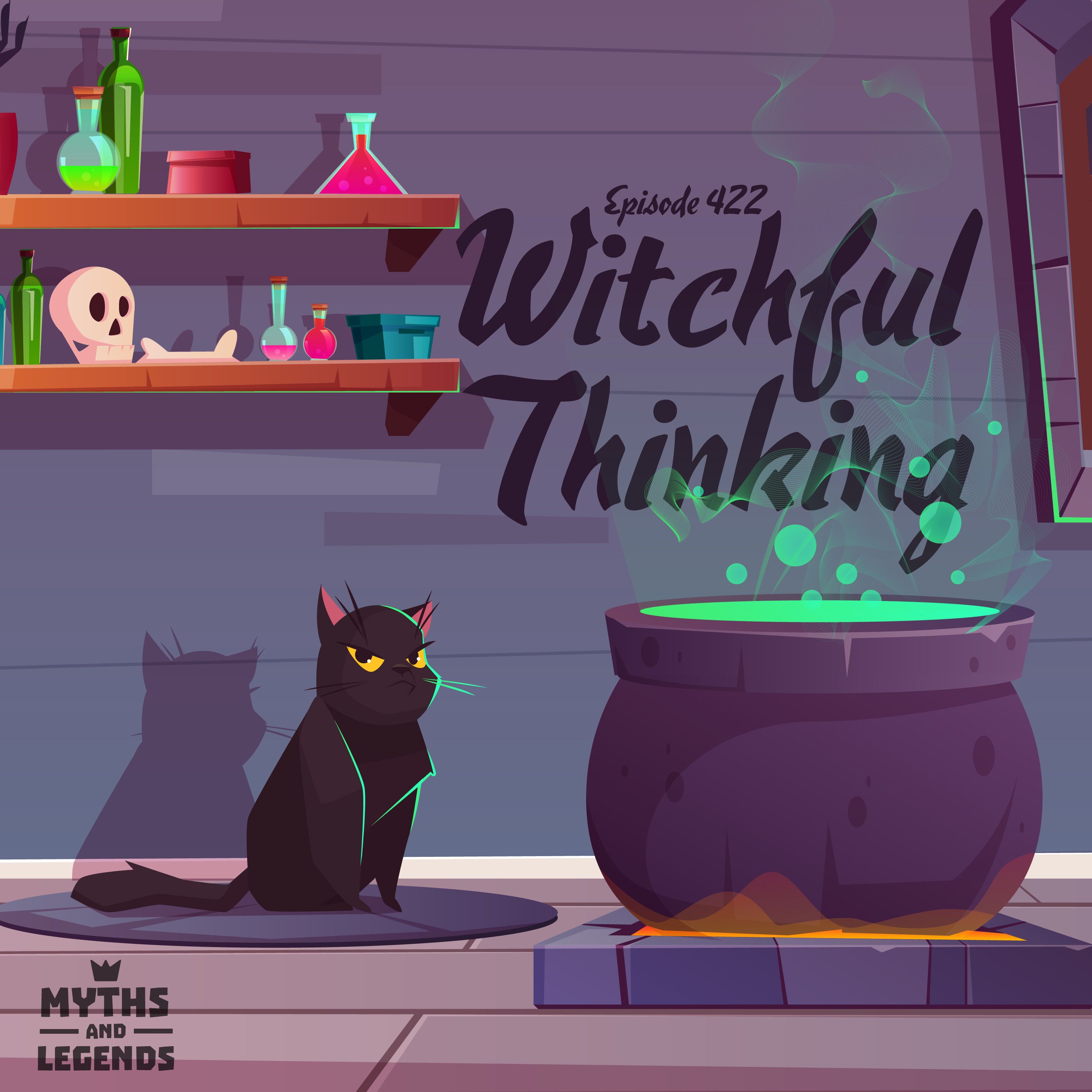
Overview of Myths and Legends — Episode 422: "Witchful Thinking"
This episode collects three witch- and wizard-centered folktales (mostly Scottish, one with a Norwegian touch) plus a creature segment about headless men from Guyana. The stories range from darkly comic cautionary tales about curiosity and greed to subversions of the “hero wins princess” trope. The hosts (Jason and Carissa Weiser) narrate: a tailor who discovers a witch’s milk-works and throws a chaotic “milk party”; Gilly McDonald, a tavern-keeper who pursues buried treasure at a wizard’s castle and narrowly escapes magical peril (and five would‑be brides); and a traveling witch‑hunter’s exaggerated cat tale / silver‑bullet story. The creature segment covers the Iwai/Eyá Ponoma — headless men with eyes on their shoulders — and a Sir Walter Raleigh anecdote.
Stories in this episode
The Tailor and the Witch’s Milk (short, comic-cautionary)
- Setup: A traveling tailor arrives at a farm and notices the household’s uncanny ability to produce milk instantly from a wall-pin.
- Discovery: The tailor secretly observes the farmer’s wife turn a pinned spigot that pours milk from the wall — she’s a witch.
- Consequence: He exposes the trick by turning the pin and causing uncontrollable milk flow. The witch returns, reclaims the pin, and punishes the tailor: he must scrub and clean their house until it’s perfect (or be tormented by time‑reversal punishment).
- Themes: curiosity/peeking at magic leads to humiliation or servitude; comic punishment rather than execution; the “don’t tangle with forces you don’t understand” moral.
Gilly McDonald and the Wizard of Takronin (main tale)
- Setup: Gilly McDonald, a restless tavern owner, hears a drifter/peddler claim a rich wizard buries gold at Castle (Takronin/Tacronen). Gilly decides to go seek treasure.
- Encounters on the road: a troupe of shape‑changing characters (acrobat, hunchback, giants, etc.) repeatedly greet him with the same mocking phrase “Well met. We are fellow travelers,” signaling he’s being watched and tested.
- At the castle: A giant/wizard captures Gilly and plans to enslave him for labor. Gilly serves dinner, tries to be shrewd, and the wizard hesitates before deciding to keep him.
- Liberation & complications: Gilly accidentally frees five imprisoned maidens (the daughters of King Lachlan) who claim they must marry whoever frees them. The maidens vie for him; after tricks and wordplay Gilly locates the buried gold, steals it, and flees.
- Conclusion: Gilly returns home wealthy, avoids marriage to the five sisters, and lives comfortably with continued offers — subverting the usual fairy-tale “hero marries a princess” ending.
- Notable elements: enchanted watches/shape‑shifters on the road, magical imprisonment of princesses, treasure buried like “potatoes,” and a protagonist whose primary character arc is avoiding marriage rather than proving valor.
Witch‑hunter, Cats, and the Silver Bullet (short, folkloric aside)
- A traveler self‑defines as a witch‑hunter and tells tall tales: cats forming a coven, building cauldrons, and being violent; a separate story where a silver bullet found in a stag is later extracted from a woman, used as “proof” she was a witch.
- Tone: the narrator treats these tales as examples of the hysteria and exploitation around witch‑hunting — easy to fabricate and abused for profit or vengeance.
Creature segment — the Iwai / Eyá Ponoma (headless men)
- Description: Headless men with eyes on their shoulders, nose lower down, mouth on the chest (horseshoe-shaped), reportedly strong and adept with huge clubs/axes.
- Origin & anecdotes: This motif appears in Guyanese folklore. Sir Walter Raleigh is said to have heard local reports of such reputedly strong, headless tribesmen, and took oral testimony of children seriously enough to mention them.
- Broader note: Shoulder‑eyed, headless humanoids appear in multiple world traditions — the episode connects the Ponoma motif to cross-cultural folkloric patterns.
Main themes & motifs
- Curiosity vs. consequence: Peeking behind magic’s curtain often brings humiliation or servitude (tailor) or entrapment (Gilly).
- Greed & temptation: Treasure rumors lure Gilly from a settled life; the promise of instantaneous wealth drives risk.
- Shape‑shifting watchers and tests: Repeating figures (acrobat/hunchback/giant) emphasize the folkloric test of travelers.
- Subversion of heroic tropes: Gilly is not eager to marry a princess; instead he prefers wealth and freedom — a deliberate twist on expectations.
- Witch-hunt skepticism: The episode highlights how “proofs” (silver bullets, rumors) and fear can be manipulated.
Notable quotes / moments
- “Where gold can be got by digging” — the peddler’s tease that sends Gilly on his quest.
- The tailor’s accidental “milk party” and the comic escalation when the milk spigot cannot be shut off.
- The repeated greeting of the shape‑changers: “Well met. We are fellow travelers,” used to creepy effect as an omen.
- The five maidens chorus: “All of you, yes, all of us” — the absurdity of being asked to marry five sisters.
Takeaways & recommendations
- This episode is a mixture of comic and dark folklore, useful if you’re interested in:
- Scottish fairy‑tale motifs (treasure‑temptation, enchanted castles, imprisoned maidens).
- How folk narratives rework the marriage/prize trope.
- Folkloric attitudes toward witches, witch‑hunters, and how rumor fuels persecution.
- If you want primary sources: the hosts link a public‑domain source in their show notes (search the episode page for the original tale collection referenced). Searching key names from the episode (Gilly/Gille MacDonald, Castle Takronin/Tacronen, King Lachlan) along with “Scottish fairy tale” will find comparative versions.
- The episode’s creature segment is a compact pointer to the wider motif of headless/shoulder‑eyed men — a good springboard for reading cross‑cultural bestiary folklore.
Episode logistics & next episode
- Hosts: Jason and Carissa Weiser.
- Music: theme by Broke for Free; creature music by Steve Combs (more credits in show notes).
- Preview: Next episode returns to Japanese folklore (abandoned temple stories) and another creature segment.
Enjoy this episode if you like folktales that balance dark consequences, comic mishaps, and a refusal to let the “hero” conform to standard fairy‑tale endings.