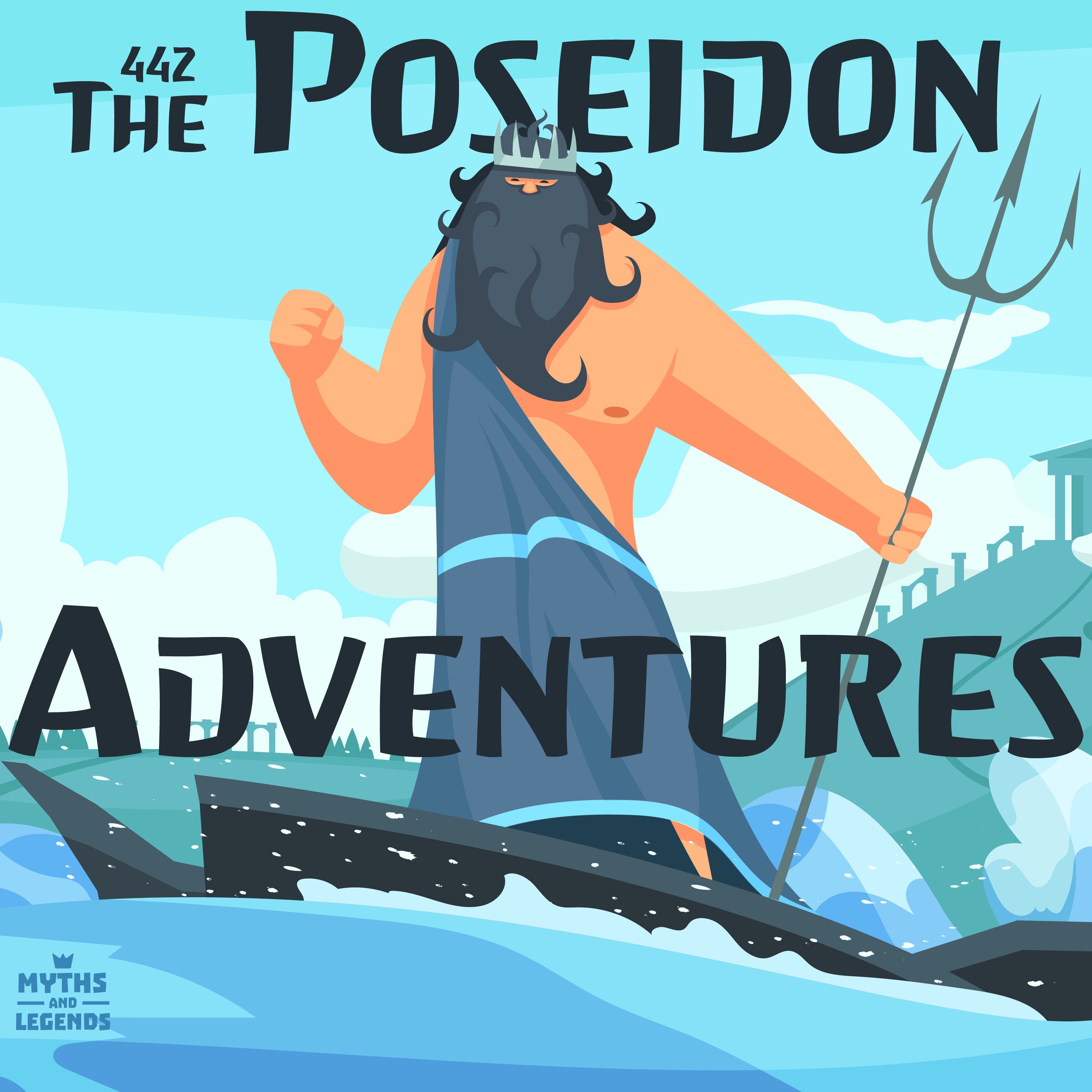
Overview of Myths and Legends Ep. 442: “Greek Myths: The Poseidon Adventures”
This episode is a comedic, framed retelling of Poseidon’s life and major mythic appearances, presented as an in-character interview between Dionysus and Poseidon. It covers Poseidon’s birth, his role in the Titanomachy, his marriage to Amphitrite, his grudges and interventions in the Trojan War, his conflicts with Odysseus and Athena, and the episode’s broader argument that Poseidon is immensely powerful but deeply unlikeable. The episode also includes a Creature of the Week segment on Alan from Philippine folklore.
Poseidon’s Mythic Life
Birth and Rise to Power
- Poseidon is described as one of Cronus and Rhea’s children, with a variant tradition where he was swapped with a foal so Cronus ate the horse instead.
- He later participates in the Titanomachy, the war between the Olympians and the Titans.
- After the war, the Olympians divide power by lot:
- Zeus gets the sky
- Hades gets the underworld
- Poseidon gets the sea
Domains and Personality
- Poseidon is not just a sea god; he is also associated with:
- Horses
- Earthquakes
- The “foundations” of the earth
- The episode emphasizes that Poseidon:
- Commands worship from sailors and seafaring peoples
- Wants respect, but not necessarily affection
- Often reacts to slights with tantrums or vengeance
Amphitrite and the Dolphin Messenger
The Search for Amphitrite
- Poseidon becomes infatuated with Amphitrite, one of the Nereids.
- She flees him, and he sends sea creatures to find her.
The Dolphin as the “Wingman”
- A dolphin is sent to persuade Amphitrite to marry Poseidon.
- The dolphin’s efforts succeed, and Poseidon later honors it by turning it into a constellation.
- This is presented as one of the few moments where Poseidon receives genuine help and a win that isn’t brute force.
Trojan War and Poseidon’s Grudges
Troy and Laomedon
- Poseidon and Apollo once helped build the walls of Troy for King Laomedon.
- When Laomedon refuses to pay them, Poseidon sends a sea monster and Apollo sends plague.
- The city is only spared when a hero intervenes.
- The episode connects this to Poseidon’s long memory and his tendency to hold grudges.
Poseidon’s Role in the Trojan War
- Poseidon sides against the Trojans, partly because of old grievances.
- He helps keep the Greeks from collapsing when Hector nearly turns the tide.
- The episode references Poseidon’s clash with Zeus during the war, where Zeus orders the gods not to interfere.
Aftermath and Family Revenge
- The episode revisits Poseidon’s recurring pattern:
- He creates or empowers monsters
- Heroes kill the monsters
- Poseidon remains angry anyway
Odysseus, Polyphemus, and Athena
Odysseus and the Cyclops
- Poseidon’s son Polyphemus is blinded by Odysseus.
- Poseidon’s rage is framed as disproportionate, especially given that Polyphemus is also a cannibalistic monster.
Athena Rivalry
- Poseidon and Athena compete for patronage of Athens.
- Athena wins with the olive tree, while Poseidon offers a salty spring.
- The episode notes Poseidon’s tantrum and the myth’s political/cultural consequences.
Medusa and the Temple of Athena
- The show directly addresses the darker version of the Medusa story:
- Poseidon violates Medusa in Athena’s temple
- Athena cannot punish Poseidon directly
- Medusa becomes the one who bears the consequences
- This is one of the episode’s most serious points: Poseidon’s power often displaces guilt onto vulnerable victims.
Core Takeaway About Poseidon
The episode’s main interpretation is that Poseidon is:
- Powerful
- Worshiped
- Respected
- But not truly loved
He is portrayed as someone who:
- Misunderstands his own power
- Loses contests of personality and politics
- Uses force when he cannot win socially
- Takes out frustration on others, especially women and mortals
The closing commentary suggests that Poseidon is not pathetic in a harmless way—he is dangerous, because his insecurity comes with divine power.
Creature of the Week: Alan
Who or What Is Alan?
- Alan is a folkloric creature from the Philippines, specifically Tingian folklore.
- The episode describes Alan as a winged, humanoid, bat-like being.
Traits and Behavior
- Alan can:
- Carry or bestow gold and beads
- Create children from afterbirth or menstrual blood
- Live in the forest and interact with travelers
- The stories emphasized that Alan is not inherently malicious if treated respectfully.
Two Example Stories
- A traveler encounters Alan and her child, receives help with a pig, but later commits a terrible act involving the child, leading to the Alan’s revenge.
- In another story, travelers steal from or disrespect Alan and suffer fatal consequences.
Moral
- The episode’s summary of Alan is blunt:
- Don’t steal their beads
- Don’t boil their children
- Otherwise, you’ll probably be fine
Other Notes
- The episode opens with a content warning for sexual assault themes in Olympian myths.
- It uses a long Dionysus-vs.-Poseidon interview gag as the main storytelling device.
- The show ends with:
- A teaser for future episodes, including Anansi
- A plug for the podcast’s King Arthur book preorder
Main Takeaways
- Poseidon is one of Greek myth’s most powerful gods, but also one of its pettiest and most difficult.
- His stories frequently show how divine power distorts justice and leaves mortals to suffer the consequences.
- The episode uses humor, but its deeper point is serious: power without accountability is destructive.