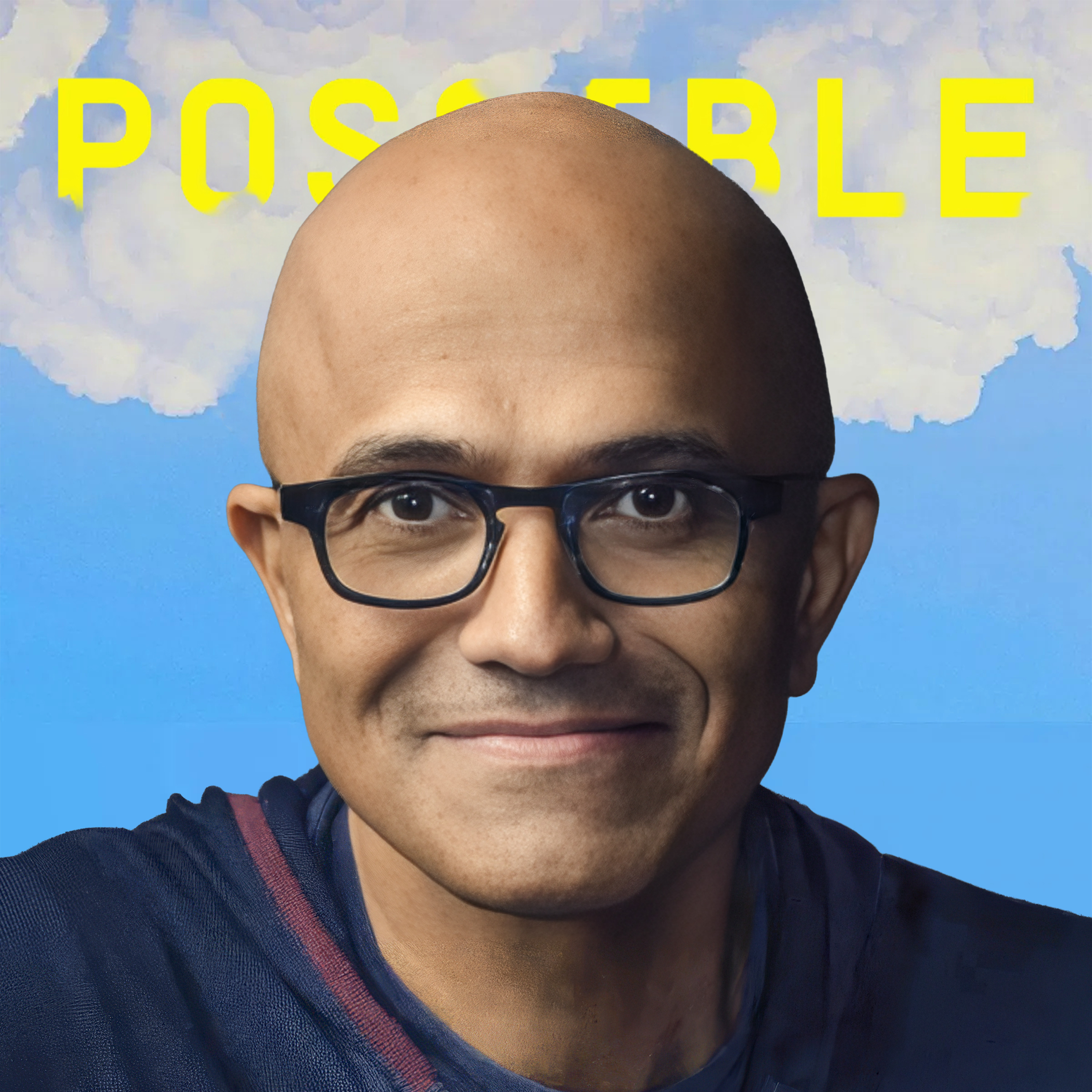
Overview of Possible with Satya Nadella
In this special episode of Possible, Reid Hoffman speaks with Microsoft CEO Satya Nadella about how AI is reshaping the nature of work, enterprise strategy, trust, and even human development. The conversation centers on a core idea: AI is not just another technology layer, but a fundamental shift in how firms create value through the interplay of human capital and “token capital” — the knowledge, reasoning, and outputs generated by AI systems. Nadella argues that the future belongs to organizations that can safely and effectively compound both kinds of capital without leaking their tacit knowledge or losing control of their data.
Key Ideas and Main Takeaways
AI is becoming the “future of the firm”
- Nadella’s framing: AI should be understood less as a tool and more as a structural force that changes how companies operate.
- He repeatedly emphasizes that every company will need a clear AI strategy tied to its own data, workflows, and IP.
- The winning organizations will be those that can compound returns from both people and AI systems together.
Human capital + token capital = the new operating model
- Nadella introduces “token capital” as the AI-generated knowledge, context, and model outputs that now sit alongside human expertise.
- He argues the key business question is no longer just “What data do we have?” but “How do our humans and AI systems learn from each other?”
- The enterprise challenge is to turn work traces, judgments, and tacit knowledge into owned, controlled AI assets.
“Don’t use frontier models for non-frontier problems”
- One of his clearest principles: match the model to the task.
- For routine, deterministic workflows, companies should not waste frontier models when smaller, tuned models can do the job better and cheaper.
- Token efficiency and careful evals are becoming strategic advantages.
The Future of Work
From knowledge work to human-agent workflows
- Nadella compares the AI transition to the rise of knowledge work in the PC era.
- He expects companies to move toward environments where humans and agents work together continuously.
- He predicts that work will increasingly involve:
- assigning intent,
- supervising agent loops,
- reviewing outputs,
- and learning from what agents produce.
Coding is the clearest preview of what’s coming
- He points to GitHub Copilot and the evolution from:
- code completion,
- to chat,
- to task-based agent mode,
- to long-running autonomous workflows.
- Microsoft’s newer interfaces, like Canvas and the idea of an “agentic development environment” (ADE), are meant to help humans manage fleets of agents.
- The same pattern, he says, will expand beyond coding into general knowledge work.
A new skill: cognitive coverage
- Nadella highlights the idea that humans will need to understand what AI did well enough to learn from it.
- He calls this “cognitive coverage,” analogous to test coverage in software.
- The modern knowledge worker will need to combine:
- orchestration skills,
- critical evaluation,
- and judgment over token usage.
Enterprise AI, Data Control, and IP
Tacit knowledge is now a strategic asset
- Nadella stresses that a company’s deepest value often lies in tacit knowledge: judgment, taste, and unique ways of operating.
- AI can extract and encode this knowledge into models, which makes controlling the training process crucial.
- If that knowledge leaks to external model companies, he sees it as effectively irreversible.
Enterprises need their own AI “supply chain”
- He says businesses will soon think very concretely about their AI supply chain:
- what models they use,
- where their data flows,
- how outputs are evaluated,
- and what stays proprietary.
- He believes companies should build and control their own hill-climbing systems inside a governed environment.
Security, observability, and containment are mandatory
- Nadella argues that agentic systems require new enterprise infrastructure:
- identity,
- sandboxing,
- policy enforcement,
- audit trails,
- reasoning trace inspection.
- He references Microsoft’s “Agent 365” vision, which extends existing security and governance layers:
- Entra for identity,
- Defender for security,
- Purview for data labeling and protection.
- For long-running agents, he also notes the need for runtime “asserts” so workflows stay within safe boundaries.
CEO Advice and Business Strategy
CEOs must lead AI from the front
- Nadella says tech CEOs cannot outsource AI strategy.
- More broadly, he believes all CEOs now need a deep understanding of AI’s role in their industry.
- Simply buying a few agents or issuing a press release is not enough.
AI changes the structure of the firm
- His advice to business leaders:
- identify your unique token capital,
- figure out how your firm learns,
- and make AI a core part of your operating model.
- This is not like the PC, cloud, or mobile era, where IT strategy was mostly about vendors and efficiency.
- AI, he says, alters the fundamental shape of the firm itself.
Trust, Ecosystems, and Microsoft’s Platform Philosophy
Microsoft’s model: create value on top of the platform
- Nadella says the most durable strategy is to be a platform company that helps others succeed.
- Trust comes from being clearly non-zero-sum: customers and partners must create more value than the platform captures.
- He sees this as essential for long-term stability in AI.
AI will force every company to rethink its ecosystem
- He expects companies to ask how their AI stack, data, and partner relationships fit together.
- He also argues that trust will depend on principled interoperability rather than winner-take-all extraction.
Sovereign AI and National Competitiveness
Countries should strengthen their own comparative advantage
- Nadella says nations should focus less on abstract sovereignty rhetoric and more on helping domestic companies thrive.
- For him, the most effective form of sovereignty is a strong economy with competitive firms using AI well.
- He warns that over-focusing on isolation can leave countries behind technologically.
Infrastructure matters
- He frames data centers as “electron-to-token conversion machines.”
- Countries should invest in:
- compute infrastructure,
- semiconductors,
- and efficient energy systems.
- But the real goal is for companies, public institutions, and small businesses to use AI to amplify local strengths.
AI, Children, and Human Development
Child safety must be a first-class concern
- Nadella says AI safety is not only about cyber or bio risks, but also about how children interact with AI.
- He warns against systems that persuade or manipulate children instead of supporting agency.
Education will need to change
- He believes the arrival of abundant AI means old assumptions about learning and credentials may no longer hold.
- He hopes AI can reduce fear and anxiety around subjects like math and science by making learning more exploratory and supportive.
- His broader point: society has a responsibility to design the next generation’s learning environment intentionally.
Religion, Humanism, and the Moral Frame for AI
The Pope’s AI encyclical as a moral signal
- Nadella praises the Pope’s intervention on AI as a defense of human dignity and agency.
- He sees it as part of a long tradition of moral reflection on labor, technology, and society.
- He argues that AI needs a shared moral framework, not just technical progress.
A virtuous cycle is required
- Nadella says the best outcomes come when:
- moral philosophy,
- markets,
- democracy,
- and technological breakthroughs reinforce one another.
- Without that alignment, society risks losing permission to continue advancing AI.
Science and Medicine as a Positive Proof Point
AI in biology could shift public perception
- Nadella is particularly excited by AI applications in science and medicine.
- He points to work like Gigatime, which uses AI to simulate expensive biomedical testing and make it more broadly accessible.
- He sees this as one of the strongest examples of AI helping human welfare in concrete ways.
Closing Vision: What’s Possible
A more prosperous world
- Nadella’s most ambitious vision is global compounding growth — even imagining 10% GDP growth if AI’s benefits were broadly distributed.
- He believes AI could help every country express its comparative advantage more fully.
The first step: accept that a better future is possible
- His final message is that humanity must first believe the future can be different.
- Rather than resigning ourselves to history repeating itself, we should build systems that enable broader abundance and shared progress.
Notable Concepts and Phrases
- “AI is the future of the firm”
- “Don’t use frontier models for non-frontier problems”
- “Token capital”
- “Hill-climbing machine”
- “Cognitive coverage”
- “Agentic development environment (ADE)”
- “AI supply chain”
Bottom Line
This conversation presents Satya Nadella’s vision of AI as a foundational shift in how organizations, economies, and societies operate. His core message is both pragmatic and humanist: companies must learn to compound human and AI capability together, protect their tacit knowledge, and build trustworthy systems that benefit people rather than displace agency.