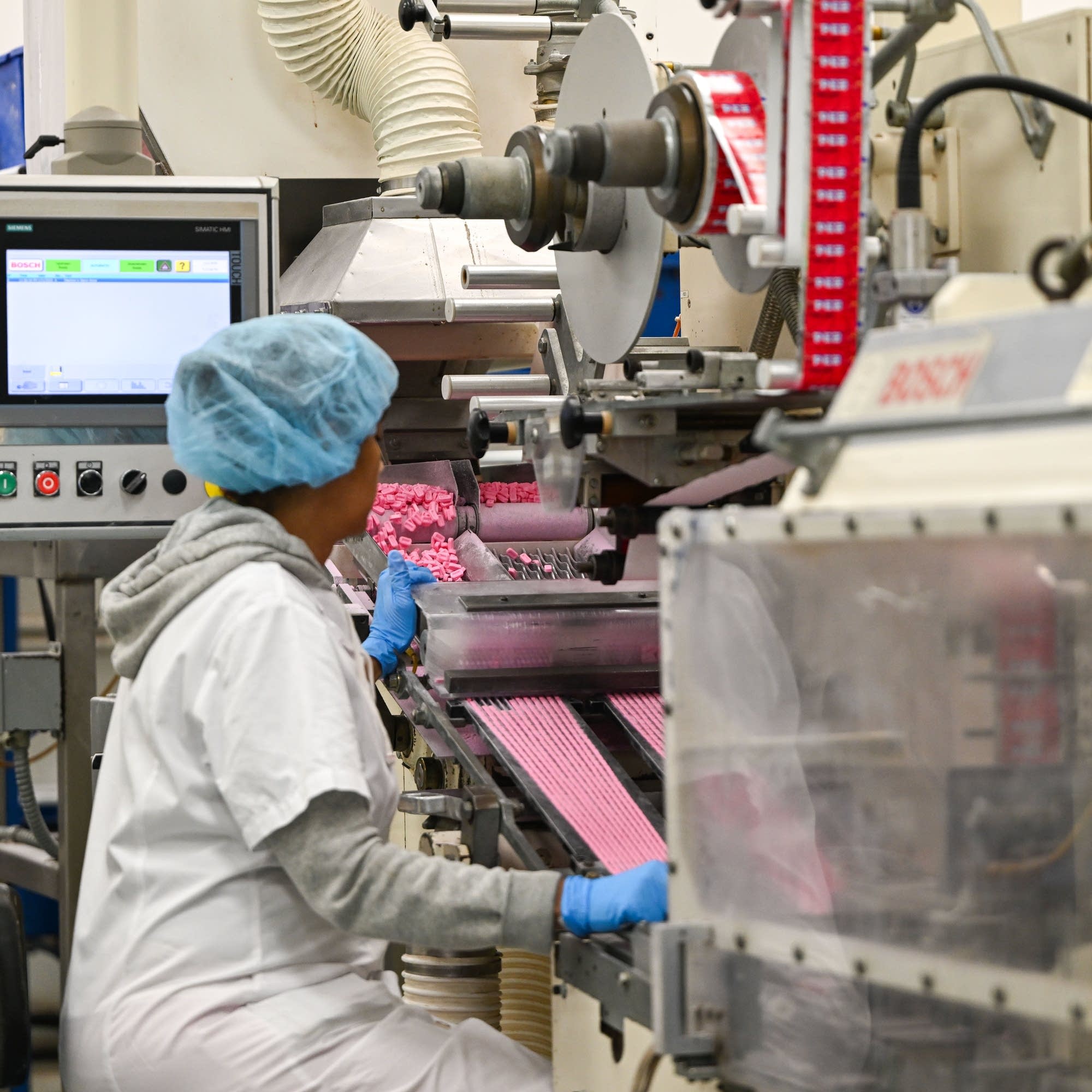
Overview of Why manufacturing employment continues to fall (Marketplace)
This episode of Marketplace (host Kristen Schwab) covers several economic stories anchored by a deep-dive into why U.S. manufacturing employment continues to decline. The show also features related segments on hiring practices and the future of the resume, a nonprofit spotlight, grocery-price context, the economic impact of low snowpack on weather-dependent businesses, market data, and recent tariff developments.
Manufacturing employment: what’s happening and why it’s falling
-
Current snapshot
- Manufacturing employment has declined year-over-year and the sector lost over 90,000 jobs in 2025, marking the third consecutive annual decline reported by the BLS.
- Manufacturing payrolls never recovered to pre-2008 levels after the Great Recession; Michigan State’s Jason Miller notes roughly a 25% job loss during that downturn.
-
Main causes identified
- Long-term structural trends: globalization (outsourcing) and automation have reduced manufacturing labor needs over decades.
- Weak single-family housing market: a substantial share of U.S. manufacturing supports housing (e.g., sawmills, furniture), so housing softness drags factory activity.
- Tariffs and policy uncertainty: tariffs meant to protect some domestic producers have raised input costs for downstream manufacturers and created unpredictability. Teresa Fort (Dartmouth) and Susan Spence (Institute for Supply Management) say:
- Input-price spikes and unclear tariff exposure make firms hesitant to place large orders.
- Buyers are ordering in small increments to avoid being stuck with suddenly higher-priced materials, which reduces manufacturers’ incentive to hire.
-
Consequence
- Uncertain cost outlook and smaller, irregular orders suppress hiring even if some sub-sectors (like steel) get short-term protection.
Hiring and the “death” of the resume
- Summary of findings (Amanda Hoover, Business Insider)
- Resumes remain common but are declining in influence—especially in tech. Recruiters increasingly source talent directly (LinkedIn, networks).
- AI has flooded recruitment portals with polished but often indistinguishable resumes, making them less useful.
- New or rising practices
- Skills/portfolio-based search tools that match candidates to actual projects.
- Short, targeted written prompts that ask applicants about specific experiences/fit.
- Paid work trials (days to weeks) to demonstrate capability rather than rely on resume pedigree.
- Risks and winners/losers
- Pros: can reduce reliance on credentials and broaden assessment to actual work quality.
- Cons: candidates not active on professional networks or unfamiliar with new formats may be disadvantaged; rapid change may leave some jobseekers behind.
Nonprofit spotlight: Triple H Ranch (My Economy)
- Organization: Triple H Ranch / Therapeutic Horsemanship (Milton, WI), founder/director Sheila Martin.
- Services: therapeutic riding for youth and adults with special needs—physical, mental, emotional, social benefits through horse interaction.
- Financials & operations:
- Fees cover roughly 25% of operating budget; grants and fundraising are essential.
- Cost per horse: about $350/month (approx. $250 fixed + $100 variable); emergency vet fund emphasized.
- Staffing: Martin currently the sole instructor, working 50–60 hours/week; two instructors are being trained with grant support.
Why food feels expensive even as it costs a smaller share of income
- Key data (Brian Walsh, Vox)
- As of 2024, Americans spend ~10.4% of disposable income on food—down dramatically from ~42.5% in 1901.
- Productivity gains: one American farmer now feeds ~170 people (vs. ~19 in 1940).
- Despite long-run affordability gains (Engel’s Law), grocery prices have risen sharply recently—groceries ~24% higher since 2020—creating sticker shock.
- Takeaway
- Structural improvements made food cheaper relative to income over the long-term, but recent price spikes and visible bills/receipts drive consumer perception that food is unaffordable.
Economic impacts of low snowpack in mountain regions (Denver example)
- Situation
- Denver area had less than half its typical snowfall by late January (normal ~27 in.), hurting both winter and summer-dependent businesses.
- Business impacts
- Car wash: down ~10% compared to prior season—fewer salted/dirty cars.
- Snow-removal services: some firms down ~70%; companies cutting days of operation.
- Summer tourism (rafting, mountain towns): lower snowpack can shorten seasons and reduce water/rafting opportunities—potential revenue losses of 50%+.
- Costs and supply issues: tariffs and import delays are increasing input prices for some local businesses.
- Response
- Cost-cutting (reduced hours), hope for late-season weather shifts, and attempts to maintain customer loyalty.
Markets & policy roundup (high level)
- Markets
- Oil: Brent ~ $85/barrel (up ~5%), U.S. crude > $80 (up ~8.5%).
- Corporate: Kroger reported a $861M profit for the year, beat expectations; new CEO (from Walmart) plans AI initiatives—Kroger stock up, Walmart down, Costco down slightly.
- Bonds: 10-year Treasury yield ~4.14%.
- Tariffs & legal developments
- A federal judge ruled that companies which paid tariffs recently struck down by the Supreme Court are owed refunds—estimates cited around $130 billion.
- Two dozen states filed suit claiming the president lacked authority to impose a 10% global tariff after the Supreme Court ruling.
Notable quotes & soundbites
- “We don't know... what other tariffs are going to be lobbed.” — Susan Spence, Institute for Supply Management (on tariff unpredictability).
- One farmer today feeds nearly 170 people—illustration of dramatic farm productivity gains.
Key takeaways and suggested actions
- For policymakers/businesses:
- Reduce input-cost unpredictability (tariff clarity) to encourage larger orders and hiring in manufacturing.
- Address housing-market weakness to revive demand for housing-linked manufacturing.
- For jobseekers:
- Maintain an active professional network and visible portfolio (LinkedIn, project samples).
- Be prepared for skills demonstrations or paid trials rather than relying solely on resumes.
- For small nonprofits and local businesses:
- Diversify funding (grants, fundraising) and maintain emergency reserves (e.g., vet funds for equine programs).
- Weather-dependent businesses should plan for variability, cut costs prudently, and invest in customer retention.
If you want a one-paragraph TL;DR: Manufacturing job losses continue because of long-term automation/globalization, housing weakness, and tariff-driven input-cost unpredictability that keeps firms from hiring; meanwhile hiring practices are shifting away from resumes toward portfolios and trials, groceries are cheaper relative to income over the long run despite recent price spikes, nonprofits and weather-dependent small businesses face tight finances, and tariff litigation plus rising oil prices are moving markets.