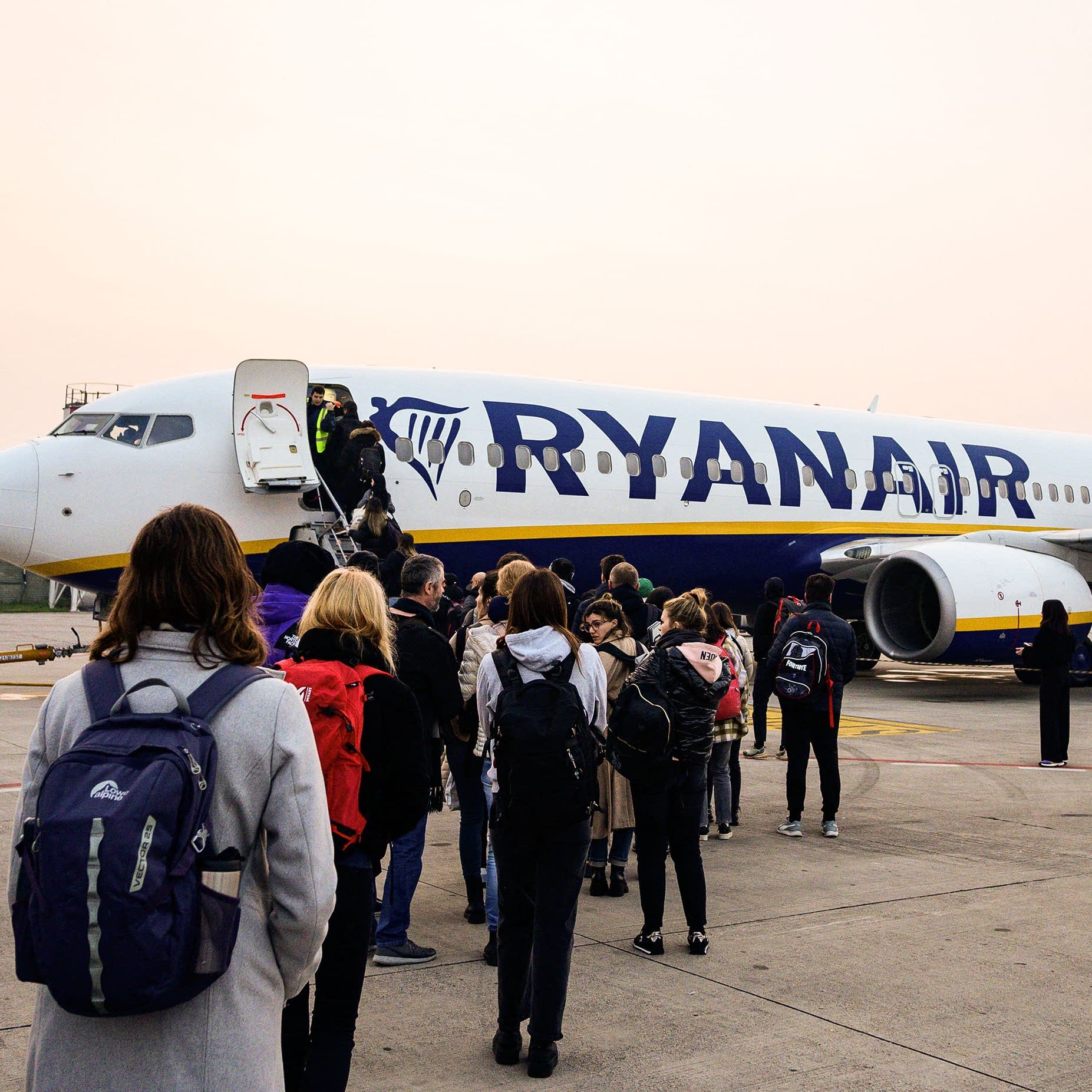
Overview of "Will Elon Musk buy Europe's biggest budget airline?"
This Marketplace Morning Report (BBC World Service) covers a public spat between Elon Musk and Ryanair CEO Michael O'Leary over installing Starlink satellite internet on Ryanair planes — and Musk’s offhand suggestion that he might buy the airline. The episode also summarizes wider aviation pressures from war-zone airspace closures, market reactions, and other business headlines.
Main story — Musk vs Ryanair
Why Michael O'Leary rejects Starlink
- O'Leary’s stated objection: fitting Starlink requires external antennas that would increase aerodynamic drag, raising fuel consumption and costs.
- Ryanair’s published numbers (as quoted): about a 2% increase in drag, roughly €1 extra cost per passenger, and about €250 million additional fuel cost annually. Ryanair argues these costs are incompatible with its ultra-low-cost model (average fare ~€45; by contrast, many long-haul carriers’ average fares exceed €1,000).
Elon Musk’s response and buyout suggestion
- Musk publicly floated buying Ryanair and replacing O'Leary, an idea he has mentioned before.
- Practical barriers to a takeover: raising large capital (reportedly about $44 billion) and EU ownership rules that require airlines flying within Europe to be majority EU-owned — a legal obstacle given Musk’s non-EU nationality.
- Tone: the exchange escalated into personal insults (O'Leary calling Musk a “very wealthy idiot”; Musk saying O'Leary should be sacked), and Ryanair ran a promotional “big idiot seat sale” featuring a Musk caricature — mixing humor with low-level public antagonism.
Broader aviation context: airspace closures and costs
- Airspace closures and restrictions around conflict zones (notably Russia/Ukraine and parts of the Middle East) are forcing substantial rerouting of flights.
- Typical long-haul detours add around 1–2 hours for some carriers (Lufthansa reported measurable cost impacts).
- Quantified impacts and research cited:
- Areas affected by armed fighting have grown ~89% over the past five years (Verisk Maplecroft).
- Closed/restricted airspace currently roughly 18 million km² — the largest segregation of airspace since WWII.
- Each additional minute of flight time roughly increases passenger fares by US$1.50 (German Aerospace Centre).
- Increased flight times also raise emissions and operational complexity; airlines must adjust network planning continuously.
- Commercial consequences: airlines face higher costs and pressure on profitability, which can reduce availability of award seats or low-fare seats and influence route decisions.
Market snapshot and other headlines
- European markets weakened amid geopolitical and policy uncertainties (mention of U.S. moves on Greenland and a forthcoming speech by President Trump at Davos).
- Hyundai Motor shares surged (~15%) after optimism about robotics initiatives; Hyundai surpassed GM to become the world’s fourth most valuable carmaker (by market value).
- Lufthansa and other big carriers are publicly acknowledging increased costs tied to rerouting around conflict zones.
Notable quotes / soundbites
- Michael O'Leary: Ryanair customers expect low fares; free Wi‑Fi concept is fine for long-haul carriers with much higher average fares.
- O'Leary on Starlink costs: antennas → ~2% drag → ~€1 per passenger → ~€250m/year.
- Contextual: “biggest airspace segregation since the Second World War” (academic/research framing of current airspace restrictions).
Key takeaways
- The Musk–Ryanair dispute is partly technical/economic (antenna drag, fuel cost) and partly a public spat that’s unlikely to result in a serious bid by Musk because of financing and EU ownership rules.
- Conflict-driven airspace closures are creating meaningful, measurable costs for airlines (longer flights, higher fares, more emissions) and are reshaping network planning.
- Watch for continued friction between airline cost models (ultra-low-cost vs. full-service carriers) around onboard amenities like Wi‑Fi, where marginal costs and pricing strategies differ starkly.
Quick data reference
- Ryanair average fare: ~€45
- Long-haul carrier average fares cited: ~€1,000+
- Estimated drag increase from external antennas: ~2%
- Ryanair-stated extra cost: ~€1 per passenger; ~€250 million/year
- Approx. takeover financing cited for Ryanair: ~$44 billion
- Increase in areas affected by armed fighting over five years: ~89%
- Closed/restricted airspace area cited: ~18 million km²
- Incremental passenger fare per extra flight minute: ~$1.50
If you want highlights only: the episode’s core is that Ryanair rejects Starlink on cost/drag grounds, Musk teased buying Ryanair (unlikely because of money and EU rules), and airlines are feeling significant operational and financial strain from wartime airspace closures.