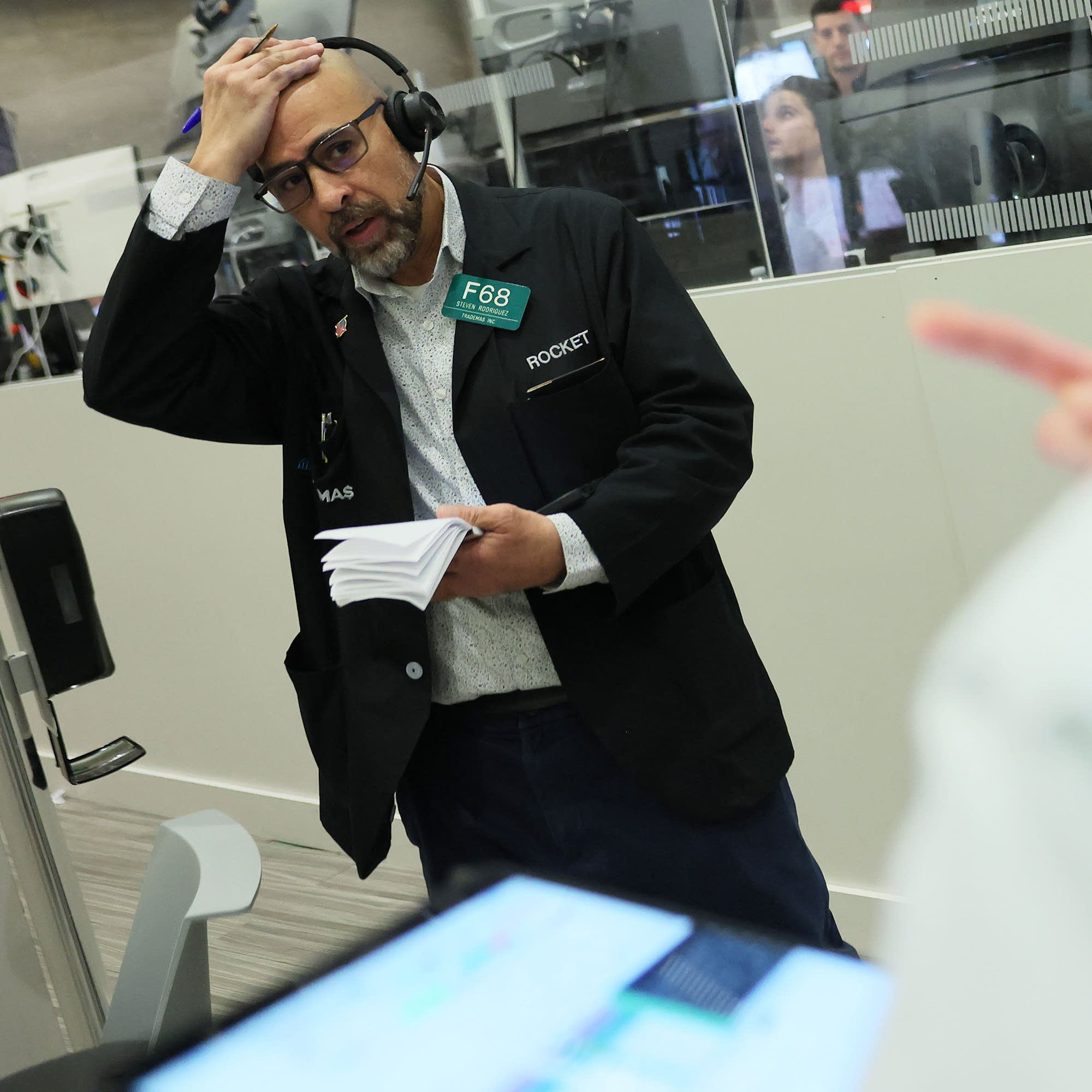
Overview of AI anxieties and market tumbles
This Marketplace episode ties together three recent economic stories: a large one-day stock-market drop partly driven by a circulated AI “doomsday” thought experiment, eBay’s $1.2 billion acquisition of secondhand-fashion app Depop, and the new tax-protected child savings account (IRC 530A) created by last year’s spending and tax law. The episode explains what happened, who’s affected, and the key risks and opportunities in each story.
Market tumble and the AI narrative
- What happened
- The Dow fell 821 points (about 1.7%) in one session. Part of the decline was linked to tariff uncertainty (a new 10% global rate took effect; President Trump pushed for 15%), and part to a widely circulated think piece about AI’s economic risks.
- The Citrini Research thought experiment
- A hypothetical “nightmare” scenario argued that AI agents could displace white‑collar jobs broadly and create a race to the bottom on fees and prices (including cutting out credit card transactions via crypto), which would damage firms beyond tech and finance.
- The memo was widely forwarded among analysts; some named firms saw steep intraday sell-offs (examples cited: DoorDash down ~6.5%, Capital One down nearly 9%).
- Context and counterpoint
- Wall Street has growing anxiety about rapid AI diffusion into industries unprepared for disruption.
- Goldman Sachs analysts estimate AI’s contribution to U.S. GDP last year was “basically zero,” underscoring a gap between provocative narratives and measured economic impact.
- Implication
- Market moves can be driven by plausible-sounding narratives circulated among investors even when measurable economic effects are small or uncertain. That amplifies volatility and can punish companies mentioned in speculative scenarios.
eBay buys Depop — strategy and risks
- Deal summary
- eBay announced it will buy Depop (a resale fashion app popular with teens/20‑somethings) from Etsy for $1.2 billion; Etsy had owned it for five years.
- Why eBay paid up
- Depop’s user base skews young (roughly 90% under age 34). eBay’s core customers are older (35+), so this is a fast way to gain Gen Z users and consumer data.
- Analysts frame it as eBay acquiring a “cool” brand and a Gen Z database that would be expensive/time-consuming to build organically.
- Risks and opportunities
- Depop has struggled with profitability (like many resale platforms).
- eBay brings scale, engineering, design, and infrastructure that could improve Depop’s experience and monetization.
- If successfully integrated, the deal could extend eBay’s customer lifecycle and relevance with younger shoppers; if not, it’s an expensive bet on culture and data rather than current profits.
New child savings accounts (IRC 530A) — design, promise, and pitfalls
- What the program does
- Part of last summer’s law created a tax-protected child savings account (referred to as 530A in coverage). For children born in certain years (the transcript cites babies born in 2025 and through 2028), the Treasury will deposit a $1,000 starter deposit if parents enroll and the child has a Social Security number.
- Potential benefits
- Experts call it potentially the most significant wealth-building policy for U.S. children if designed and implemented well.
- Main design problems and concerns
- Enrollment is opt-in and primarily linked to filing a tax return with a new IRS Form 4547. That creates a barrier for low-income families who often do not file federal returns and for families unfamiliar with the program.
- Because many low-income households owe no federal income tax and do not file, the intent to reach all children conflicts with an opt-in-by-tax-filing mechanism.
- Awareness is low among communities that would benefit most; outreach and assistance from tax-prep organizations can help but may not reach everyone.
- Immigrant communities may be wary of providing information to the IRS, limiting participation.
- Implementation notes
- The IRS has produced materials and training; some community tax-prep clients who learn about the program do choose to enroll.
- Implication
- The program’s potential is high, but uptake and equitable access hinge on outreach, simplified enrollment pathways, and addressing confidentiality/security fears.
Key takeaways
- Market sentiment and viral analyst memos can move billions of dollars in value even when measurable economic impacts (e.g., AI’s GDP contribution last year) are minimal.
- Narratives about AI risk are increasingly influential; investors and companies should distinguish between plausible long-term disruption and immediate, evidence-based impacts.
- eBay’s Depop acquisition is a strategic bid for Gen Z users and data; success depends on improving monetization and integrating the brand without killing what makes Depop appealing.
- The new child savings accounts are a major policy opportunity for wealth building but risk excluding the children who need them most unless enrollment and outreach are simplified and decoupled from tax-filing barriers.
Actionable recommendations
- For investors: treat widely shared “thought experiments” as one input among many—check fundamentals and broader data before reacting.
- For parents/guardians: if you have a child born in the eligible years and want the $1,000 and a tax-protected account, learn about Form 4547 and IRS enrollment steps now; seek help from local tax-prep or community organizations.
- For policymakers/advocates: push for automatic enrollment options or alternative outreach channels to reach non‑filing households and vulnerable communities to maximize program equity.
- For e-commerce/resale stakeholders: watch how legacy platforms leverage acquisitions to reach younger cohorts; platform experience and community culture will determine long-term success.
Notable quotes from the episode
- “The hypothetical... painted a nightmare scenario in which AI displaced white-collar jobs throughout the economy.” — reporting on the Citrini memo
- “Goldman’s calculation for how much AI boosted GDP last year, basically zero.” — marketplace summary of Goldman Sachs estimate
- “This could be transformational, but only if the design works.” — Qin Huang, Washington University in St. Louis, on the child savings account
- “The design says opt in. Those two things are in direct contradiction.” — critique of linking universal eligibility to opt-in tax filings