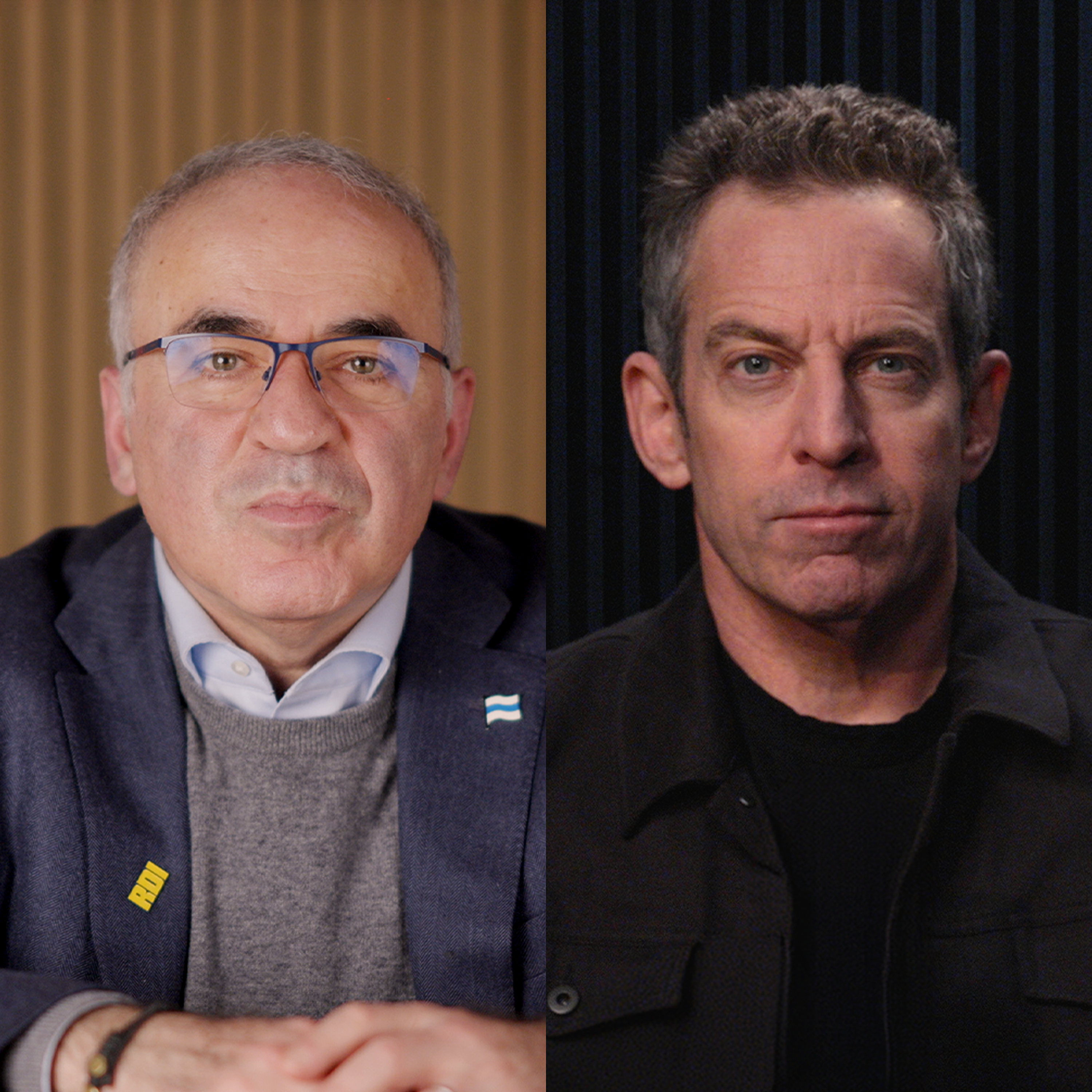
Overview of Making Sense Podcast — #461 — Dictators Always Tell You What They'll Do
Sam Harris interviews Garry (Gary) Kasparov about the persistent threat of authoritarianism—drawing on Kasparov’s experience in the Soviet Union, his work with the Renew Democracy Initiative (RDI), and recent developments in the U.S. under Donald Trump. Kasparov argues that authoritarian tendencies often reveal themselves openly (and should be heeded), traces parallels between Putin’s stepwise aggression and Trump’s norm-busting domestic behavior, and stresses the urgency of the 2026 midterms as a decisive moment for American democracy.
Key topics covered
- Kasparov’s background and the mission of the Renew Democracy Initiative (RDI)
- Why historians and former dissidents take rhetoric and stated intentions of authoritarians seriously
- Putin’s pattern of signaling and incremental aggression (2005 speech, 2007 Munich, Georgia 2008, Crimea/2014, full-scale invasion of Ukraine)
- Comparisons between Putin-style authoritarianism and Trumpism in the U.S.
- The GOP’s capitulation and staffing of loyalists in government
- Strategic choices for Democrats if they regain Congress (2026 midterms, implications for 2028)
- The international costs of U.S. erosion of democratic leadership
Garry Kasparov and Renew Democracy Initiative
- RDI founded in early 2017 in response to Trump’s 2016 victory; intended as a center for people uncomfortable with political extremes on either side—“a home for the politically homeless.”
- Kasparov’s early warnings come from lived experience in the Soviet system and observing Putin’s steady, public road map for restoring Russian power.
- RDI focuses on combating polarization, defending democratic institutions, and restoring credibility to democratic governance.
Core arguments and main takeaways
- Dictators give clues: “Dictators always lie about what they have done, but very often they tell you exactly what they’re going to do.” Kasparov’s rule: listen to what authoritarians say.
- Putin as template: Incremental, public claims about restoring Russian influence were followed by concrete steps (NATO pressure claims → Georgia → Crimea → Ukraine). Western inaction emboldened escalation.
- Trump is explicit and deliberate: He acts like a king, openly speaks of wielding power in ways that threaten checks and balances, and has normalized previously unthinkable behavior.
- Corruption under Trump is systemic: Kasparov distinguishes ordinary corruption from what he sees in Trump’s model—state resources and policy being used systematically for personal enrichment.
- GOP capitulation is a major surprise and worry: Kasparov did not expect the Republican Party to so readily accommodate norm-busting appointments and loyalty-based staffing. That lack of resistance accelerates erosion of norms.
- The erosion is gradual but cumulative: A “slow-motion” collapse by repeated norm violations rather than a single leap.
Evidence, examples, and notable quotes
- Putin examples: 2005 speech characterizing the Soviet collapse as a catastrophe; 2007 Munich speech warning about NATO expansion; Georgia (2008) and Crimea/Ukraine (2014 onward).
- Trump examples: public statements about federalizing elections, using federal agencies and offices to prepare to influence outcomes, appointing loyalists and unqualified personnel.
- Notable Kasparov quotes:
- “Dictators always lie about what they have done, but very often they tell you exactly what they're going to do.”
- “Corruption is not a problem. Corruption is the system.”
- RDI as “a home for politically homeless.”
Domestic politics: the path forward and strategic dilemmas
- 2026 midterms are decisive: Kasparov views 2026 as the campaign that will shape the landscape for 2028. A strong Democratic showing could undercut Trumpism; failure could make recovery far harder.
- If Democrats regain both chambers:
- Use subpoenas and oversight to expose corruption and limit the ability of Trump-era loyalists to do further damage.
- Impeachments: Kasparov argues for judicious use of political capital—target corruption and officials who abused power (he’s cautious about the political cost of impeaching Trump himself).
- The goal should be to “defang the snake”—limit future capacity to weaponize the state—rather than purely punitive spectacles that further polarize.
- Restoring credibility is essential:
- Democrats must avoid appearing merely as partisan cleansers; they should rebuild trust by including reasonable centrists and demonstrating fairness.
- Rebuilding institutional legitimacy and public confidence must be central to any recovery plan.
- Avoid a simple pendulum: Reforms must not be framed as revenge or a leftward swing; they should be framed as restoring neutral professionalism and constitutional guardrails.
International implications
- Loss of U.S. leadership: Kasparov argues that America is losing moral stature and that recent policies have signaled tolerance or even support for authoritarian leaders (examples: friendly posture toward Viktor Orban; diminished credibility with Eastern Europe).
- Consequences for allies and global order: Rebuilding trust will be difficult and slow; U.S. actions have real consequences for Ukraine and overall European security.
- Reconstructing alliances and credibility should be a top priority after any domestic restoration of norms.
Red flags to watch (what would signal emergency)
- Open attempts to federalize and centrally control U.S. elections.
- Systematic use of federal agencies (FBI, DOJ, Interior, etc.) to influence or manipulate electoral outcomes.
- A critical mass of officials (beyond a handful of top loyalists) in law enforcement and the bureaucracy willing to break laws or violate constitutional norms.
- Rapid appointment of loyalists to key institutions with no professional oversight or checks.
- Public signals by ruling figures that they will not accept electoral loss.
Practical recommendations and action items
- For policymakers and incoming majorities:
- Prioritize rebuilding institutional credibility and bipartisan norms.
- Use oversight (subpoenas, public hearings) to expose systemic abuses while weighing political costs of high-profile prosecutions/impeachments.
- Implement structural safeguards to limit unilateral executive abuses (election administration protections, transparency, guardrails on appointment powers).
- Engage allies early to repair international trust.
- For civic-minded listeners:
- Treat the 2026 midterms as consequential and participate (vote, engage local/community election processes).
- Support organizations that defend democratic norms and nonpartisan institutions.
- Demand transparency, accountability, and independent professionalism from public institutions.
Bottom line
Kasparov warns that authoritarian actors often declare their intentions and then proceed incrementally; ignoring those declarations risks normalizing serious democratic erosion. The immediate political battleground is the 2026 midterms—how they go will largely shape the possibility of recovery or further decline. Restoring democracy requires both accountability for abuses and credible, non-partisan efforts to rebuild trust in institutions at home and with allies abroad.