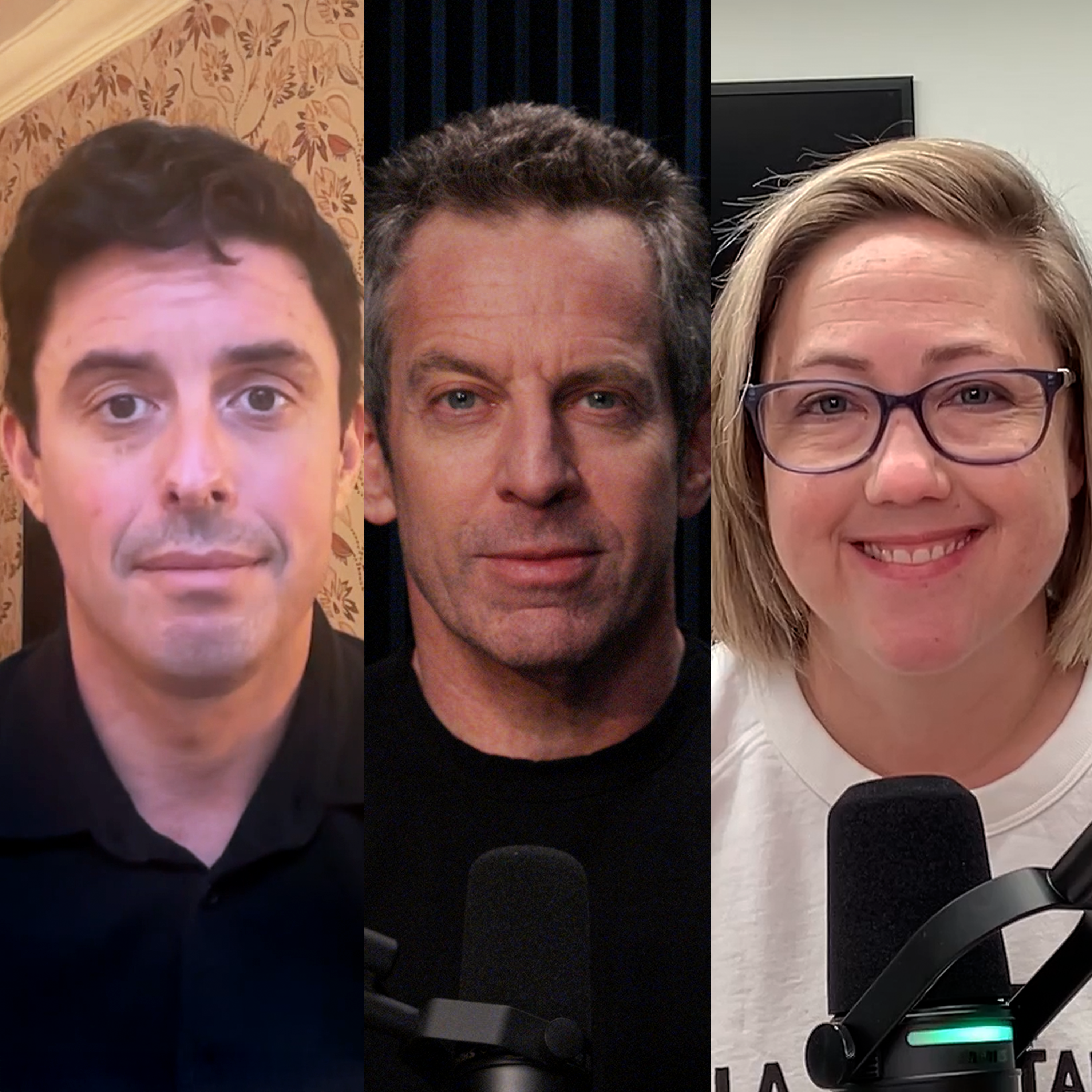
Overview of #458 — The Bulwark Against MAGA (Making Sense Podcast — Sam Harris with Sarah Longwell & Tim Miller)
This episode (preview) is a wide‑ranging conversation between Sam Harris and two leading Never‑Trump conservatives, Sarah Longwell and Tim Miller, both key figures at The Bulwark. They review the origin of The Bulwark, explain why many smart conservatives accommodated or rationalized Donald Trump, map the media/party feedback loops that sustain Trumpism, and assess prominent media figures and influencers (Ben Shapiro, Candace Owens, Tucker Carlson, Nick Fuentes, J.D. Vance, Charlie Kirk/TPUSA). The available transcript is the subscriber preview; the full conversation continues on the subscriber feed.
Participants and short bios
- Sam Harris — Host, Making Sense Podcast. Philosopher/neuroscientist and liberal commentator.
- Tim Miller — Co‑founder/host at The Bulwark (Bulwark Podcast). Former Republican campaign consultant turned Never‑Trumper.
- Sarah Longwell — Co‑founder/leader at The Bulwark, runs focus groups and voter research; formerly at a Republican communications firm; organizer of anti‑Trump conservative projects.
Main topics covered
- Origin story of The Bulwark: how it began as an aggregator/remnant of anti‑Trump conservative media and evolved into a media organization and podcast network.
- Why many conservatives—incl. smart, formerly principled people—accommodated Trump:
- Rationalization, tribalism and sunk costs.
- Incentive structures: voters, right‑wing infotainment, and Republican elected officials form a reinforcing “triangle of doom.”
- Business pressures on media figures and platforms.
- The role of media and platforms:
- Short‑form, entertaining, conspiratorial content recruits new and younger audiences.
- Algorithms and platform dynamics amplify sensationalism and conspiracies.
- Profiles and assessments of key figures/influencers:
- Ben Shapiro: talented, commercially successful; criticized for pivoting toward accommodation of Trumpism; business incentives and audience expectations matter.
- Candace Owens: described as highly entertaining and influential with young MAGA audiences; seen as a recruiter/radicalizer through infotainment and conspiratorial content; debate over whether she’s performing a character or genuinely radicalized.
- Tucker Carlson: trajectory from mainstream journalist to a leading conspiratorial voice; family/associates (e.g., Buckley Carlson) seen as influential in his content direction; possible next steps include continued media power or political ambitions.
- Nick Fuentes and the “America First” cluster: part of the recruiting pipeline for young men into extremism; overlaps with Candace/Tucker audiences.
- Charlie Kirk / TPUSA and America Fest controversies: how conspiracy narratives can thrive even around traumatic events (e.g., Charlie Kirk’s assassination), exposing how hungry audiences are for contrarian or conspiratorial explanations.
- J.D. Vance: discussed as a bridge figure within the party who may straddle influencer and political power; conversation cuts off as Sam asks whether President Vance would be preferable if Trump were suddenly gone.
- Cultural mechanics of modern radicalization: “vice signaling,” soap‑opera style feuds among influencers, and the appeal of being the contrarian who “sees” hidden plots.
Key insights and takeaways
- The “Republican triangle of doom” (voters + right‑wing infotainment + Republican elected officials) creates a durable incentive structure that rewards accommodation of Trumpism and punishes dissenters.
- Rationalization and social incentives can make people accept or excuse extreme behavior long after objective harms are clear; cognitive dissonance is powerful.
- Short‑form, personality‑driven content (TikTok, YouTube shorts, clips) acts as an efficient recruiter—especially for young audiences—because it packages politics with entertainment, culture, dating, and identity.
- Conspiratorial narratives are intoxicating and offer identity/community; the details often matter less than the feeling of being “the one who sees.”
- Business models and audiences shape the public positions of media figures. Commercial survival often trumps ideological consistency.
- There is a bifurcation in the right: mainstream conservative voters and party figures vs. an increasingly influential America‑First / influencer ecosystem that traffics in conspiracies and extremist adjacency. Controlling the party likely requires courting the latter.
Notable lines / succinct quotes (paraphrased)
- “The Republican triangle of doom: voters, right‑wing infotainment media, and Republican elected officials.”
- “The brain—rationalization is a hell of a drug.” (on why smart people can justify following Trump)
- “Sadness and rage are good fuel. They burn cleanly if you let them.” (on the founding energy behind The Bulwark)
- Short‑form conspiratorial content functions as recruitment: entertainment + community + ideology = radicalization pipeline.
Concrete examples & cases discussed
- Ben Shapiro’s pivot toward support/acceptance of Trump post‑January 6: analyzed as a mix of genuine policy alignment (e.g., Israel, deregulation) and business/audience pressure.
- Candace Owens: rise as entertainer/recruiter for young MAGA followers; claims such as conspiratorial allegations around Charlie Kirk’s death highlight how conspiracies spread across audiences.
- Tucker Carlson: evolution into a central voice for conspiratorial content; his network and family connections (e.g., Buckley Carlson) cited as accelerants.
- Charlie Kirk / TPUSA: America Fest moments as a test of how conspiracies and accusations can be normalized within right‑wing audiences.
Implications & recommended follow‑ups (from the guests’ perspective)
- To understand American political behavior, listen to voters directly (focus groups). Sarah Longwell emphasizes the value of listening to ordinary voters rather than assuming D.C. narratives.
- Watch how incentives (audience, platform algorithms, fundraising) shape media behavior — addressing the problem requires addressing these incentive structures.
- Monitor the growth of short‑form political content aimed at young audiences; counter‑messaging requires matching culture and format, not just facts.
- For those seeking more context or the full extended discussion, the guests and host point listeners to The Bulwark network (Bulwark Podcast, The Next Level, Takes, Focus Group) and Sam Harris’s subscriber feed (the preview ends here).
Where to follow / resources mentioned
- The Bulwark (podcast network): Bulwark Podcast; The Next Level (roundtable with Tim, Sarah, JVL); Takes; Focus Group (Sarah’s voter audio).
- Making Sense Podcast (Sam Harris) — full episode available to subscribers at samharris.org.
Note: this summary covers the publicly available preview portion of the episode. The full conversation (longer discussion and further treatment of J.D. Vance and other threads) requires the subscriber feed referenced in the transcript.