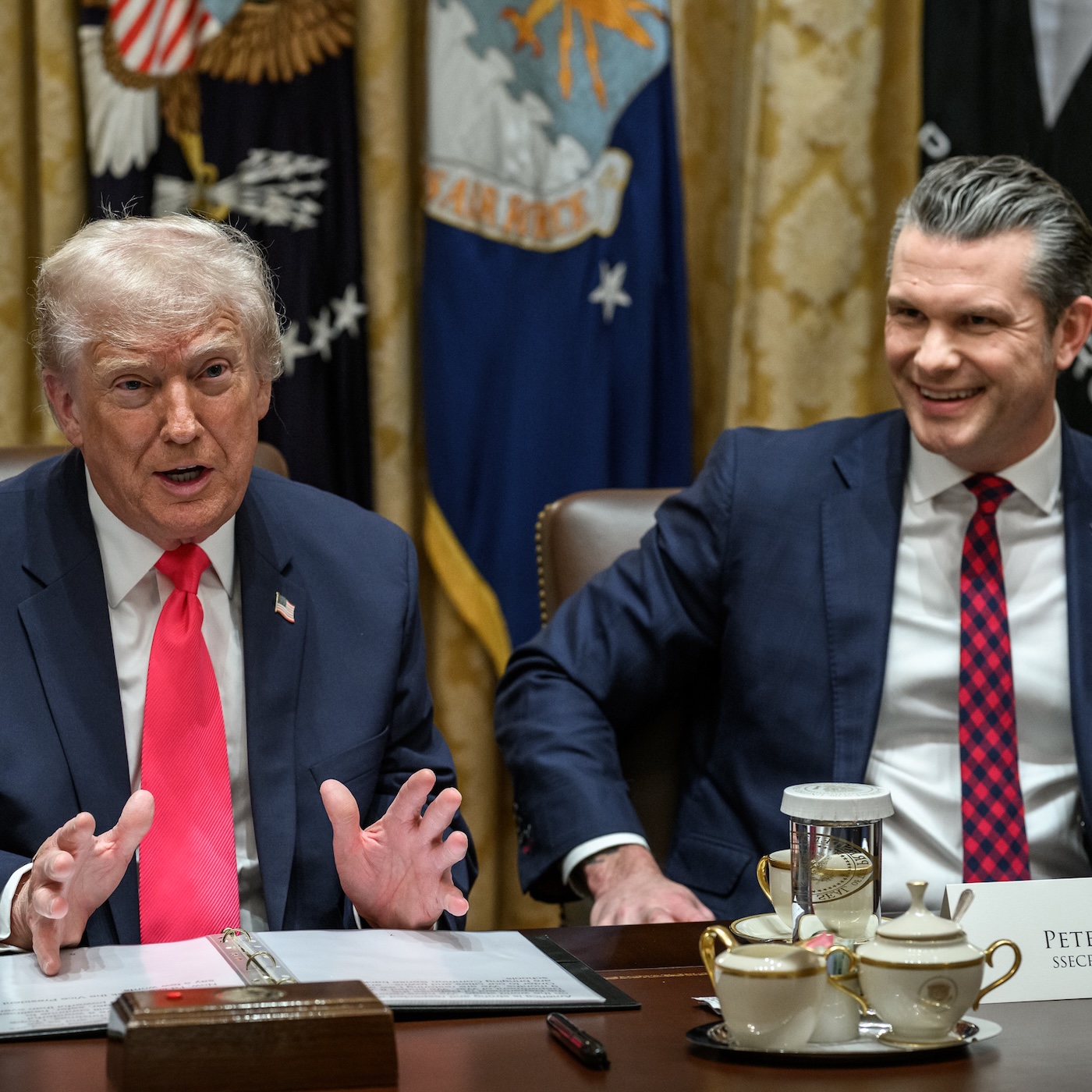
Overview of Left, Right & Center — "Trump rants, Hegseth deflects while Congress looks for answers"
This episode (KCRW's Left, Right & Center) breaks into three main strands: President Trump’s incendiary comments aimed at Somali Americans and the broader immigration debate; a deep dive into a controversial U.S. military strike in the Caribbean tied to Secretary of Defense Pete Hegseth and resulting congressional oversight; and concerns about foreign influence and inauthentic accounts on social media. Guests Mo Alethi (left) and Sarah Isger (right) offer contrasting but often overlapping perspectives on causes, legal issues, institutional consequences, and what meaningful responses should look like.
Key topics discussed
-
Trump’s comments about Somali Americans, Ilhan Omar, and immigration
- Clip of Trump calling Somali Americans and Rep. Ilhan Omar “garbage,” and saying the U.S. is “at a tipping point.”
- Reporting that fraud prosecutions in Minnesota’s Somali community preceded the rhetoric.
- Local leaders warn of ICE raids, due-process violations, and racial profiling.
-
Broader immigration debate
- Sarah Isger argues for rebuilding the system: easier legal immigration, merit-based immigration with retention of some family-based channels, cracking down on illegal “line-cutting.”
- Mo Alethi underscores long-standing anti-immigrant strains in U.S. history and says Trump legitimizes xenophobic elements that had been politically marginalized.
- Policy note: the White House announced a change to asylum-related work permits (valid 18 months instead of five years), prompting concern it increases bureaucracy.
-
The Caribbean boat strikes tied to Pete Hegseth
- September 2 operation: initial missile struck and sank a boat with ~11 people; a second strike reportedly hit two survivors in the water.
- Reporting suggests as many as 23 suspected drug-boat strikes and ~82 deaths across operations.
- Questions raised about legality (possible war crimes if survivors were targeted), inconsistent Pentagon statements, and the strategic logic (fentanyl entry points unlikely via these small Caribbean craft).
-
Congressional oversight and accountability
- Chairs of Armed Services Committees pledge investigations; bipartisan concern present in the Senate.
- Discussion of the limits of Congress’s power (oversight vs. actual enforcement like purse power or impeachment), and political incentives protecting senior officials.
- Likely political outcome: admiral(s) to take the public fall; impeachment of Hegseth seen as very unlikely unless explosive new evidence emerges.
-
Social media authenticity and foreign influence
- X’s roll-out of account-origin labels exposed many influential conservative accounts as originating outside the U.S. (Nigeria, Chile, India, etc.).
- Foreign actors and governments have long sought to influence U.S. politics; platforms can and should do more (bot-detection, authenticity standards).
- Historical context: DOJ/Mueller actions against Russian influence operations; problem persists and platforms currently hold much responsibility.
-
Listener mail: loneliness and radicalization
- Discussion about whether loneliness causes radicalization or fringe people become isolated — both dynamics are acknowledged.
- Technology and erosion of civic institutions (e.g., fraternal/civic groups) amplify online radicalization and loneliness.
Main takeaways
- Rhetoric matters: Trump’s public denigration of immigrants/Somali Americans doesn’t create anti-immigrant sentiment from nowhere — it legitimizes and amplifies strains that have long existed in U.S. history.
- The Caribbean strikes raise serious legal and moral questions:
- Targeting people no longer able to fight (survivors in the water) risks violating U.S. rules of engagement and international law and could amount to war crimes if proven.
- Operational rationale is dubious (small boats unlikely to traffic fentanyl into U.S.), and Pentagon messaging has been inconsistent.
- Congress can perform oversight publicly, but its real enforcement tools (funding restrictions, impeachment) are politically constrained; meaningful accountability is uncertain.
- Social media origin labels expose the scale of foreign influence operations. Platforms could adopt stronger authenticity rules, but political will to regulate is limited — especially when such influence benefits some political actors.
- Outrage alone is insufficient for policy change; guests urge combining protest with voting, legislative engagement, and civic rebuilding.
Notable quotes and lines (highlights)
- From the president (clip): “I don't want them in our country… Ilhan Omar is garbage. She's garbage.”
- Mo Alethi: On Trump’s effect — “What’s different now is the president of the United States is legitimizing it.”
- Sarah Isger on immigration policy goals — “I would love to totally redo our immigration system from the ground up… much easier to come legally… something closer to a merit-based system.”
- On the strikes and laws of war: “No-quarter orders have been unlawful for over a hundred years… it just leads to a lot more death and casualties.”
- On civic engagement: “Hashtag activism is not activism… showing outrage is not enough.”
Legal and policy implications (concise)
- Potential war crimes inquiry: If the second strike deliberately targeted people no longer combat-capable, it may violate U.S. and international law.
- Oversight mechanisms: Congress can investigate and demand briefings/video (admiral expected to testify), but budgetary or impeachment remedies are politically fraught.
- Immigration reform options discussed: build a merit-based pathway, simplify legal immigration processing, address incentives encouraging illegal entry and asylum claims.
Recommended actions / what listeners can do
- Don’t rely on outrage-only responses: register and vote; press congressional offices to demand transparent oversight and evidence; support candidates prioritizing institutional checks.
- Push tech platforms for authenticity measures: demand clearer provenance labels and bot-account enforcement to reduce foreign influence.
- Support local civic organizations and community-building efforts that reduce loneliness and create offline anchors (reducing vulnerability to radicalization).
- Stay informed: seek verifiable reporting and insist on evidence when officials claim lethal force was justified.
Quick episode roadmap (for listeners who want specific segments)
- Opening: Trump cabinet meeting clip and discussion of Somali community reaction.
- Mid-episode: Deep dive into Caribbean strikes, legal questions, and congressional oversight.
- Later: Social media origin labels and foreign influence; listener mail about loneliness and radicalization.
- Close: Wrap-up and calls for both civic engagement and institutional accountability.
Credits: Episode produced by KCRW/Left, Right & Center; guests Mo Alethi and Sarah Isger; host David Green.