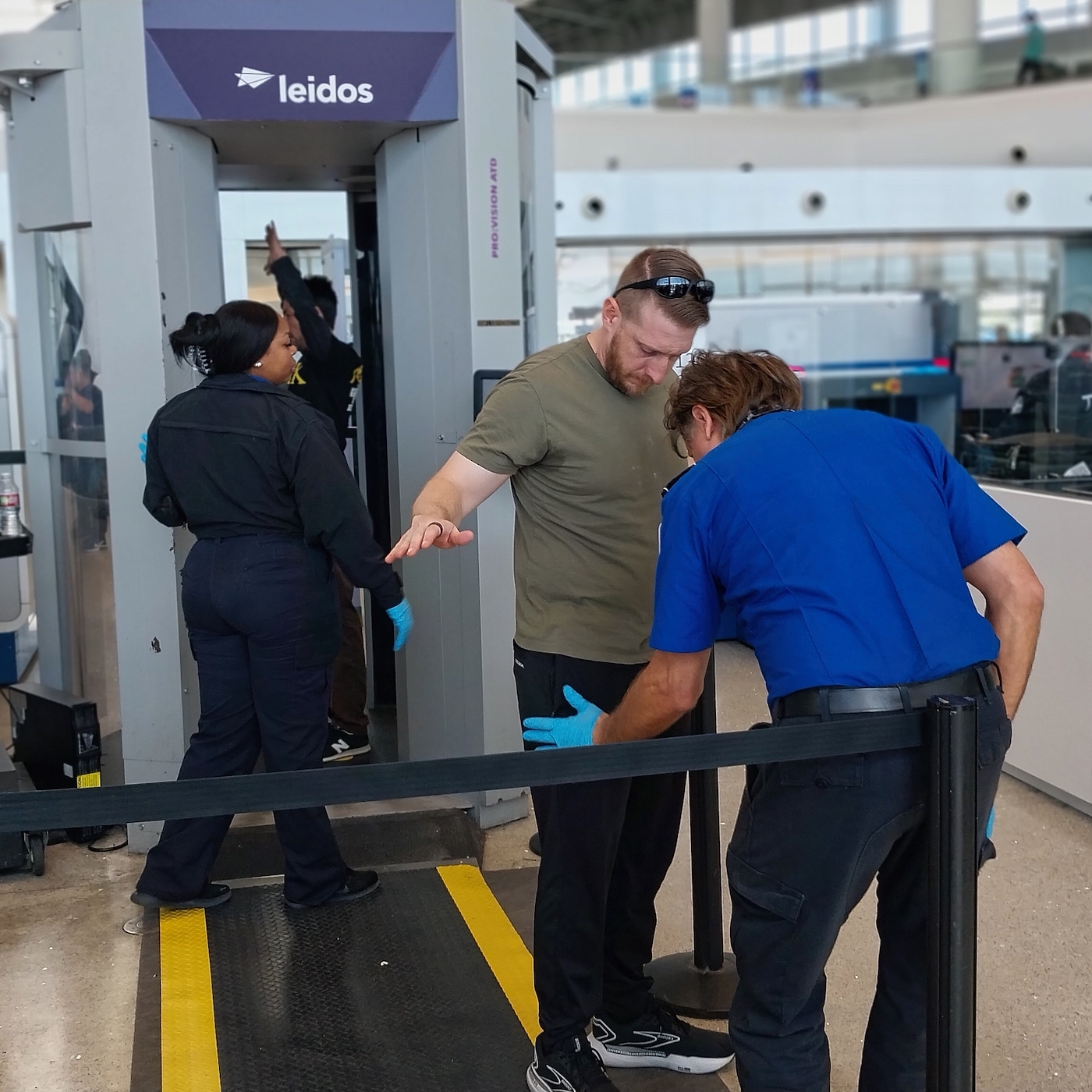
Overview of How TSA Lines Are Shifting Political Leverage On Immigration (Left, Right, and Center — KCRW)
This episode (host David Green) discusses how long TSA lines and a partial Department of Homeland Security (DHS) funding standoff have reshaped the political battlefield over immigration. Guests Mo Alathie (left) and Sarah Isger (right) analyze Democrats’ tactic of separating ICE from other DHS funding, the Trump administration’s responses (including deploying ICE to airports), legal and electoral risks of federal officers near polling places, and a related Supreme Court case about mail‑in ballot delivery windows. The show blends policy analysis, political strategy, legal context, and practical voter advice.
Key takeaways
- The current DHS partial shutdown (ongoing since Valentine’s Day at time of recording) has produced long TSA lines and strained DHS workers; Democrats are trying to fund TSA separately from ICE to alleviate the travel pain while pressing for ICE reforms.
- Polling shows voters are blaming Republicans more than usual for the shutdown, and Democrats appear unusually unified on combining TSA relief with ICE accountability—giving Democrats short‑term political leverage.
- The White House and some Republicans are divided: President Trump has pushed for inclusion of the Save America Act and publicly defended visible ICE deployments; many Hill Republicans want a quicker compromise to shore up midterm prospects.
- ICE agents deployed to airports have mixed effectiveness—reports suggest they’re mostly visible but not trained to perform TSA screening tasks, raising questions about the rationale (security vs. political theater).
- Legal and democratic risks: proposals or actions to station ICE or federal agents near polling places could trigger lawsuits and chilling effects on voting; federal judges may face complex and messy battles (complicated by the Purcell principle about changing election rules close to an election).
- The Supreme Court heard a case about states (Mississippi) allowing ballots received up to five days after Election Day to be counted; the justices appeared skeptical, raising questions about whether Congress intended “Election Day” to require receipt that same day. The dispute is not purely partisan (Mississippi enacted the rule).
- Practical voter advice: check your local election office closer to the election for precinct, early voting dates, and mail‑ballot deadlines; vote in the way that makes sense for you and verify state-specific requirements (postmark vs. received deadlines).
Topics discussed
- DHS partial shutdown and political negotiations
- Democrats’ strategy to split ICE funding from other DHS components (TSA, CBP, etc.)
- GOP resistance and President Trump’s insistence on unrelated legislation (Save America Act)
- Airport chaos and ICE deployment
- Tales of four‑to five‑hour lines; anecdotal variation across airports
- ICE presence often ceremonial/visible rather than operational; issues with training/equipment
- ICE and elections
- Trump/Bannon comments about using ICE or federal law enforcement around polling places
- Press secretary’s refusal to categorically rule out ICE presence near polls
- Legal limits and possible litigation, including Purcell concerns
- Voter intimidation concerns and broader erosion of trust in institutions
- Mail‑in voting and the Supreme Court case
- Mississippi’s five‑day receipt rule under review; arguments about whether Congress fixed Election Day as the date votes must be received
- Potential consequences for states, election administration, and voter behavior
- Voter guidance and civic participation
- Practical counsel to voters: verify rules locally, plan ahead, and participate in primaries
- Listener Q&A
- How to talk about taxes with family: start with empathy, ask values, and focus on where tax dollars go
- Lighthearted question about Sarah running for president (humorous, candid rebuttal)
Notable quotes & moments
- Republican Senate Leader John Thune (clip): DHS must be funded; homeland security workers are hurting.
- Mo Alathie: Democrats are united on funding everything except ICE and view splitting funding as a way to both fund TSA and press for ICE reforms.
- Sarah Isger (on ICE at airports): “They are standing there in their uniforms, sometimes with masks, sometimes not, holding their weapons. That's not doing anything to move the lines quicker.”
- Steve Bannon (reported): “We’re going to have ICE surround the polls come November.” (Prompted reporters to question the White House.)
- President Trump on mail ballots: “I hate mail-in ballots...it’s a way of cheating.” (Used in discussion of political messaging about ballot integrity.)
- Legal/administrative point (explained by guests): The Purcell principle complicates last‑minute judicial changes to election rules, but federal deployment of officers raises separate legal and political questions.
Legal and political implications (concise)
- Separating ICE from DHS funding is a political lever: it lets Democrats claim they want to fix airport chaos while pushing for ICE reforms; success depends on public opinion and GOP cohesion.
- Deploying federal immigration agents to airports or polling places risks legal challenges and could suppress turnout if voters perceive intimidation—especially in polarized climate where institutional trust is low.
- The Supreme Court’s pending decisions (likely summer) on ballot receipt windows could change practical conditions for mail voting in up to 15 states and ignite further political fallout; Congress can always override or set uniform federal rules.
Practical action items / recommendations for voters
- As the election approaches:
- Check your county/state election website (enter your address) for your polling place, early voting dates, and mail‑ballot rules.
- If you plan to mail a ballot: verify whether your state requires postmark by Election Day or receipt by Election Day and allow extra mailing time.
- If you’re unsure, consider voting in person (early or on Election Day) to avoid surprises—but choose the method that fits your life.
- Stay informed in September–October as court rulings, precinct changes, or early voting schedules may be clarified.
- Engage conversations with friends/family empathetically; ask what they care about (schools, healthcare, taxes) rather than arguing.
Listener interactions & human moments
- Advice segment: how to talk to family upset about taxes—focus on empathy, ask values, encourage participation in primaries.
- Humor & culture: guest rants/raves included defending hours‑old coffee, tasting the Great Salt Lake, and a “phone booth” art project connecting generations across cities as a counter to social media divisiveness.
- Audience encouraged to send 30‑second voice memos (lrc@kcrw.org).
Bottom line
Airport lines and a DHS funding impasse have created a narrow but potent political opening: Democrats can claim they want to restore TSA staffing while demanding ICE reforms, and polling suggests some shifting trust on immigration. But legal complexities (ICE at polling places, Supreme Court mail‑ballot cases) and the broader erosion of institutional trust mean the situation could produce litigation, voter confusion, and political theatrics that may ultimately harm trust in elections. Voters should proactively verify local rules and deadlines and plan how they will cast their ballots.