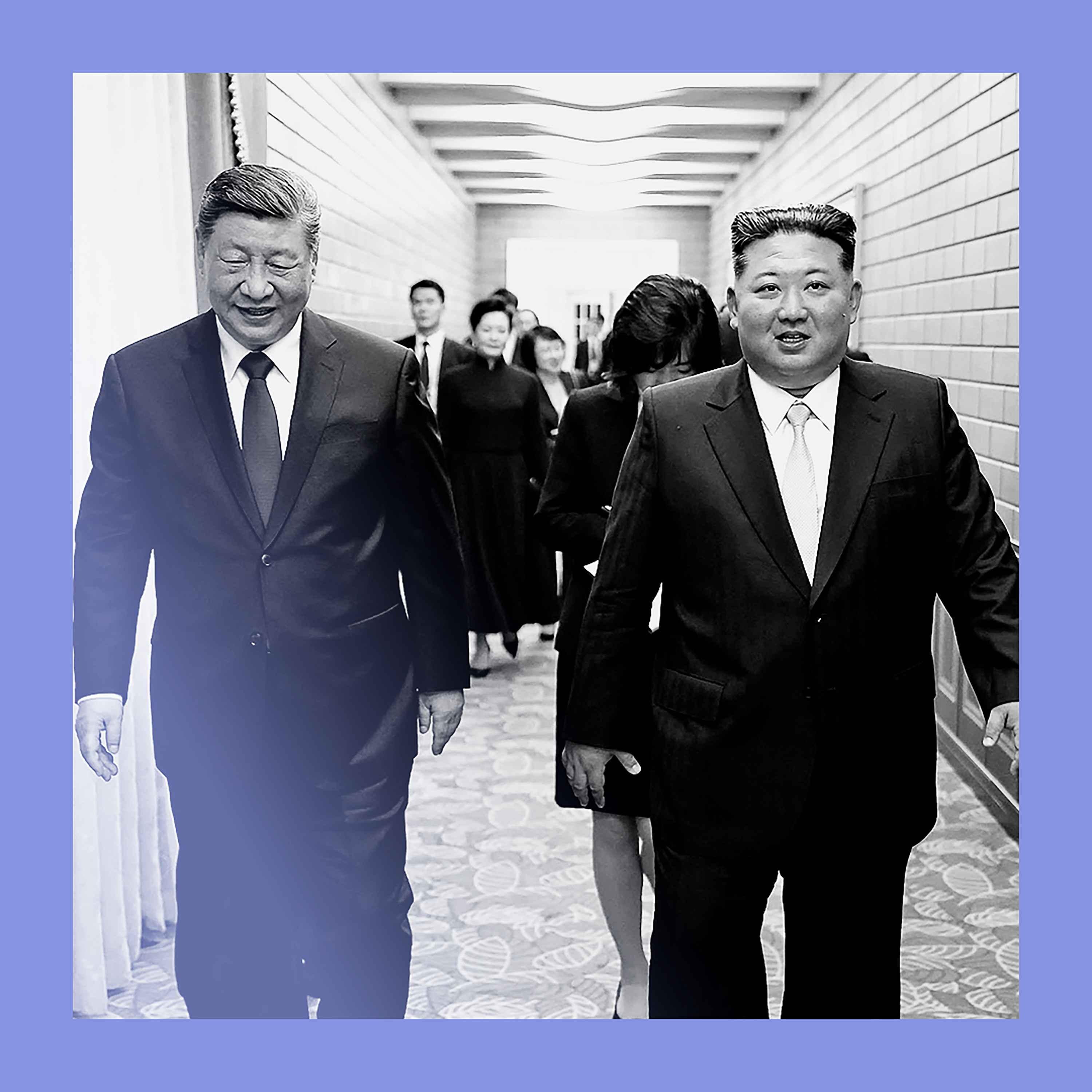
Overview of There Xi goes: visiting North Korea (The Economist)
This episode of The Intelligence examines three geopolitical and social stories: Xi Jinping’s visit to North Korea and what it signals about China’s priorities; life under M23 rebel rule in eastern Congo; and how new Japanese immigration rules may unintentionally wipe out many Nepalese-run Indian curry restaurants that have become part of local life.
Xi Jinping’s visit to North Korea
China’s leader arrived in Pyongyang after a seven-year gap in high-level contact, staging a highly symbolic display of “evergreen friendship” with Kim Jong Un. But the visit is less about pressuring North Korea to denuclearize and more about China’s own strategic concerns.
Main points
-
China is no longer focused on disarmament leverage.
- In 2019, Beijing was still aligned with the U.S. and Russia in pressing Kim over nuclear weapons.
- Now Xi appears more concerned with Russia’s growing influence in Pyongyang and with the possibility of another Trump-Kim summit.
-
North Korea’s nuclear program is far more advanced.
- Experts estimate North Korea has about 50–60 warheads.
- It may be able to produce material for 10–20 additional warheads per year.
- Since 2019, Kim has tested more than a dozen intercontinental ballistic missiles, suggesting real progress toward reaching the U.S. mainland.
-
Kim Jong Un seems determined to keep the arsenal.
- Just before Xi’s visit, North Korean officials described the country’s nuclear status as “irreversible.”
- Kim is likely emboldened by the example of Iran and by support from both China and Russia.
-
China’s fears are strategic, not moral.
- Beijing worries that a nuclear North Korea could prompt Japan and South Korea to seek their own nuclear weapons.
- It also fears regime collapse could lead to a unified, pro-Western Korea and possibly U.S. troops closer to China’s border.
-
Russia has become a major backer.
- North Korea has supported Russia’s war in Ukraine with troops and missiles.
- In return, Moscow has provided money and support, and has effectively treated North Korea as a de facto nuclear state.
Bottom line
Xi’s visit signals acceptance that North Korea’s nuclear status is now entrenched. The main game is no longer denuclearization; it is managing the balance of power around a nuclear-armed, Russia-aligned North Korea.
Life under M23 rebel occupation in eastern Congo
The episode then shifts to Goma, in the eastern Democratic Republic of Congo, where rebel group M23 now controls a vast area after a major offensive.
Main points
-
M23 has transformed from rebel force into de facto ruler.
- The group now controls territory roughly the size of Greece, home to around 15 million people.
- It is both a Congolese insurgency and a proxy conflict, with Rwanda accused of backing it.
-
M23 is trying to build state-like legitimacy.
- Its leaders are pitching the region as a place of order, business, and investment.
- It seeks to present itself as a responsible custodian of the region’s mineral wealth and as a partner the West might do business with.
-
The reality on the ground is harsher.
- The city looks cleaner and more orderly than before, with stricter policing and better traffic discipline.
- But the local economy is in bad shape: banks remain closed, and many businesses are struggling.
-
Human rights abuses remain severe.
- Organizations like Human Rights Watch and Amnesty have documented forced recruitment, sexual violence, and summary executions.
- Residents are still being caught between government forces, militias, and rebels.
-
Ordinary people are trapped in cycles of violence.
- The segment ends with the story of Kavira, a mother whose family has been battered by both government-aligned and rebel forces.
- The central takeaway is that political and mineral-power narratives obscure the human cost.
Bottom line
M23 is trying to sell stability and opportunity, but eastern Congo remains a place of insecurity, economic collapse, and deep humanitarian suffering.
Japan’s threatened Indian curry restaurants
The final segment looks at a surprising consequence of Japan’s tightening immigration policy: the possible disappearance of thousands of Nepalese-run Indian curry restaurants.
Main points
-
These curry houses are deeply embedded in Japanese daily life.
- Japan has around 4,000–5,000 Indian curry restaurants, many run by Nepalese immigrants.
- They are found in major cities and rural towns alike and have become local institutions.
-
The owner profile is often immigrant and highly integrated.
- One example is Sanjay Sahani, a Nepalese restaurateur in Tokyo who has lived in Japan for nearly 20 years.
- He speaks fluent Japanese and considers Japan home.
-
A visa crackdown aimed elsewhere may hit them hardest.
- Japan raised the capital requirement for a business-management visa from 5 million yen to 30 million yen.
- Applicants must also employ at least one full-time Japanese worker or permanent resident.
- The policy was meant to stop wealthy foreigners, especially some Chinese nationals, from using shell companies to gain residency.
-
Small immigrant businesses may not survive the new bar.
- Many curry shops won’t be able to meet the new capital and hiring thresholds.
- Because Japan’s labor market is already tight, even Japanese businesses struggle to hire local workers.
-
There is public pushback.
- Some Japanese residents have launched petitions to stop the rule.
- The argument is not just economic but cultural: these restaurants add diversity and character to neighborhoods.
Bottom line
A policy designed to curb visa abuse may unintentionally erase a beloved part of Japan’s urban and culinary landscape.
Key takeaways
- China’s North Korea policy is shifting from pressure to containment and management.
- North Korea’s nuclear program is now entrenched, with Russia helping to reinforce it.
- M23 is trying to normalize rebel rule in eastern Congo, but civilian suffering remains immense.
- Japan’s immigration rules could damage small immigrant-owned businesses that have become essential to local communities.
Notable insight
The most important details are often the ones not being discussed: not denuclearization in Pyongyang, not “business opportunity” in Goma, and not just visas in Japan — but the human and strategic consequences underneath those narratives.