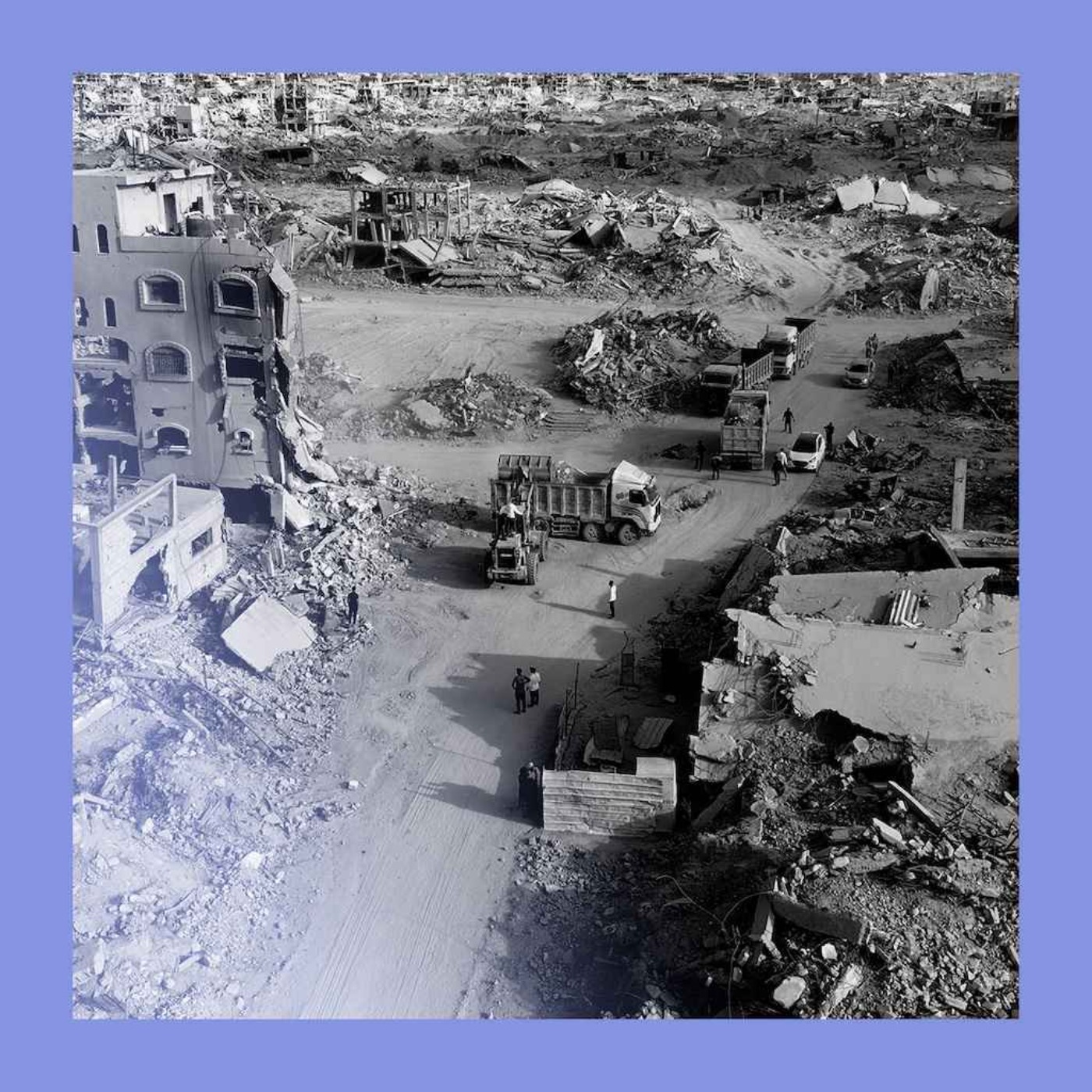
Overview of Toil and rubble: who will rebuild Gaza?
This episode of The Intelligence (The Economist), hosted by Rosie Blore, examines the scale of destruction in Gaza after two years of war and the political, logistical and financial obstacles to rebuilding. It focuses on two competing reconstruction concepts (an Egyptian-led multi-year plan and a smaller Israeli‑American modular-build approach), why neither is likely to proceed quickly, and what the international community is likely to do in the interim. The episode also includes two shorter segments: an analysis of recent layoffs and AI’s role in hiring trends, and an obituary of James Watson.
Main segments & guests
- Gaza reconstruction — Greg Karlstrom, Middle East correspondent.
- AI and layoffs — Alex Domash, economics correspondent.
- James Watson obituary — Anne Rowe, obituaries editor.
- Host: Rosie Blore.
The destruction in Gaza: scale and key figures
- 80–90% of buildings damaged or destroyed.
- ~300,000 homes destroyed or heavily damaged — leaving at least 1 million+ people homeless (more than half the population).
- ~55–60 million tonnes of rubble (Greg’s visual: “about 13 Great Pyramids of Giza” worth).
- 80–85% of businesses destroyed; ~80%+ of farmland damaged (much of it now in Israeli‑controlled areas).
- Two‑thirds of the road network wiped out.
- Result: basic services and infrastructure largely reduced to rubble; mass unemployment and homelessness.
The Egyptian-drafted plan (the long-form proposal)
Overview
- A multi-phase, five-year plan endorsed by several Arab states.
- Phase 1 (~6 months): clear rubble (55–60m tonnes) and prepare reclaimed land (e.g., off-coast projects).
- Phase 2 (~2.5 years): build at least 200,000 homes and reconstruct clinics, schools and basic infrastructure.
- Phase 3 (years 4–5): rebuild governing institutions and broader state functions.
Advantages
- Large local labour pool (high unemployment) to employ for reconstruction.
- Egypt would supply engineering/oversight expertise.
- Raw materials could be routed from Egypt.
Major obstacles
- Timeline realism: engineers estimate rubble clearance could take years (possibly six or more), not six months.
- Rafah crossing: Israel has de facto veto over large construction material flows through Rafah; unrestricted access is unlikely while Hamas remains in control.
- Funding gap: estimated cost around $55 billion. Donors (notably Gulf states) demand guarantees that Hamas is disarmed and that reconstruction won’t finance future conflict — condition not currently met.
- Political: Gulf donors have said they won’t fund major rebuilding unless Hamas is neutralized/disarmed.
The Israeli‑American “limited reconstruction” proposal
Concept
- Build small, modular towns/villages on Israeli‑controlled parts of Gaza (the area north/south of the “yellow line”/ceasefire line).
- Start with one or two modular settlements (clinics, schools, housing for a few thousand), expand if successful.
Advantages claimed by proponents
- Could bypass delays tied to disarming Hamas and donor conditions.
- Faster demonstration projects to provide shelter and services.
Obstacles and risks
- Population movement: Israeli‑controlled areas currently have almost no Palestinian residents — persuading displaced Gazans to relocate there is difficult.
- Mobility and civil‑rights concerns: unclear whether residents would have freedom of movement across Gaza.
- Political symbolism: Arab donors worry funding these projects would make the partition permanent (the “yellow line” becoming a de facto border) and would be politically unacceptable. Gulf governments have refused such proposals.
- Legitimacy: rebuilding only on Israeli‑controlled land could entrench division and leave Palestinian‑controlled areas neglected.
Likely short-to-medium-term path: rehabilitation, not full reconstruction
- With neither plan likely to proceed at scale without political breakthroughs, the near future will probably focus on:
- Rehabilitation rather than full reconstruction (temporary shelters, basic services).
- Water, sanitation and emergency infrastructure projects.
- Small‑scale projects to provide relief and employment rather than mass urban redevelopment.
- Key preconditions for any large-scale reconstruction remain unresolved: how to disarm and secure Gaza; who governs; and who will provide the funding without perceived support for Hamas.
What to watch next (policy and donor levers)
- Donor stances in the Gulf and broader international community: willingness to commit funds and conditions attached (disarmament, governance).
- Israeli policy regarding Rafah and material imports — whether restrictions are eased.
- Political arrangements for Gaza’s governance that could reassure donors (and Israel).
- Pace and scale of interim humanitarian rehabilitation (shelters, water, clinics) and employment programs.
Notable quotes & vivid imagery
- “About 13 Great Pyramids of Giza worth of debris.”
- Reconstruction cost: “on the order of $55 billion.”
- “More than half of Gaza’s population… are homeless now.”
Brief summaries of the other two segments
AI and layoffs (Alex Domash)
- Recent wave of high-profile layoffs (~1 million announced over past year, a 50% rise from a year earlier).
- Common narrative: layoffs = AI takeover. Domash’s view: the data don’t fully support that simple link.
- Main explanation: “reversion to the mean” — post‑pandemic hiring booms (2021–22) in professional and information services are slowing back to pre‑pandemic trends.
- Tech/AI hiring surged earlier (software developer openings >2x 2019 levels) and then slowed; companies may be pausing hiring while investing in AI.
- Concern: in a future recovery companies might invest in automation/AI rather than rehire white‑collar roles, potentially reducing rehiring demand for professionals.
James Watson obituary (Anne Rowe)
- Achievements: co‑discoverer (with Francis Crick) of DNA’s double-helix; instrumental in initiating the Human Genome Project; advocated for open data (made his sequenced genome public).
- Later life controversies: repeated racist and sexist remarks (claims about intelligence by race and gender) led to widespread condemnation, loss of honors and positions (Cold Spring Harbor emeritus titles stripped).
- Anecdote: he obtained Rosalind Franklin’s crystallography photos indirectly (a point of ethical controversy); initially dismissed Franklin’s character but later acknowledged her scientific contribution.
- Died aged 97.
Quick episode takeaways
- Gaza’s physical destruction is vast; rebuilding is logistically daunting and politically fraught.
- Two competing reconstruction blueprints exist but both face near‑term showstoppers: Israel’s control over crossings and security concerns, donor reluctance until Hamas is disarmed, and political objections to projects that could cement partition.
- Expect provisional humanitarian and rehabilitation efforts rather than large-scale reconstruction until political conditions change.
- In other coverage: the current layoffs wave is likely part correction to prior excess hiring, but AI could reshape re‑hiring decisions in future recoveries; James Watson’s scientific stature is shadowed by his later controversial statements and ostracism.