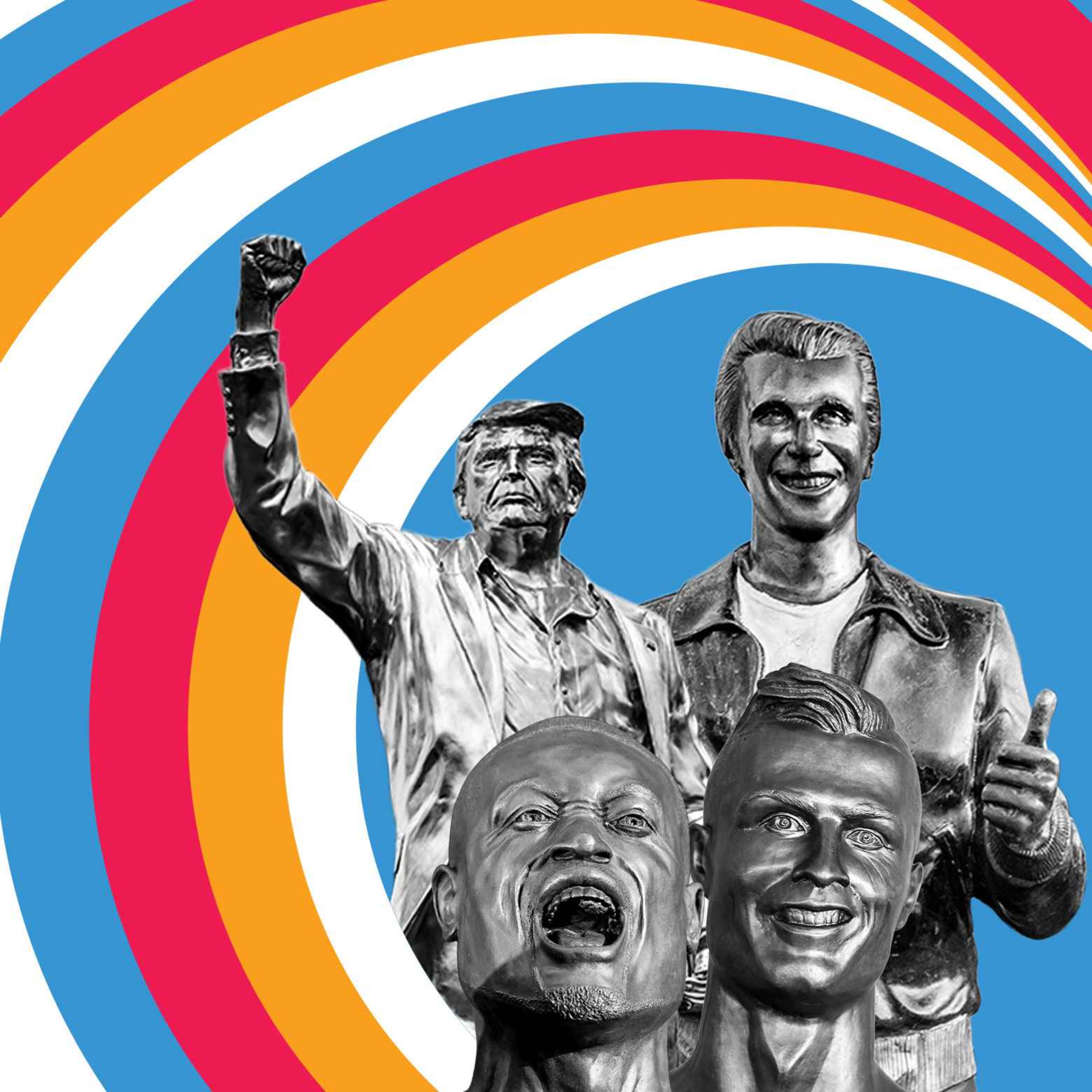
Overview of We Are Monumentally Bad at Statues
This episode of Decoder Ring asks why the U.S. seems strangely incapable of making good realistic statues anymore—especially in the context of Donald Trump’s proposed “National Garden of American Heroes,” a planned monument of 250 lifelike statues of famous Americans. Through a mix of art history, production logistics, and cultural criticism, the episode argues that figurative sculpture was once a highly advanced craft, but the specialized skills, infrastructure, and cultural status needed to produce it have largely disappeared in the West.
The Big Question: Why Are Modern Statues So Bad?
The episode begins with a parade of infamous recent sculptures—Lucille Ball, Cristiano Ronaldo, Dwyane Wade, Lionel Messi, and even a Trump statue—many of which became viral for looking distorted, uncanny, or simply unlike the people they were meant to represent.
Core problem
- Realistic figurative sculpture is extremely hard to do well.
- Most people are highly sensitive to faces and proportions, so even small mistakes are obvious.
- The skills required for lifelike sculpture are rare, labor-intensive, and expensive.
Trump’s “Garden of American Heroes” as a Case Study
The proposed monument is used as a symbol of America’s loss of sculptural capacity.
What the project was supposed to be
- A garden of 250 life-size statues of American icons.
- The list includes obvious figures like Lincoln, MLK Jr., Harriet Tubman, and JFK, but also more surprising names like Milton Friedman, Dr. Seuss, Julia Child, Alex Trebek, Shirley Temple, and others.
- The statues were meant to be realistic, classical, and made of traditional materials like marble and bronze.
Why it ran into trouble
- The timeline was wildly unrealistic.
- America no longer has enough highly skilled realist sculptors or enough foundries and fabrication capacity.
- Even the first wave of statues was delayed, and none appeared on schedule.
How Great Statues Used to Be Made
The episode explains that making a proper statue is a deeply technical process.
Typical sculpture workflow
- The artist first models the figure in clay.
- The design is then transferred into marble or bronze using specialized tools and labor.
- Marble work often relies on artisans and machines to transfer measurements accurately.
- Bronze casting requires molds, multiple stages, welding/finishing, and careful handling of shrinkage and thickness.
Key insight
- Popular imagination makes sculpture sound solitary and romantic, but it is actually a collaborative, highly technical industrial process.
The Historical Rise and Fall of Figurative Sculpture
The episode traces sculpture’s history from ancient Greece to modern times.
Ancient Greece and Rome
- The Greeks revolutionized sculpture by making free-standing figures that looked alive and balanced.
- Romans copied and adapted Greek styles, adding more realism.
- Classical sculpture flourished because it depended on:
- Wealth
- Population density
- Specialized labor
- Public space
- Political stability
Collapse and loss
- After the fall of Rome, these conditions disappeared.
- Figurative sculpture traditions faded for more than a thousand years.
- The “dark ages” joke here is that the loss was real: the expertise genuinely vanished.
Renaissance revival
- Sculpture returned with the Renaissance as cities got wealthier and artists deliberately revived classical methods.
- Major milestones included:
- Donatello’s David
- Michelangelo’s David
- Bernini’s dramatic Baroque sculpture
- This revival re-established realistic sculpture as a prestige art form.
Why Realist Sculpture Fell Out of Favor
The episode argues that sculpture didn’t just become harder to produce—it also became culturally suspect.
19th-century academic training
- Art schools like the École des Beaux-Arts in Paris trained sculptors in strict academic realism.
- American sculptors often trained in Europe or under European-trained artists.
- The result was a flood of technically skilled but often bland public monuments.
Modernism changes the rules
- In the 20th century, modernism rejected academic realism in favor of experimentation, fragmentation, abstraction, and individual expression.
- Rodin is presented as a key transitional figure who broke classical rules while still working in sculpture.
Political baggage
- Realism and neoclassical monumental art became associated with authoritarian aesthetics.
- Nazi and Stalinist propaganda art used realistic, heroic figures to project power.
- As a result, classical figurative sculpture began to feel reactionary, outdated, or even politically suspect.
Why the Skills Disappeared
A central argument of the episode is that art skills are not permanent—they have to be taught, used, and maintained.
What happened in art education
- Art schools increasingly prioritized conceptual and theoretical work over technical training.
- Students learned to talk about art more than to make highly skilled realist sculpture.
- Traditional plaster casts and academic methods were literally smashed or abandoned in some contexts, making the old techniques harder to preserve.
Where the skill went instead
- Much of the technical sculpture expertise migrated to:
- Hollywood creature and prop design
- Large-scale fabrication for entertainment
- Commercial and industrial art production
- So the skill wasn’t entirely lost—it just moved away from fine art institutions.
Why Some Countries Still Can Do It
The episode notes that monumental realist sculpture is still very much alive in places where the state supports it.
North Korea
- North Korea has a massive state-run fabrication center, Mansudae Art Studio.
- It produces giant statues of national leaders and exports monumental sculptures abroad.
- The system is centralized, highly specialized, and geared toward state propaganda.
China and Russia
- These countries also maintain robust realist training traditions.
- Art students undergo rigorous technical education from a young age.
- Realism remains institutionally valued and politically useful.
The key takeaway
- Monumental realism survives where there is:
- strong state support,
- strict training,
- and a cultural demand for heroic representation.
The Episode’s Final Argument
The show ultimately lands on a bittersweet conclusion:
- It is probably good that America is not North Korea.
- It is probably good that we do not want Nazi-style heroic sculpture.
- It is probably good that our art institutions value experimentation, freedom, and personal vision.
But at the same time:
- We have clearly lost a real craft.
- The decline is not imaginary.
- If society stops teaching and practicing a skill, it can genuinely disappear.
Main Takeaways
- Realistic statue-making is an intensely specialized craft, not just “drawing in 3D.”
- The West once had strong figurative sculpture traditions, but they were weakened by modernism, political associations, and changes in art education.
- Trump’s “Garden of Heroes” is a perfect example of how hard it is to revive a lost cultural skill on demand.
- Countries like North Korea and China still retain the infrastructure and training to make monumental realist sculpture.
- Skills are use-it-or-lose-it: if they stop being taught, they can fade from a culture almost completely.
Closing Thought
The episode’s bigger point is not just that American statues are often bad—it’s that art forms can become “impossible” not because of technology, but because of cultural choices about what gets taught, funded, and valued.