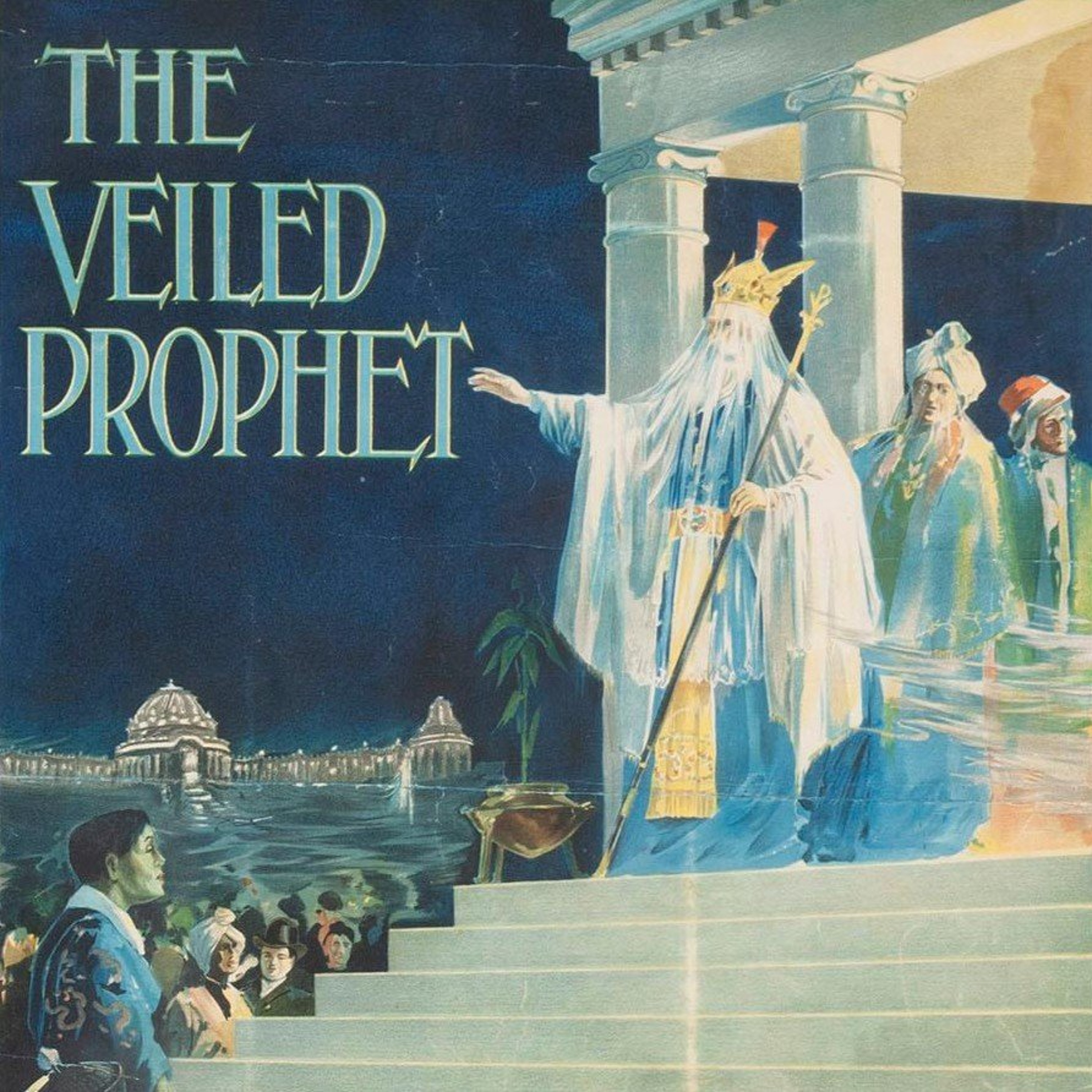
Overview of UNLOCKED: 1056 - Prophets Unveiled feat. Devin Thomas O’Shea
This episode is a wide-ranging interview with Devin Thomas O’Shea, author of The Veiled Prophet: Secret Societies, White Supremacy, and the Struggle for St. Louis. The conversation uses the Veiled Prophet Society as a lens to explore St. Louis history, labor संघर्ष, white supremacy, elite power networks, parade culture, and how American secret societies often function as prestige clubs and class-solidarity machines disguised as tradition, theater, or civic celebration.
Main Topics Discussed
The Veiled Prophet Society
- The Veiled Prophet Society is described as a secretive St. Louis elite club with roots in post-Civil War reactionary politics.
- Its mascot/figure is framed as a veiled, theatrical, Klansman-adjacent character with roots in Confederate and anti-labor symbolism.
- The group began as a way for St. Louis elites to celebrate and signal their victory over labor militancy and Black political power.
St. Louis as an American case study
- The episode treats St. Louis as a city where the contradictions of American capitalism are unusually visible:
- boom and bust cycles
- racial segregation
- labor conflict
- industrial expansion and collapse
- urban renewal and highway-driven fragmentation
- St. Louis is presented as “too big to ignore, too small to pay attention to,” making it a useful place to study broader U.S. patterns.
- The city’s geography, especially its river position and later highway/interstate development, shaped both its economy and its segregation.
The Great Railroad Strike of 1877
- A major portion of the discussion focuses on the 1877 railroad strike, which spread across the country and hit St. Louis hard.
- The strike is framed as:
- a nationwide labor uprising
- a turning point in labor history
- tied to the end of Reconstruction
- a response to wage cuts and worsening conditions during the Long Depression
- In St. Louis, the strike became a powerful general strike involving workers beyond railroad laborers.
- The elites saw the strike in apocalyptic terms and responded with repression, militia force, and arrests.
Parades as political theater
- The podcast spends a lot of time on parades as a form of public intimidation and symbolic power.
- O’Shea describes the Veiled Prophet procession as a kind of “sharivari” or mob-morality pageant:
- a theatrical public display meant to warn, shame, or discipline opponents
- a way to show who controls the city
- The early Veiled Prophet parade is described as overtly violent in symbolism, including imagery of executions and butcher blocks.
- Later, the parade evolves into a more polished debutante-ball format, but the function remains the same: elite power, prestige, and exclusion.
Secret societies as “prestige economies”
- The conversation argues that secret societies often work less as true conspiratorial masterminds and more as:
- drinking clubs with rituals
- networks of elite solidarity
- systems for distributing prestige, access, and social power
- Freemasonry, the Odd Fellows, the Knights of Columbus, the Klan, and the Veiled Prophet are discussed as different versions of this same basic social form.
- The episode emphasizes that these groups need:
- symbolism
- initiation rites
- costumes
- mythology
- public-facing theater
- The “secret” part is less important than the shared identity and bonding among powerful men.
Historical and Political Themes
White supremacy and anti-labor reaction
- The Veiled Prophet Society is framed as a reactionary institution built to defend white supremacy, plantation ideology, and elite rule.
- The group’s symbolism and rituals are tied to:
- Confederate memory
- anti-abolitionism
- anti-union violence
- the policing of Black political participation
- The discussion stresses that many of these elite networks were also anti-German or anti-immigrant when those populations challenged slavery or elite rule.
Reconstruction, labor, and racial hierarchy
- A recurring argument is that labor struggles and Black freedom struggles were deeply connected.
- The episode emphasizes that the elite response to worker organizing often went hand-in-hand with efforts to suppress Black political rights.
- St. Louis becomes a place where these historical struggles appear in concentrated form.
Urban segregation and infrastructure
- The podcast connects past elite power to present-day urban planning:
- highways carving up neighborhoods
- redlining
- forced displacement
- concentrated poverty in Black neighborhoods
- This is presented as an extension of the same class-and-race logic that animated the Veiled Prophet era.
20th-Century and Modern Connections
Military industry and elite consolidation
- O’Shea discusses how St. Louis became deeply tied to the military-industrial complex:
- ammunition
- rifles
- wartime production
- defense contracts
- The city’s wealth increasingly flowed through industrial and military production, deepening elite coordination.
Clark Clifford and mid-century power
- Clark Clifford is highlighted as a Missouri-linked power broker who moved through the Truman and Johnson eras.
- He is portrayed as a classic insider:
- politically connected
- influential in Washington
- tied to elite club culture
- The conversation uses him as an example of how the old prestige networks migrated into modern policy and lobbying power.
MLK assassination and St. Louis connections
- The episode briefly covers the alleged St. Louis links to the Martin Luther King Jr. assassination investigation.
- It mentions John Sutherland, a white supremacist/St. Louis elite figure, and witness claims that he discussed paying for King’s murder.
- The discussion emphasizes how murky, expansive, and still-contested the assassination conspiracy landscape remains.
Ferguson and contemporary racial control
- Ferguson is presented as a modern expression of long-running St. Louis dynamics:
- municipal fragmentation
- tax extraction through policing
- racialized governance
- suburban power over poor Black residents
- The episode frames Ferguson as a “fracture line” where old structures of extraction and segregation became visible to the rest of the country.
Secret Societies, Billionaires, and the Present Day
Why old elite clubs still matter
- O’Shea argues that secret societies still matter because they express elite psychology:
- desire for hierarchy
- domination
- exclusivity
- control over prestige and access
- But he also notes that modern billionaires can increasingly act alone, reducing the need for formal elite clubs.
Peter Thiel, Elon Musk, and “dark enlightenment” logic
- The episode briefly connects the Veiled Prophet to modern right-wing billionaire networks and “dark enlightenment” style thought.
- The point is not that these are identical organizations, but that they share:
- anti-democratic instincts
- elite bonding
- coded ideology
- the need for a cool, exclusive in-group
The survival of the “secret society” model
- The conversation suggests that modern versions of these groups may be less ceremonial, but the function is the same:
- coordinate the powerful
- create loyalty
- normalize reactionary politics
- make exclusion feel stylish or inevitable
Key Takeaways
- The Veiled Prophet Society is not just a weird local tradition; it is a window into how white supremacy and elite class power organize themselves in America.
- St. Louis is used as a microcosm of U.S. history: labor conflict, racial control, urban segregation, and capital accumulation.
- Parades and pageantry are not decorative here; they are political tools of intimidation, legitimacy, and class signaling.
- Secret societies often operate less like omnipotent conspiracies and more like prestige clubs that help elites reproduce their power.
- The same dynamics that shaped the 19th-century Veiled Prophet still echo in modern elite networks, billionaire influence, and racialized policing.
Notable Framing Ideas
- “Drinking club with Robert’s Rules of Order” as a useful shorthand for elite secret societies.
- The Veiled Prophet as a “prestige economy” that distributes status to insiders.
- Parades as symbolic warfare: public, theatrical, and meant to remind people who owns the city.
- The idea that reactionary politics often needs fun, costumes, and camaraderie to feel appealing.
Closing Note
The interview ends on a more playful note, with the hosts and guest imagining a counter-tradition: a more democratic, inclusive, and possibly drag-inflected “counter–Veiled Prophet” celebration that would reclaim parade culture from elite white supremacy.