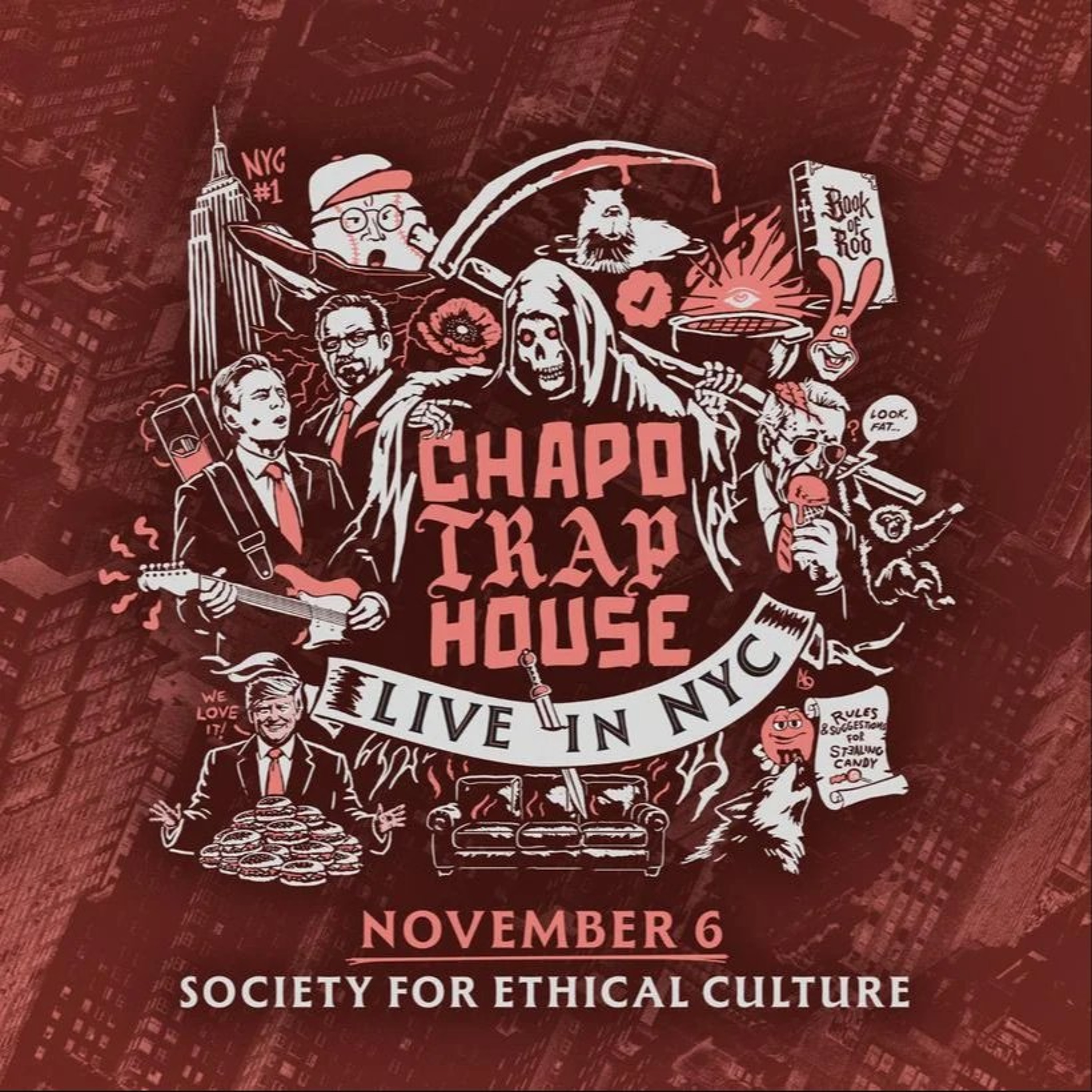
Overview of Chapo Trap House 10-Year Anniversary Live Show
This special anniversary episode is a live, highly satirical stage show celebrating 10 years of Chapo Trap House in New York City. Across sketches, musical parodies, guest banter, and political riffs, the hosts revisit the show’s 2016 origins while mocking the absurdity of contemporary U.S. politics, media culture, and ideological posturing. The tone is chaotic, self-aware, and aggressively funny, with recurring jokes about elections, Trump-era politics, the Israel/Iran war, liberal hypocrisy, and the bizarre logic of online discourse.
What Happens in the Show
Opening bit and musical parody
- Lex Walton kicks things off with a spoof of Phil Ochs’ “I Ain’t Marching Anymore” / “I’m a Liberal,” rewritten as a mock anthem of performative liberalism.
- The song satirizes:
- selective outrage,
- Democratic Party complacency,
- “No Kings” liberal activism,
- and the willingness of centrists to condemn violence while still supporting the system that produces it.
- This leads into the anniversary framing: the show began in New York during the 2016 election cycle, and the hosts use the occasion to “go back 10 years in time.”
Looking back at the 2016 election-night era
- The show revisits a clip from the original 2016 election-night material, including a now-famous joke about Dale Earnhardt and David Carradine.
- The hosts frame the segment as a “post-game analysis” of the past decade:
- what changed,
- what didn’t,
- and how the same political absurdities keep repeating.
Midterm-election mock analysis with David Roth
- David Roth joins for a long political riff that treats election results like sports analysis.
- The conversation jokes about:
- “marquee races,”
- candidate personalities,
- and the idea that political success often comes down to vibes, branding, and spectacle rather than policy.
- They mock both parties, but especially the Democrats’ tendency to run bizarre, compromised, or deeply awkward candidates and then claim victory or moral high ground anyway.
Recurring themes in the political commentary
The discussion repeatedly returns to:
- Trump’s decline and reinvention
- He is portrayed as someone who instantly distances himself from losers and doubles down on anyone who flatters him.
- The future of the Republican Party
- The hosts joke that the GOP’s next phase will be even more incoherent and ridiculous.
- The Israel/Iran war
- The show frames the conflict as politically destabilizing and, in their satirical telling, one of the reasons Democrats benefited electorally.
- The absurdity of liberal politics
- From megachurch-style Democrats to “electability” debates, the hosts skewering the idea that the party’s basic moral posture is stable or coherent.
Stavros Halkias Segment
Introduction and meta-comedy
- Stavros Halkias arrives to loud applause, and the bit immediately turns into backstage-style chaos.
- The venue itself becomes part of the joke:
- “Society for Ethical Culture” is treated as suspiciously ethical,
- and the building is compared to a school or church with something off about it.
“Who comes after Trump?”
- The hosts introduce a bit about who the next Trump-like figure might be.
- This launches into a long, absurd riff on an upstate New York Republican and his rap-video-style campaign persona.
- The joke is less about literal politics and more about how modern right-wing identity is built through performance, grievance, and social-media spectacle.
Free Press Advice Column Roast
The setup
- The hosts discover an advice column called “Tough Love” and spend a long stretch tearing through its letters.
- They mock the tone, the content, and especially the fact that the advice columnist is Abigail Shrier.
Main subjects in the advice letters
- Sexless marriages
- Unhappy spouses
- Family resentment
- Brothers taking sides after divorce
- Transphobic parenting panic
- A friend accusing another of anti-Semitism
- General loneliness, grievance, and emotional dysfunction
What the segment is really doing
- The bit functions as a satire of:
- conservative “family values” media,
- anti-trans culture-war discourse,
- and the self-inflicted misery of the publication’s readership.
- The hosts repeatedly note how the letters feel less like moral dilemmas and more like evidence of social collapse.
Closing Performance and Final Monologue
Benghazi poem / anniversary epilogue
- Toward the end, the show turns into a dramatic, absurd spoken-word poem celebrating the “birth” of the Chapo universe.
- It repeatedly invokes “Benghazi” as a symbol of the entire era of political/media obsession.
- The recitation mixes:
- Obama-era scandal culture,
- podcast history,
- and the show’s own decade-long mythology.
Final song: “Thank God for the Bomb”
- The show closes with a darkly comic song about apocalypse, ideology, and the futility of internet politics in the face of catastrophic violence.
- The ending is intentionally over-the-top and mournful, but still comedic in the Chapo style:
- politics is theater,
- ideology is fragile,
- and the whole culture feels like it is one disaster away from collapse.
Key Takeaways
- The show is both a celebration and a self-parody of Chapo Trap House’s 10-year run.
- Its central comedic method is to take political seriousness and push it into absurdity, exposing hypocrisy on both the left and right.
- Major targets include:
- Trump and the Republican Party,
- Democratic Party complacency,
- liberal media performance,
- culture-war panic,
- and online politics more broadly.
- The live format amplifies the group’s usual strengths:
- improvisation,
- guest chemistry,
- and a mix of genuine political anger with relentless ridicule.
Notable Names and Appearances
- Lex Walton
- David Roth
- Stavros Halkias
- Heather Lansman
- Chapo Trap House regulars referenced throughout, including Felix, Matt, and others from the show’s orbit
Overall Impression
This anniversary special is less a conventional episode than a live variety show built around political comedy, nostalgia, and self-mythologizing. It revisits the original Chapo era while insisting that the same absurdities still rule American politics. The result is sprawling, confrontational, and very much in the show’s signature voice.