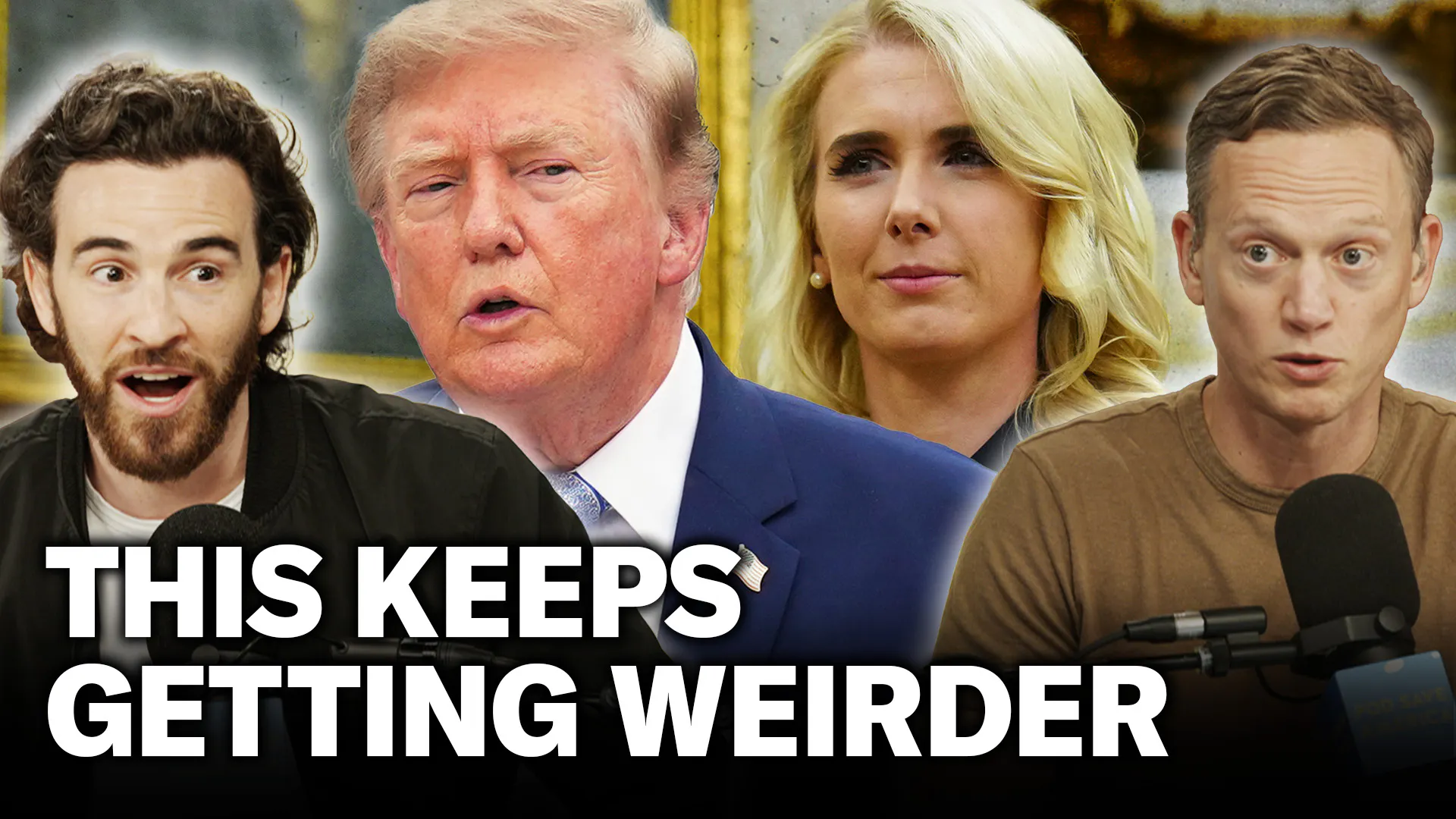
Overview of Jon Ossoff Shines Spotlight on Trump’s WEIRD Relationship with Natalie Harp
This episode is a sharp, comedic political rundown centered on Trumpworld’s obsession with loyalty, image, and grievance. The hosts start with speculation about who might replace White House Press Secretary Karoline Leavitt, then pivot to Sen. Jon Ossoff’s viral attack on Natalie Harp — Trump’s famously devoted aide — and how the White House overreacted in a way that only amplified the story. The episode closes with a look at troubling polling shifts for Trump among Hispanic men, the broader midterm landscape, and a funny takedown of a right-wing “independent journalist” being trolled in Sacramento.
White House Press Secretary Sweepstakes: Who Can Best Sycophant for Trump?
The episode opens with a playful discussion of who might replace Karoline Leavitt as White House press secretary. The hosts argue that, in Trump’s White House, the job is less about competence or professionalism and more about being a shameless, on-camera defender of the president.
Leading names discussed
-
Scott Jennings
- A CNN commentator and former Bush/McConnell operative.
- Seen as appealing to Trump because he’s loud, combative, and willing to defend anything Trump says.
- The hosts note that Trump values unwavering loyalty over skill.
-
Alina Habba
- One of Trump’s lawyers and legal spokespersons.
- The hosts highlight how she’s already proven she can repeat Trump-friendly talking points with a straight face.
- Her career is framed as another example of Trump favoring loyalists over qualified people.
-
Jesse Watters
- Mentioned as a possible sleeper candidate because he already does propaganda-style TV for Fox.
- The hosts doubt he’d leave Fox or that Trump would even want someone with Watters’ wink-and-nudge style, since Trump doesn’t do irony well.
Main takeaway
Trump’s ideal spokesperson is portrayed as someone who is:
- shameless,
- visually “central casting,”
- and willing to repeat whatever Trump wants, regardless of truth or credibility.
Jon Ossoff vs. Natalie Harp: Turning Trump’s Weirdness into a Political Liability
A major segment focuses on Sen. Jon Ossoff’s speech calling out Trump’s dependence on sycophants, including Natalie Harp, who was described as part of Trump’s inner circle and his “human printer.”
Why the Natalie Harp line went viral
Ossoff mocked Trump for:
- not wanting to do the job of president,
- focusing on vanity projects like a ballroom,
- and traveling with Natalie Harp on a “defenseless flying palace.”
The hosts argue that Ossoff’s line worked because:
- it was vivid and funny,
- it highlighted the bizarre relationship between Trump and Harp,
- and it forced the White House to respond.
What the White House did
Instead of ignoring the attack, Trump surrogates and officials reportedly:
- coordinated a furious response,
- defended Harp as if she were under serious political attack,
- and inadvertently kept the story alive for days.
The hosts say this was a strategic mistake because it:
- gave Ossoff more attention,
- helped him look like the sharpest communicator in the race,
- and made Trumpworld seem even more defensive and weird.
Key insight about Natalie Harp
The episode emphasizes that Harp is not just a random aide:
- she is highly visible around Trump,
- reportedly prints flattering material for him,
- and symbolizes the administration’s preference for people who flatter rather than challenge him.
Broader theme
The hosts argue that Trump’s staff is built around:
- loyalty through shame-free devotion,
- not professionalism,
- and that the White House’s furious reaction to Ossoff exposed exactly how thin-skinned and image-obsessed Trumpworld remains.
Trump’s Political Weakness: Polling Trouble Among Hispanic Men
The episode then shifts to polling and the broader 2026 midterm environment, using CNN’s Harry Enten as a springboard.
Major polling takeaway
Trump’s support among Hispanic men has dropped dramatically:
- He won them by about 10 points in 2024,
- but now his net approval among that group is deeply underwater.
The hosts describe this as a huge swing and argue it’s especially damaging because Republicans had been hoping their 2024 gains with Latino voters would become durable.
Why Trump is losing ground
The conversation points to:
- worsening views of the economy,
- tariffs and trade wars,
- foreign policy chaos,
- and higher costs tied to Trump’s own decisions.
The hosts emphasize that much of the economic pain is self-inflicted.
Midterm implications
They discuss updated Senate ratings and note that:
- some states Republicans thought were safe are now competitive,
- Texas has become more vulnerable for Republicans,
- and Democrats could be unusually competitive in states like Ohio, Iowa, Alaska, and Michigan.
Main takeaway
Trump’s coalition may be more fragile than it looked in 2024, and Republican gerrymandering plans may be less secure if these demographic shifts continue.
The “Independent Journalist” Bit: Nick Shirley Gets Roasted in Sacramento
The final segment covers a viral video of Nick Shirley, a right-wing “independent journalist,” being mocked while filming in Sacramento.
What happened
A local prankster repeatedly taunted Shirley by:
- calling attention to his supposed “small penis,”
- making him visibly uncomfortable,
- and turning the encounter into a public embarrassment.
The hosts praise the trolling as a rare and satisfying example of someone pushing back against a right-wing provocateur.
Why it matters
The segment serves as a comedic closer and reinforces the episode’s larger theme:
- right-wing media figures often thrive on antagonism,
- but they do not handle ridicule very well when the tables are turned.
Bottom Line
This episode argues that Trumpworld runs on:
- loyalty over competence,
- weird personal relationships,
- coordinated outrage,
- and a constant need to manufacture enemies.
At the same time, Democrats like Jon Ossoff are learning how to weaponize that weirdness effectively, turning Trump’s own inner-circle dysfunction into a political liability.