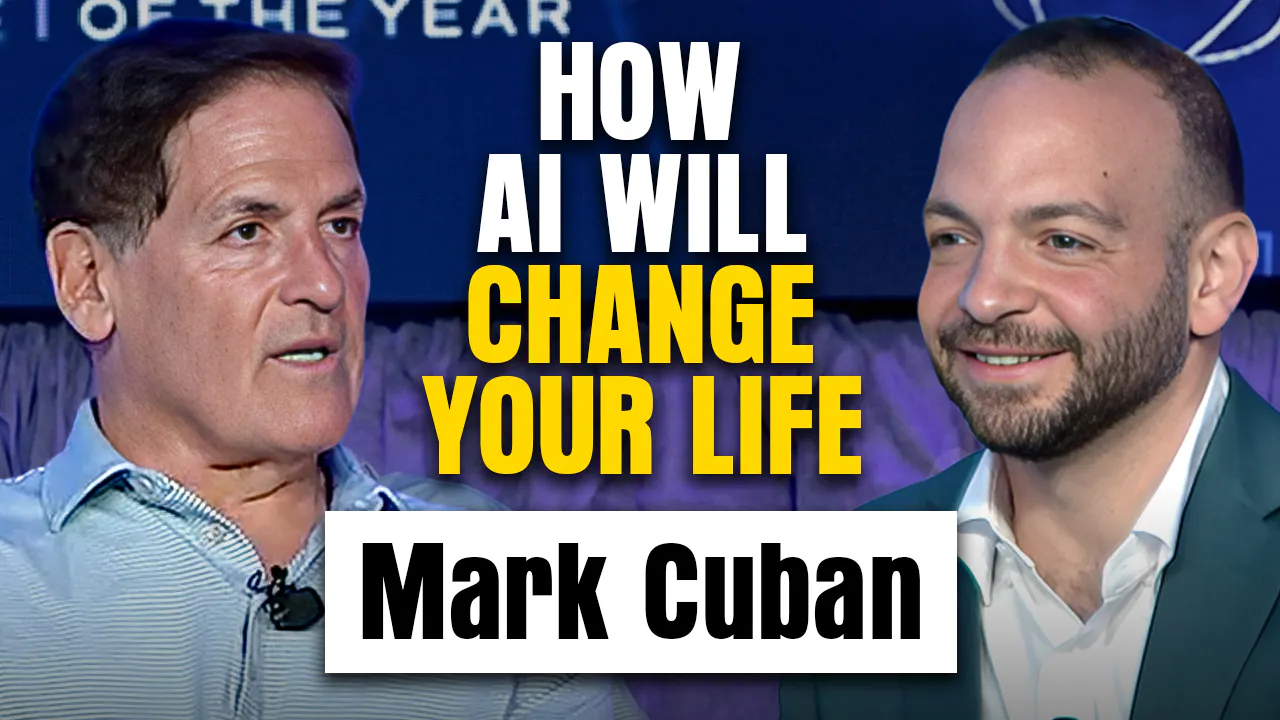
Overview of Mark Cuban: AI Hype vs. Reality, OpenAI's Wasting $1 Trillion, Lebron vs. Jordan
In this conversation on Big Technology Podcast with Alex Kantrowitz, Mark Cuban argues that AI is not overhyped so much as underused: the real gap is between people who are actively learning and building with AI and those who are still treating it like a novelty. He frames AI as an exponential shift already reshaping business, education, and work—especially through agents and large language models like Claude, ChatGPT, Grok, and Gemini—while warning that many companies are still approaching it too incrementally. Cuban is bullish on AI as a productivity tool and a democratizer of knowledge, but skeptical of massive infrastructure spending, undifferentiated software businesses, and founders who rely on hype rather than proprietary value.
Main Takeaways
- AI is already a major business tool, not a future concept.
- The key divide is use case, not capability: people using AI to learn and build will outperform those using it only to avoid work.
- Businesses must redesign around AI, not just “add AI” to old processes.
- Agents are especially valuable for repetitive, tedious tasks that would otherwise go to interns or entry-level staff.
- Companies with unique IP and proprietary data are safer than generic software vendors.
- Cuban is skeptical of trillion-dollar AI spending claims, saying the economics may not support the current narrative.
- Education is one of AI’s biggest upside areas, especially personalized tutoring and adaptive learning.
- He expects significant job displacement, but not mass “jobs are optional” unemployment.
AI: Hype vs. Reality
Cuban rejects the idea that there’s a big gap between AI hype and reality. In his view, AI is already changing how work gets done, just not always in obvious consumer-facing ways.
Why he thinks the shift is real
- He compares AI to previous inflection points like:
- the PC era,
- the internet,
- early streaming.
- Each wave had skeptics, but early adopters gained the advantage.
- He sees AI as exponential, not linear, because its capabilities and usefulness are improving too quickly for old assumptions to hold.
His “drunk intern” metaphor
Cuban describes AI agents as like a “hungover intern”:
- they can handle tedious tasks,
- they work 24/7,
- they don’t replace judgment,
- but they can massively increase output.
How Cuban Says Businesses Should Use AI
Cuban’s core advice is that companies should not just use AI to speed up old workflows—they should rebuild workflows around AI.
Best use cases
- Customer service
- Repetitive admin tasks
- Research and comparison work
- Drafting emails and summaries
- Building MVPs and prototypes
- Internal process optimization
What he’s doing himself
He gives examples of using Claude to:
- generate a price comparison report for Cost Plus Drugs,
- analyze legal options from an email,
- draft a business plan,
- produce a patent-style application,
- build structured outputs much faster than search engines ever could.
What founders and workers should do
- Learn AI deeply.
- Use it to move faster.
- Be willing to iterate constantly.
- Treat curiosity as the most valuable skill.
AI and the Future of Work
Cuban believes AI will displace some jobs, especially highly repetitive ones, but he does not buy apocalyptic predictions like “50% unemployment.”
Who is most at risk
- People doing only:
- reformatting,
- yes/no responses,
- basic repetitive entry-level tasks.
Who will do well
- Critical thinkers
- Curious learners
- People who know:
- when to use an agent,
- when not to,
- how to validate outputs,
- how to blend human judgment with AI speed.
He especially emphasizes that middle management and “AI translation” roles will matter—people who can help companies decide how and where to use AI effectively.
Education: AI as a Democratizer
One of Cuban’s strongest themes is that AI could transform education.
Why he’s bullish
- AI can act like a tutor for anyone with a phone.
- It can personalize lessons by:
- pace,
- difficulty,
- format,
- interests.
- It can help teachers see where a student is struggling and adapt in real time.
Tools and examples he mentions
- NotebookLM: turning manuals or documents into podcasts.
- AI-based tutoring: easier, cheaper, and more scalable than traditional one-on-one help.
- Learning through conversation: he believes people need to get comfortable “talking to” AI.
His bigger point
AI can make knowledge accessible to:
- an 8-year-old in a poor neighborhood,
- a college student,
- a 96-year-old trying to learn something new.
AI in Startups and Software: The “Saspocalypse”
Cuban agrees that AI is putting pressure on traditional software businesses, especially standardized SaaS products.
His view on software risk
- If a company’s product is mostly standardized and easy to replicate, it’s vulnerable.
- If a company has unique IP, proprietary data, or complex regulatory knowledge, it has a better chance.
Example: DocuSign
He says DocuSign is safer than it might appear because:
- signing laws vary by region and country,
- compliance is complex,
- that domain-specific knowledge is hard to replace cheaply.
What he warns against
- Software businesses that are just “seat-based”
- Products with no meaningful proprietary advantage
- Companies assuming AI won’t be able to replicate core features
OpenAI, Spending, and the AI Business Model
Cuban is sharply skeptical of the current capital spending race in AI.
His take on the trillion-dollar infrastructure narrative
- He thinks much of the spending projection is overblown.
- He believes many companies are “spending money away at scale” without a clear return.
- He doubts all of that capital expenditure will be justified.
But he also sees why they’re doing it
- The foundational model market may end up winner-take-most.
- Companies are trying to raise and spend aggressively to avoid being left behind.
- The fear of not being the winner pushes everyone to keep raising.
His broader prediction
There may be only a few meaningful AI winners.
- Too many winners, and the market gets fragmented.
- Too much spending without differentiation, and some firms become “just an app” after burning through huge sums.
The Next Wave: Beyond Text Models
Cuban argues today’s AI is still limited because it is mostly trained on text and images, not full real-world context.
What’s missing
- Physical understanding
- Consequences of actions
- Video and environmental awareness
- World-model reasoning
Where he thinks AI is heading
He expects a shift toward worldview models that can:
- understand the physical world,
- interpret video,
- analyze materials and environments,
- move beyond language-only reasoning.
He gives an example of investing in a company using satellites to identify the makeup of natural materials from above.
Why He Thinks AI Will Keep Reshaping Everything
Cuban’s bottom line is that AI is not a one-time product cycle. It’s a continuing transformation.
His recurring theme
- Iterate constantly
- Learn continuously
- Expect customers, employees, and competitors to get smarter
- Build with the assumption that the tools will keep changing
He believes the biggest winners will be:
- people who learn the tools best,
- companies that redesign around them,
- teams that stay adaptable.
Lightning Round and Sports Opinions
In the closing lightning round, Cuban keeps his trademark blunt style.
Sports takes
- Jordan over LeBron in one-on-one.
- Kobe could beat either on a given night.
- He supports reducing NBA games from 48 to 40 minutes to improve pace, health, and intensity.
- He also suggests changing the NBA draft rules to reduce tanking incentives and limit pick hoarding.
Other quick hits
- He jokes about Bart Simpson as his 2028 favorite candidate.
- He avoids deep political commentary, saying he focuses on issues like lower drug prices that matter to both parties.
Notable Themes and Quotes
- “If you’re not using one of the large language models… you’re falling way behind.”
- “AI is a great tool to allow you to optimize all those things.”
- “The number one skill set… is curiosity.”
- “If you’re just using it so you don’t have to do the work, you’re going to struggle.”
- “There are going to be two types of companies: those who are great at AI and those who went out of business.”
Bottom Line
Mark Cuban sees AI as a real, accelerating platform shift that rewards curiosity, experimentation, and business reinvention. He’s optimistic about AI’s ability to expand access to knowledge, improve productivity, and help small businesses punch above their weight. But he’s also skeptical of hype-driven spending, generic software, and companies that fail to build durable advantages before AI commoditizes their offerings.