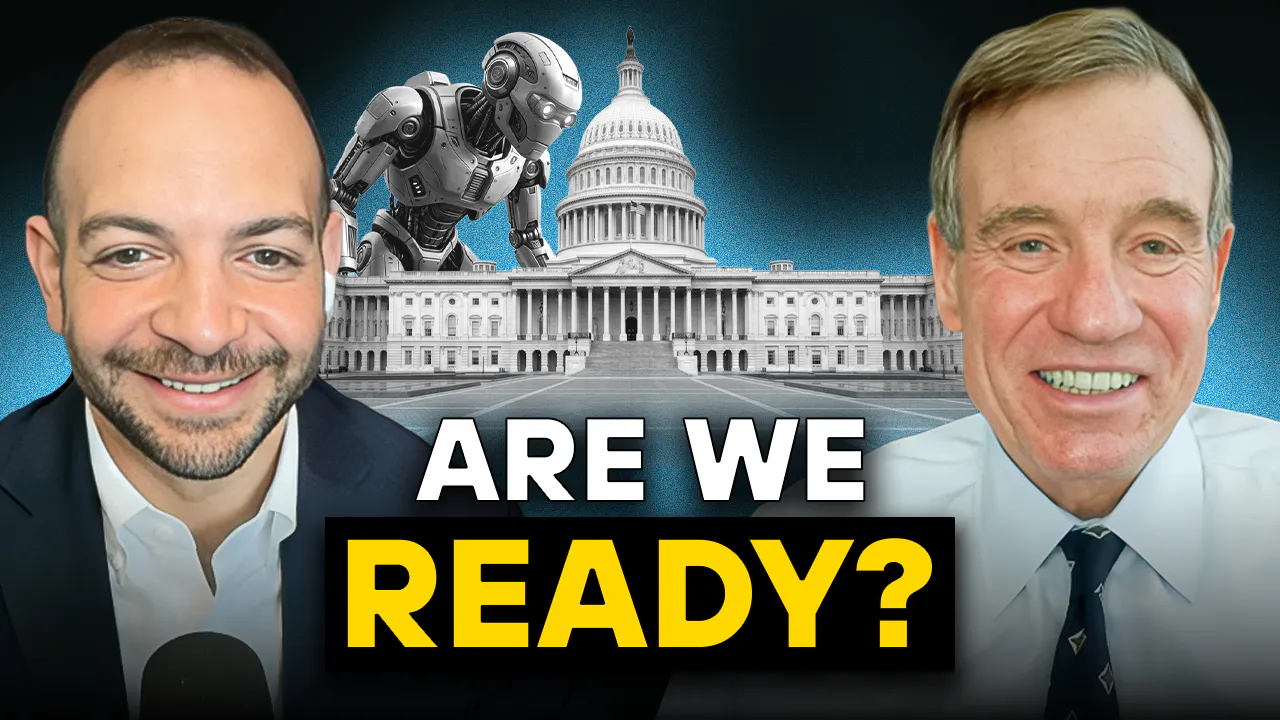
Overview of Big Technology Podcast episode — "Senator Mark Warner: Nobody’s Ready for What AI Could Do To Us"
Host Alex Kantrowitz interviews U.S. Senator Mark Warner about the speed and societal impact of recent AI advances. Warner argues government and society are unprepared for potentially exponential AI-driven disruption — especially short-term economic and workforce effects — and discusses legislative responses, the Anthropic/Department of Defense dispute, data-center politics, oversight needs for military AI, and practical next steps for policymakers and industry.
Key takeaways
- Senator Warner believes government and society are not ready for rapid AI progress and that short-term economic disruption (3–5 years) could be severe, especially for recent graduates and early-career workers.
- There is widespread private-sector evidence of hiring changes (interns, first-year hires, back-office staffing) but insufficient public data to measure AI-driven job displacement.
- Warner is pushing bipartisan, incremental legislation: better data collection (Bureau of Labor Statistics reporting on AI job disruption), a commission to study the economic transition, and financial-market-focused AI oversight.
- He strongly opposes a unilateral Department of Defense “supply chain risk” designation for Anthropic, warning such a precedent would be dangerous if applied without due process.
- Local opposition to AI data centers is heating up (environment, energy, local quality of life), and states like Virginia are debating new revenue/mitigation frameworks that could become national models.
- Military use of AI (surveillance, targeting, autonomous weapons) raises urgent oversight and ethical questions; Warner calls for bipartisan transparency and review.
Topics discussed
- Current mood in Washington on AI: insufficient understanding across many lawmakers; tendency to punt on complex tech issues.
- Private-sector signals of disruption:
- Major firms reducing internship/new-hire pipelines.
- Mid-size companies automating back-office roles (e.g., 23 → 3 staff examples).
- Anecdotes of law firms pausing first-year associate hires.
- Legislative efforts and policy proposals:
- BLS data collection on AI job impacts.
- A bipartisan commission (akin to the Cyber Solarium model) to plan the economic transition and ground rules.
- Bills around AI impacts on financial markets.
- Anthropic / DOD dispute:
- Warner objects to a single official (Secretary/Assistant Secretary level) being able to declare an American AI company a supply chain risk without due process.
- He warns the precedent could be used politically and hurt U.S. tech competitiveness.
- AI and warfighting:
- Concerns about AI-driven surveillance, target-selection systems (Palantir discussed), and the potential move toward weapons without a human-in-the-loop.
- Calls for bipartisan oversight (Intelligence and Armed Services committees).
- Data center politics:
- Polling shows public skepticism about data centers’ environmental and local impacts.
- Warner suggests industry should help fund transition programs, invest in on-site/self-generation power, water mitigation, and more tangible local benefits.
- Social and psychological impacts:
- Deepfakes, non-consensual imagery, AI “romantic” relationships, and election-disruption potential are all rising concerns.
- Warner argues these are smaller than the economic/job disruption risk but still significant.
Notable quotes
- “I don't think government's ready. I don't think society's ready.”
- “We are not even collecting data on this yet.”
- “This is going to particularly hit kids coming out of college.”
- Calling a DOD supply-chain designation for an American company “a death warrant” if applied without due process.
- “Getting it wrong can be a major disaster.”
Legislation & policy ideas mentioned
- BLS reporting requirement to measure AI-driven job disruption and job-creation dynamics.
- Bipartisan commission on the economy of the future (modeled on successful cyber commissions).
- Bipartisan bill addressing AI’s impact on financial markets.
- Calls for: industry contributions to reskilling programs, clearer rules/guardrails around harmful outputs (e.g., non-consensual deepfakes), statutory protections around data-center impacts (energy, water, local benefits).
- Stronger, bipartisan oversight and transparency for DOD/Intelligence contracts using AI, and review mechanisms (third-party/academic review).
Risks and areas of urgency
- Rapid, concentrated job disruption — early-career hiring pipelines (interns, first-year hires) threatened first.
- Lack of real-time, public data to measure and respond to workforce displacement.
- Political misuse of security designations that could arbitrarily bar companies from government contracts (sets chilling precedent).
- Military use of AI without adequate oversight (autonomous weapons, surveillance) and the challenge of making those policy/ethical decisions quickly and transparently.
- Public backlash over environmental and community impacts of large-scale data centers, which could slow infrastructure deployment and provoke harsher regulation.
Practical recommendations / action items (Warner’s framing)
- Policymakers: establish better data collection (BLS), create a bipartisan commission to plan economic transition, pass targeted bills on financial-market impacts.
- Industry: engage constructively with policymakers, help define and fund retraining/reskilling programs, commit to local mitigation measures (power, water, visual screening), and support third-party oversight processes.
- Oversight: Congress should demand transparency on DOD/Intelligence AI programs and push for bipartisan review and limits (e.g., on autonomous weapons without human oversight).
- Local governance: states and counties should negotiate clearer economic benefits from data centers (revenue sharing, community investments).
- Public communication: be honest about shifting job prospects in specific fields (e.g., some business/analyst roles), and invest in visible community benefits to build trust.
Bottom line / conclusion
Senator Warner views AI as transformative and potentially disruptive on a timescale measured in years, not decades. He argues the U.S. is neither collecting the right data nor prepared with policies to manage the likely rapid economic displacement and ethical challenges. Warner urges bipartisan policymaking, industry cooperation on reskilling and local mitigation, and immediate oversight of government AI use — warning that a wrong or slow response could have widespread social, economic, and geopolitical consequences.