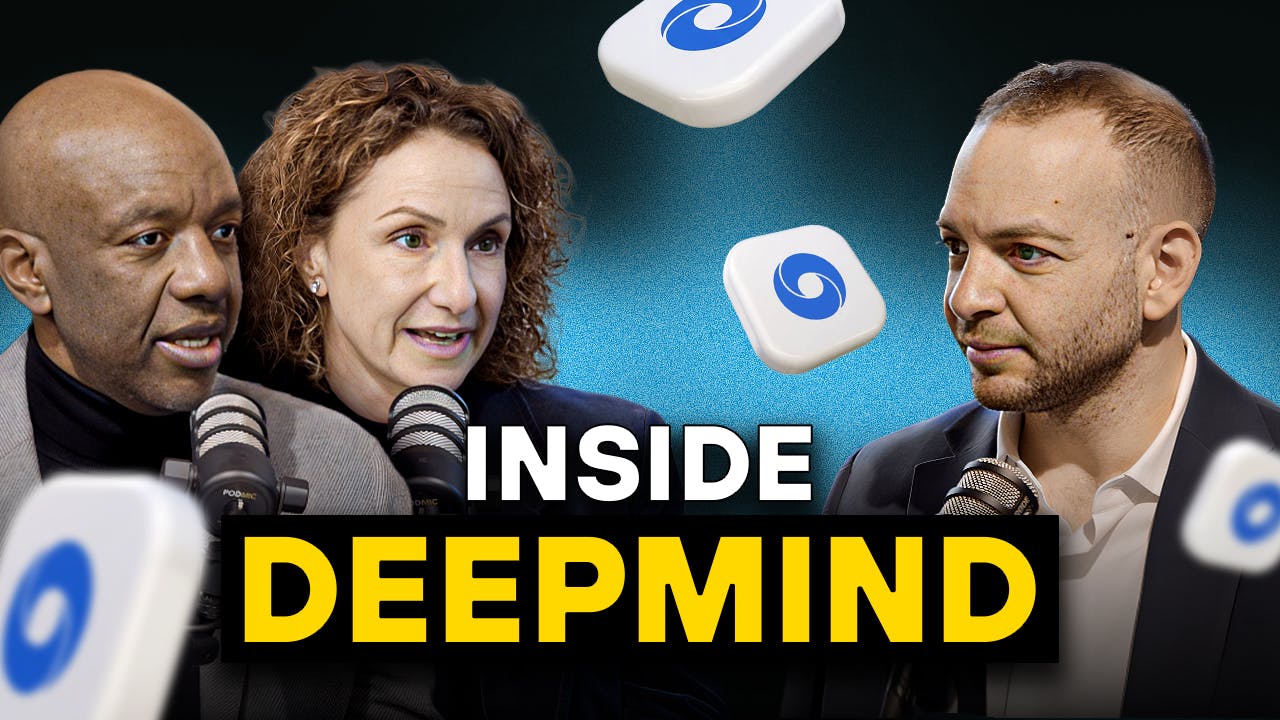
Overview of Big Technology Podcast — How Google DeepMind Operates & Experiments
This episode (recorded at Davos) features Lila Ibrahim (COO, Google DeepMind) and James Manyika (SVP, Research Labs, Technology & Society at Google) in conversation with host Alex Kantrowitz. They explain how DeepMind and Google’s research organizations structure ambitious research, spin experiments into products, and balance bold, rapid shipping with responsibility. The discussion covers organizational design, Labs and notable experimental products (NotebookLM, Flow), AI in education, and frontier technologies (quantum, materials discovery, weather forecasting, and Project Suncatcher).
Key takeaways
- Mission-first approach: DeepMind’s guiding mission is “build AI responsibly to benefit humanity.” Big, clear research agendas + autonomy for researchers are central.
- Hybrid governance: Work is both top-down (mission and prioritized programs like Gemini) and bottom-up (researcher-driven ideas and cross-team experiments).
- Gemini as foundation: The Gemini program is the company’s central AI foundation that’s deployed across products (Search, Workspace, apps); models iterate roughly every 5–6 months.
- Labs rebooted: Google Labs (restarted ~3 years ago) focuses on building experimental, AI-first products from research and internal ideas — roughly ~30 experiments at a time.
- NotebookLM & Flow: NotebookLM (grounded notebooks with citations, audio “podcast” overviews, multilingual support, video summaries) and Flow (scene-by-scene video generation for creators) are flagship Labs products demonstrating research → product flow.
- AI in education: High adoption (survey: ~85% of learners 18+, ~81% of teachers reported using AI). When designed for learning (guided learning, step-by-step tutoring), AI can boost mastery and teacher productivity, but it requires new workflows and guardrails to manage risks (cheating, inequitable access).
- Responsible shipping tension: Google emphasizes a balance — be bold and ship (learn from real use), but couple that with red-teaming, safety testing, and policy frameworks.
- Frontier tech progress: Quantum computing, materials discovery, weather forecasting, and even “space-based training” (Project Suncatcher) are active, tangible efforts with near- to mid-term milestones.
How Google DeepMind operates
-
Mission & structure
- Big research agendas set thematic direction (e.g., learning science, weather, protein folding) but teams are given autonomy on methods.
- Interdisciplinary teams (bioethicists, neuroscientists, computer scientists) are emphasized to unlock new insights.
- Leadership (Demis Hassabis) sets timing and priority signals — when to explore, pause, or scale.
-
Top-down vs bottom-up
- Both: leadership prioritizes large problems (top-down), while researchers propose and self-organize experiments (bottom-up).
- The model aims to combine long-term frontier science with real-world product impact.
-
Integration with Google product teams
- DeepMind/Google Research collaborate closely with product teams rather than simply “farming out” models.
- Models are tested and refined with product contexts so newer model generations appear quickly across Google offerings.
Google Labs and experimentation
- Intent: Rebooted to produce AI-first experimental products from research and internal ideas; focuses on fast prototyping and creative user inputs (filmmakers, educators, SMBs).
- Scale: ~30 projects active in Labs at any time; mixture of projects built inside Labs and ideas sourced from elsewhere in Google (20% time-like culture still exists).
- Notable products:
- NotebookLM: documents/papers/videos/personal files are ingested, produces grounded outputs with citations, supports audio/podcast-style overviews and video summaries, multilingual.
- Flow: video generator allowing scene-by-scene composition and continuation; built with filmmaker input.
- Pomeli: SMB web-presence builder; CC, Disco and other productivity/agent experiments.
- Idea sourcing: Many experiments originate from researchers across Google (some still via “20% time” or similar internal exploration), and Labs acts as the place to test and scale them.
AI in education — state, benefits, and risks
- Adoption & perception
- Survey highlighted: ~85% of learners 18+ using AI; ~81% of teachers using AI. ~80% of learners found AI helpful for learning.
- Benefits
- Personalized tutoring: guided learning, stepwise problem breakdowns, support for learners with disabilities (dyslexia example).
- Teacher productivity: pilots reported teachers saving ~10 hours/week by offloading grading/prep tasks—time reallocated to teaching and differentiated lesson planning.
- New pedagogy opportunities: guided learning can improve mastery and suggests rethinking assessment cadence (e.g., weekly tests to incentivize learning-with-AI).
- Risks & mitigation
- Cheating and equity: risk of creating gaps between students who use AI “well” vs “poorly” or have access vs those who don’t.
- Need for system-level convening: schools and administrators should define policies, incentives, assessment redesign, and teacher training.
- Responsible design: integrate pedagogy experts, measure learning outcomes, and invest in mitigation (red-teaming, transparency).
Frontier technologies covered (quick state updates)
- Quantum computing (James)
- Progress faster than many expect: Willow chip benchmarks (RCS) showed dramatic speeds vs classical supercomputers.
- Key breakthrough: below-threshold error correction — error rates decrease as systems scale, enabling practical scaling.
- First “useful” quantum computation: quantum-echo results for molecular spin dynamics (validated experimentally; Nature cover), suggesting practical applications within ~5 years.
- Materials discovery (Lila)
- AI-driven materials search expanded known stable crystal candidates from ~40 to 400,000+ predicted structures.
- Potential impact: better batteries, superconductors, lighter/stronger materials — implications for EV range, energy storage, and computing hardware.
- Weather forecasting & disasters (both)
- GraphCast and other models improve forecasts; specific work predicts riverine floods with extended lead times. Riverine flood predictions now cover ~150 countries and 2+ billion people.
- Use cases include hurricane path ensembles, flood warning, and operational improvements (airline logistics, crisis preparedness).
- Project Suncatcher (moonshot)
- Long-term vision: harness solar energy in space for massive compute (train models in space).
- Near-term plan: send TPUs (AI chips) to space and run training runs; milestone training runs targeted around 2027.
- Rationale: abundant solar energy, continuous operation; conceptually a multi-decade effort toward space-based compute infrastructure.
Culture, talent and product cadence
- Retention: DeepMind retains long-tenured researchers via portfolio breadth—people can pursue deep science or applied/model work.
- “Relentless shipping” balanced with responsibility: iterative cycle (e.g., Gemini generations every ~5–6 months) while maintaining red-teaming and safety practices.
- Cross-pollination: internal collaborations (DeepMind + Google Brain + product teams) accelerate research → product transitions (AlphaFold, GraphCast, Gemini integrations).
Notable quotes & insights (selected)
- “Build AI responsibly to benefit humanity.” — Summarizes DeepMind’s guiding mission.
- Gemini is described as the company’s “engine room”: foundational models that show up across Search, Workspace and other products shortly after release.
- On research culture: “go from research to reality” — an emphasis on translating breakthroughs into societal impact (AlphaFold, flood forecasting examples).
- On experimentation: Labs features many creative, interdisciplinary projects and invites broader input (filmmakers, educators, SMBs).
Practical recommendations / action items
For educators and administrators
- Pilot guided-learning tools and measure mastery (not just answers).
- Reexamine assessment design (timing, format) to align incentives with learning, not copying.
- Convene stakeholders to build responsible-use policies and teacher training.
For product leaders and researchers
- Maintain portfolio balance: protect long-term research while enabling rapid productization for high-impact advances.
- Embed interdisciplinary teams early (ethics, domain experts, product designers).
- Use Labs-like environments for prototyping with real users and red-teaming before wide rollouts.
For listeners/creatives/SMBs
- Try Labs experiments (NotebookLM, Flow, Pomeli) where available and provide feedback — these are early interfaces to new creative/productivity workflows.
- Expect faster iteration cycles: major AI model advancements will keep arriving frequently; evaluate new generations quickly but responsibly.
Closing note
The episode emphasizes that Google’s research ecosystem blends ambitious, long-horizon science with rapid iteration and product integration. The organization is deliberately experimental (Labs), mission-driven (responsible AI), and focused on translating breakthroughs into real-world impact (education, climate/adaptation, materials, quantum). The speakers stress both the opportunities and the societal responsibilities that come with accelerated AI deployment.