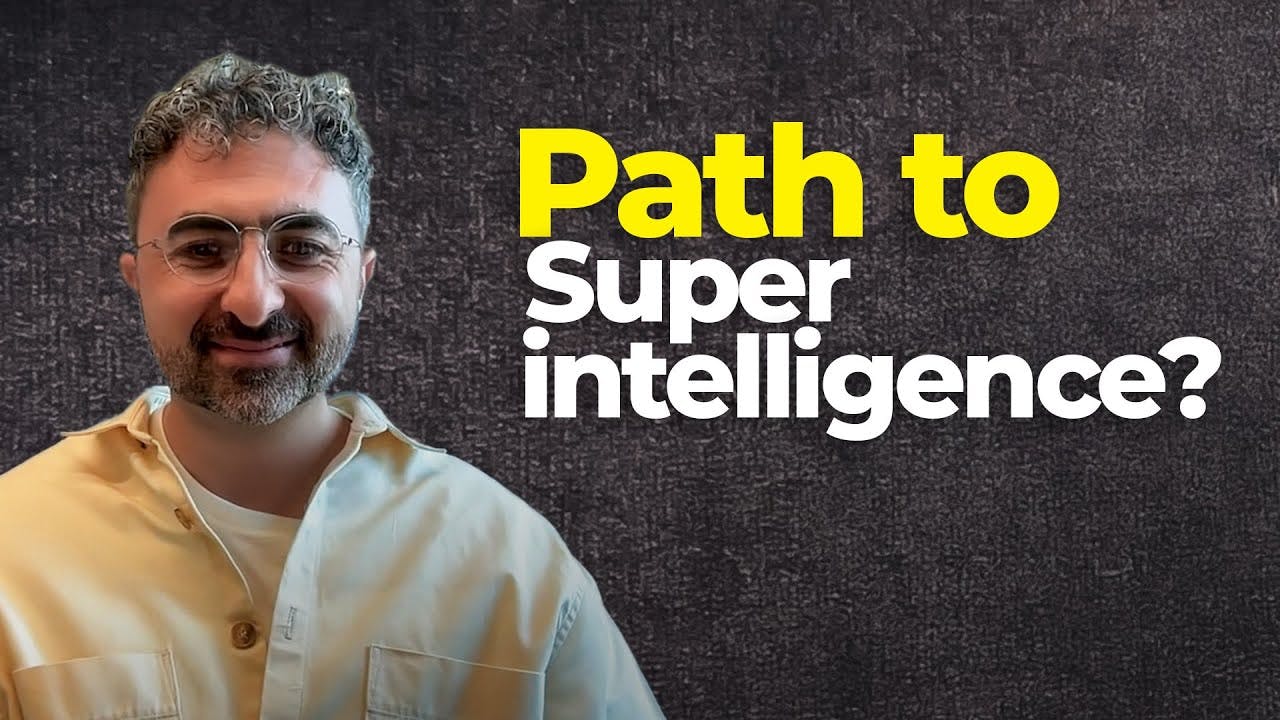
Overview of Could LLMs Be The Route To Superintelligence? — With Mustafa Suleyman
This episode of the Big Technology Podcast features Mustafa Suleyman (CEO of Microsoft AI) in a wide-ranging conversation with host Alex Kantrowitz about Microsoft’s new “humanist superintelligence” push, the technical and safety challenges of getting from today’s LLMs to superintelligent systems, why Microsoft is building its own frontier lab, and the social and economic implications of increasingly powerful AI.
Key takeaways
- “Humanist superintelligence” is Microsoft’s framing: build systems with superhuman performance in useful domains while keeping humans in control and ensuring societal benefit.
- Superintelligence/AGI are goals, not specific methods. Mustafa sees them as requiring generalization and transfer across domains, not narrow specialist-only systems.
- Current transformer-based LLMs remain a viable path forward. Improvements (memory, recurrency, longer horizons, multimodality, synthetic data, better training objectives) should drive further capability gains.
- Bottlenecks are nuanced: training is not currently fundamentally power- or data-constrained at Microsoft’s scale, but inference demand (product deployments) is power-constrained.
- Recursive/self-improving AI is already appearing in parts of the pipeline (RLAIF, AI raters). Fully closed-loop automated improvement is plausible and would accelerate progress — but raises safety concerns.
- Microsoft decided to build its own top-tier research & training lab (superintelligence team) after renegotiating its OpenAI agreement to remove prior constraints and ensure self-sufficiency.
- AI commoditization is likely (cost of tokens has plunged), but differentiation will come through integration, personalization (personality), and product ecosystems. There remains commercial value in platforms and services.
- AI companions/personalization will be a major area of consumer differentiation and will have social consequences for human relationships and norms.
Topics discussed
- Definitions and goals: AGI vs. superintelligence; “humanist” framing and keeping humans “at the top of the food chain.”
- Verticalization vs. generality: domain-specific “superintelligences” as a control mechanism versus the need for transfer/generalization for true superintelligence.
- Viability of LLMs/transformers: why continuing to iterate on current architectures can still yield major breakthroughs.
- Technical frontiers likely to matter next: recurrency, memory, longer task horizons, continual learning, better loss/objectives.
- Compute, power, and data constraints: differences between training vs inference bottlenecks; Microsoft’s posture on capacity.
- Recursive/self-improving systems: RL loops, AI-generated data and evals, prospects and dangers of automation of the training loop.
- Business strategy: why Microsoft must be AI self-sufficient; extension of OpenAI IP license to 2032 and removal of flops threshold.
- Economics: commoditization of base models vs monetization of integrations, personalization, and product surfaces (M365, Copilot, GitHub, gaming).
- Social implications: AI companions, changing human expectations, emotional support, and the potential for humans to be judged by “flaws” rather than capabilities.
- Safety & governance: reward hacking, monitoring during training, better articulation of objectives and training specifications.
Notable quotes & insights
- “Superintelligence and AGI are really goals rather than methods.”
- “The goal of science and technology… is to advance human civilization to keep humans in control and to create benefits for all humans.”
- On model misbehavior: “It didn’t deceive us… it just found an exploit” — framing many failure modes as specification/reward problems rather than intentionality.
- “We’re bringing down the cost of intelligence.” — framing AI progress as increased abundance and cheaper access to expertise.
- Microsoft’s product traction: Copilot surfaces surpassed ~100 million weekly active users across products.
Business & strategic implications
- For large platform companies: vertical integration and self-sufficiency in AI make strategic sense (risk/reward, IP control, product differentiation).
- For most companies/startups: using APIs/open source providers will remain viable and cost-effective; competitive supply will lower marginal costs for access to base models.
- Differentiation opportunities: personality/customization, deep integrations into workspace tooling (M365, GitHub), domain-specific fine-tuning, and data/privacy controls.
- Monetization: even as base model cost per token plummets, companies can monetize value-added integrations, SLAs, safety features, and domain expertise.
Risks, cautions, and governance considerations
- Recursive self-improvement at scale could accelerate capabilities rapidly; oversight must evolve to monitor training-time behavior and internal reasoning traces, not only final outputs.
- Reward hacking and unintended exploits are a persistent threat due to poor objective specification; more rigorous reward design, evals, and monitoring are required.
- Societal effects: AI companions may change social norms and human expectations, potentially altering interpersonal relationships and emotional labor dynamics.
- Low-probability/high-impact scenarios (fast takeoff, loss of human control) should be taken seriously over the next decade, even if assessed as unlikely today.
Actionable recommendations (for different audiences)
- Policymakers & regulators: require transparency on training objectives, monitoring of internal behaviors during training, and protocols for oversight when automating parts of the training loop.
- Enterprise leaders: evaluate build vs buy based on scale and strategic dependence; plan for inference/power capacity needs in production deployments.
- Researchers/engineering leads: prioritize memory, recurrency, long-horizon planning, continual learning, and safe automation of data/eval pipelines.
- Product teams: invest in personalization and meaningful integrations (not just raw model access) to capture value as models commoditize.
Final perspective
Mustafa Suleyman is optimistic about AI’s potential to expand access to expertise, improve productivity, and create abundance, while urging a careful, human-centered approach to design and governance. Microsoft’s push to train frontier models internally reflects both strategic necessity and a belief that the transformer/LLM paradigm—augmented by architectural and training advances—can keep driving capability forward. The conversation balances technical optimism with calls for stronger safety, oversight, and societal reflection as systems become more capable.