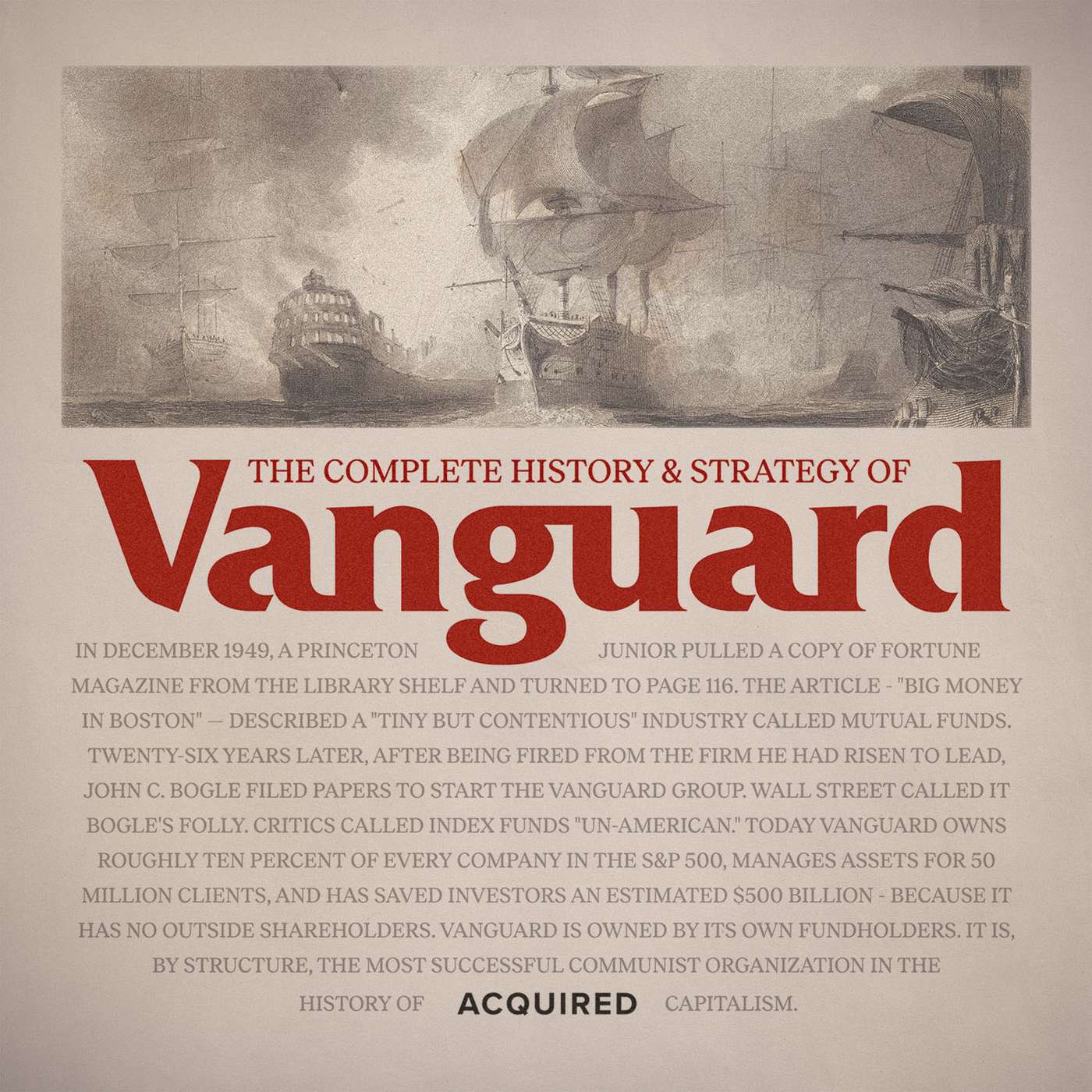
Overview of Vanguard
Ben Gilbert and David Rosenthal trace the rise of Vanguard from a struggling mutual-fund back office into the dominant force in low-cost investing. The episode centers on Jack Bogle, the fiercely principled founder who believed investors should keep more of their returns and that a fund company should exist solely to serve its customers. That belief led first to Vanguard’s unique mutual ownership structure and then to its most important innovation: the retail index fund, which helped transform investing for millions of Americans.
The episode also frames Vanguard as more than a company story: it is a case study in how structure shapes strategy, how costs compound over time, and how a single founder’s philosophy can reshape an entire industry.
The Core Story of Jack Bogle
Early life and formative scars
- Jack Bogle was born in May 1929, just months before the Great Depression.
- His family lost its wealth during the Depression, and his father abandoned the family.
- Jack and his brothers worked multiple jobs as children to support themselves and their mother.
- The experience left Jack intensely aware of:
- financial fragility,
- the importance of frugality,
- and the moral weight of stewardship.
Princeton, Wellington, and early ideas
- At Princeton, Bogle became fascinated by economics after discovering mutual funds through a Fortune article.
- His senior thesis argued that mutual funds would become a major industry and that lower fees were crucial to investor returns.
- He joined Wellington Management, rose through the ranks, and eventually became president of the firm.
Vanguard’s Founding and the Mutual Ownership Model
Why Vanguard was different
- During a crisis at Wellington in the 1970s, Bogle proposed a radical idea:
- the fund should own the management company,
- and the company should operate at cost for the benefit of fund holders.
- This became Vanguard’s defining structure:
- the investors own the firm
- there are no outside shareholders
- profits are effectively returned to customers through lower fees.
“Strategy follows structure”
- The episode emphasizes Bogle’s famous idea that once you design the ownership model, the business strategy largely follows.
- Vanguard’s structure made it almost inevitable that it would:
- cut fees,
- prioritize long-term returns,
- and resist profit-maximization for its own sake.
The Index Fund Revolution
How the first retail index fund happened
- In the 1970s, Bogle realized a simple truth:
- active managers collectively are the market,
- and after fees, most will underperform.
- Inspired by Paul Samuelson’s research, Bogle pushed for a fund that would simply track the market at minimal cost.
- In 1976, Vanguard launched the Vanguard 500 Index Fund, the first retail index fund.
Why it was such a breakthrough
- The fund was not originally a smash hit:
- it raised less capital than expected,
- it was awkwardly structured,
- and it faced skepticism from the industry.
- But over time, the logic won:
- lower fees compound into huge gains,
- and index investing beats most active managers over long horizons.
The math of cost
- The episode stresses that even a 1% annual fee can erase enormous wealth over decades.
- Bogle’s core insight was not “active managers can never win,” but rather:
- costs are guaranteed,
- and in the long run, lower costs are one of the few reliable advantages investors can control.
Vanguard’s Growth and Industry Impact
From niche idea to giant firm
- Vanguard grew slowly at first, but its model scaled beautifully once assets accumulated.
- Over time, it launched:
- money market funds,
- bond funds,
- advisory services,
- and eventually ETFs.
- Today, Vanguard manages roughly $12 trillion in assets, with the majority now in passive funds.
Industry-wide transformation
- Vanguard did not just win clients; it forced the entire industry to reduce fees.
- The episode credits Vanguard and Bogle with transferring hundreds of billions of dollars from Wall Street fees back to investors.
- Their presence made low-cost investing mainstream and helped reshape retirement investing, especially through:
- 401(k)s,
- brokerage platforms,
- and financial advisors.
The ETF Fight and Bogle’s Last Major Split
Jack Bogle’s resistance to ETFs
- When exchange-traded funds emerged, Bogle viewed them skeptically.
- He worried they would:
- encourage trading and speculation,
- introduce short-selling,
- and undermine the long-term mindset he thought investing required.
- Vanguard initially passed on ETFs, a decision the episode frames as one of Bogle’s biggest strategic mistakes.
The leadership transition
- After a heart transplant and retirement from CEO duties, Bogle eventually clashed with successor Jack Brennan and the new leadership.
- The company needed to modernize:
- launch new products,
- invest in technology,
- and respond to competitors like Fidelity and BlackRock.
- Bogle’s purity of mission helped build Vanguard, but it also made him resistant to necessary evolution.
Financial Crisis and the Triumph of the Vanguard Model
2008 as Vanguard’s vindication
- The financial crisis devastated active managers and Wall Street’s credibility.
- Vanguard’s passive funds fell with the market, but they did not fail structurally.
- Meanwhile, many active funds and hedge funds:
- underperformed,
- suffered redemptions,
- and lost investor trust.
- Warren Buffett’s famous endorsement of low-cost index funds is highlighted as a major validation.
Vanguard’s post-crisis acceleration
- After 2008, investor inflows into Vanguard surged.
- The company became the largest mutual fund manager in the world.
- Its model increasingly became the default for retirement savers and long-term investors.
Modern Vanguard, Competitors, and Open Questions
Fidelity and BlackRock
- Fidelity and BlackRock adapted and became powerful competitors:
- Fidelity leaned into brokerage, 401(k)s, and better customer service.
- BlackRock won big through ETFs, especially after acquiring iShares.
- Both firms show that Vanguard’s model does not eliminate competition; it changes where firms compete.
Current challenges
The episode raises a central question:
Does Vanguard’s customer-owned structure still help it, or does it now constrain it?
Concerns include:
- weaker technology and customer service than competitors,
- limited ability to invest in growth,
- competition from brokers who distribute Vanguard products but own the customer relationship,
- and the rising importance of ETFs, advisory services, and private markets.
Recent leadership and expansion
- Vanguard eventually brought in its first outside CEO, Salim Ramji.
- The firm is now exploring:
- advisory services,
- deeper technology investment,
- private markets,
- and new products that could better serve clients.
Key Takeaways
What Jack Bogle really believed
- Bogle was not simply anti-active management.
- He was pro-low-cost investing.
- His central belief: over long periods, cost matters more than almost anything else.
Why Vanguard mattered
- It proved that a firm could be organized to serve customers rather than shareholders.
- It gave ordinary investors access to the returns of capitalism without paying Wall Street a huge toll.
- It helped turn stock ownership into a mainstream part of American life.
The deeper lesson
- Vanguard is a rare example of a company where ownership structure created the business model, not the other way around.
- Bogle’s genius was not just investment insight, but institutional design.
Notable Quotes and Ideas
- “Strategy follows structure.”
- “Where returns are concerned, time is your friend; where costs are concerned, time is your enemy.”
- “The grim irony of investing is that we investors as a group not only don’t get what we pay for, we get precisely what we don’t pay for.”
- Warren Buffett’s endorsement of Bogle as someone who deserves a statue for helping American investors.
Final Legacy
The episode ultimately presents Jack Bogle as a rare kind of business founder: someone who changed an entire industry while refusing to enrich himself at the expense of customers. Vanguard is both a financial institution and a philosophy in action. Its story is about index funds, yes—but even more, it is about what happens when a company is built around the idea that the customer should be the owner.