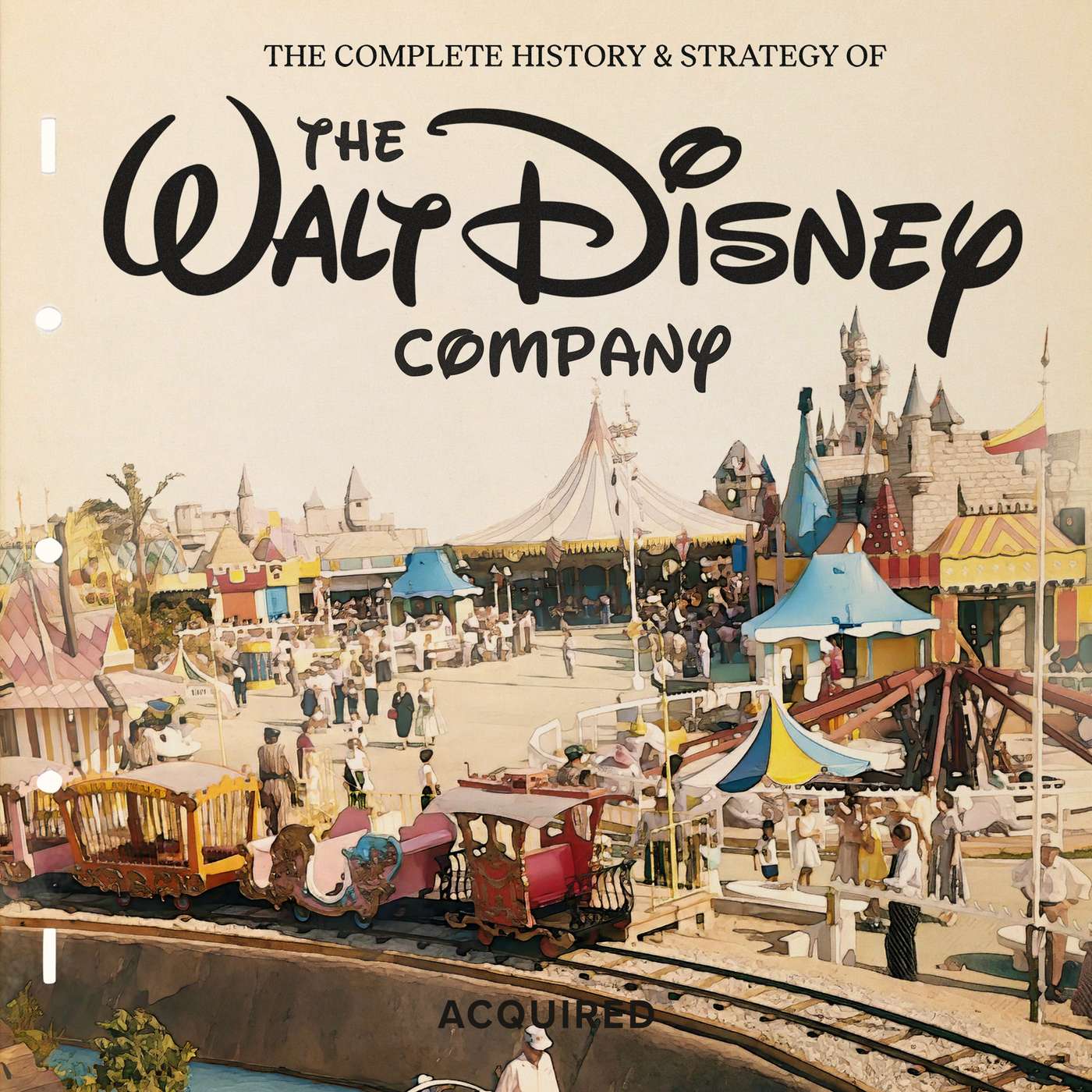
Overview of The Walt Disney Company
Ben Gilbert and David Rosenthal trace the early history of Disney from Walt’s childhood in the Midwest through the creation of Mickey Mouse, Snow White, Disneyland, and the company’s transformation into a unique intellectual-property machine. The episode focuses on the business history of Disney: how Walt and Roy Disney repeatedly bet the company on new technology, new distribution channels, and new forms of monetization—then built the first true IP flywheel in entertainment.
Main Takeaways
- Disney’s origin is a business and technology story, not just an artistic one.
- Animation, synchronized sound, the multiplane camera, and theme parks were all major technical bets.
- Walt Disney learned early that owning IP mattered.
- The Oswald the Lucky Rabbit debacle taught him that if you don’t own the character, you don’t own the business.
- Mickey Mouse became the foundation of a new business model.
- Disney combined film, merchandising, comic strips, clubs, re-releases, TV, and parks into a compounding system.
- Snow White proved that feature-length animation could be a legitimate blockbuster medium.
- It was a huge creative and commercial success, and it funded the next stage of the company.
- Disneyland turned the company into a much broader entertainment platform.
- The park, TV show, and merchandise together created a self-reinforcing ecosystem.
- Walt was both visionary and reckless.
- His willingness to “go for broke” produced breakthroughs, but also strikes, debt, and internal turmoil.
Walt Disney’s Early Life and First Lessons
Childhood and formative influences
- Born in Chicago in 1901, Walt spent meaningful early years in Marceline, Missouri, which became an emotional template for the idealized small-town America later reflected in Disney’s work.
- His father, Elias Disney, was repeatedly unsuccessful as an entrepreneur, while Walt’s uncle Robert Disney was more successful and financially stable.
- As a child, Walt received a drawing tablet from Aunt Maggie and discovered that his art could make money when a neighbor paid him for a horse drawing.
Early work and military service
- The family moved to Kansas City, where Walt sold drawings and worked on newspaper routes.
- He briefly attended high school in Chicago, then left to serve with the Red Cross in France during World War I, where he picked up the chain-smoking habit that would later contribute to his death.
- Returning to Kansas City, he worked in an advertising art shop and met Ub Iwerks, his crucial early creative partner.
The First Disney Companies: Failure, Learning, and Oswald
Laugh-O-Gram and the Kansas City years
- Walt and Ub launched Iwerks-Disney Commercial Artists, then pivoted into animation through local film and advertising work.
- Walt created “Laugh-O-Grams,” short animated cartoons that were locally successful but ultimately not sustainable as a business.
- Laugh-O-Gram Films went bankrupt in 1923.
Moving to Hollywood
- Walt followed advice from his uncle Robert to leave Kansas City and “skip town.”
- In Los Angeles, he initially tried to break into directing, even fake-pitching himself at Universal.
- He soon returned to animation and repurposed an old project, Alice’s Wonderland, which combined live action and animation.
The Alice comedies and the Disney Brothers Cartoon Studio
- Distributor Margaret Winkler liked Alice’s Wonderland and commissioned a series of follow-up shorts.
- Walt and Roy founded the Disney Brothers Cartoon Studio in 1923.
- This became the company’s first real business footing and established Roy as the finance/operations counterpart to Walt’s creative leadership.
Oswald and the ownership lesson
- Disney was hired to create a character for Universal that would be “like Felix the Cat, but not Felix.”
- The result was Oswald the Lucky Rabbit, a hit.
- But in 1928, distributor Charles Mintz stripped Disney of the animators and the IP.
- Walt and Roy learned a brutal lesson: if you don’t own the character, you don’t own the value.
Mickey Mouse and the Disney Flywheel
Birth of Mickey
- On the train ride back from New York after losing Oswald, Walt and Lillian Disney developed the idea for a new character.
- The first concept was Mortimer Mouse, but Lillian suggested Mickey.
- Ub Iwerks is likely the one who actually drew the early Mickey designs.
Steamboat Willie and synchronized sound
- Disney realized that sound could make animation feel like it had personality and timing.
- Steamboat Willie became the breakthrough:
- It was one of the first cartoons with synchronized sound
- It premiered in 1928 and became a sensation
- Disney learned that to stand out, he had to lead with a new technology, not just mimic existing competitors.
The birth of the flywheel
The episode argues that Disney effectively invented the modern IP flywheel:
- Create genuinely compelling core IP
- Distribute it as widely as possible in its primary form
- Extend it into ancillary formats
- Merch
- Comics
- Clubs
- Books
- Records
- Re-releases
- Re-release the core content over time
- Use TV and parks as additional amplifiers and monetization layers
Why Disney’s flywheel worked
- Animation is ideal for durable IP
- The characters don’t age
- They aren’t tied to one actor
- They can be endlessly reused
- Disney also kept the core content scarce and high quality, while expanding aggressively into ancillary channels.
- The company became unusually good at turning one successful character into a broad, long-lived commercial ecosystem.
Merchandising, Media, and the Disney Brand
Mickey Mouse Club
- A theater manager in California proposed a Mickey Mouse Club for kids.
- The idea spread nationally through theaters:
- Theaters bought a “club charter”
- Kids got access to Mickey-branded goods
- It became a massive success, with millions of members.
Comic strips and licensing
- Disney launched a daily Mickey comic strip through King Features Syndicate.
- The comic strip became both:
- A monetization stream
- Free daily marketing for Mickey and Disney
Kay Kamen and consumer products
- Walt hired Kay Kamen, who professionalized Disney licensing.
- Kamen turned Mickey merchandise into a serious global business.
- A key early hit was the Mickey Mouse watch from Ingersoll:
- Huge sales
- Helped save the watch company
- By the mid-1930s, merchandise income had become a major source of profit, often exceeding film-related revenue.
Snow White: The First Feature-Length Animated Film
Why it was such a big deal
- Snow White and the Seven Dwarfs was considered “Disney’s Folly” because no one believed audiences would sit through a full animated feature.
- Walt insisted on going all in:
- No compromise on money
- No compromise on talent
- No compromise on time
The production process
The episode gives a detailed breakdown of how Disney animation worked:
- Story department and story reels
- Sound and music synchronization
- Layout and staging
- Background painting
- Character model sheets and maquettes
- Frame-by-frame animation
- Inbetweening and cleanup
- Ink and paint
- Multiplane camera for depth and movement
Why Snow White mattered
- It cost about $1.5 million and took years to make.
- It became a massive success:
- Huge box office
- Special Oscar recognition
- Validation of animation as a serious art form
- It also created the template for Disney’s future:
- Big bet on a core work
- Then monetization via soundtrack, merch, re-releases, and more
The Disney Burbank Studio and the Strain of Scale
The new studio
- After Snow White, Walt built a large new campus in Burbank.
- The facility was designed around animation’s needs:
- North-facing windows for consistent light
- Art classes, cafeterias, recreation, and amenities
- A “utopian” campus atmosphere
But bigger ambitions meant bigger risks
- Walt wanted to produce multiple feature films per year.
- He greenlit ambitious projects like:
- Pinocchio
- Fantasia
- Bambi
- These were expensive, experimental, and in some cases lost money.
The strike
- Financial pressure led to wage cuts and layoffs.
- The 1941 animators’ strike was a major rupture:
- Picketers at the Burbank studio
- Walt gave an infamous, alienating speech
- The strike lasted months and permanently changed the company culture
- Walt became deeply anti-union and later testified as a friendly witness in anti-communist hearings.
World War II, The Vault, and the Rebuilding of the Business
War disruptions
- World War II devastated Disney’s core film business:
- European distribution collapsed
- Staff were drafted
- The studio was partly requisitioned by the military
- Disney pivoted into:
- Propaganda
- Training films
- Government work
- This kept the company alive but did not strengthen the IP flywheel.
The Disney vault
- With no home video or TV, Disney discovered that older films could be re-released profitably.
- Snow White’s 1944 re-release became a huge hit.
- This created the idea of the vault:
- Hold back the core product
- Re-release it years later to new generations
- That pattern became central to Disney’s long-term economics.
Cinderella and the postwar recovery
- Cinderella became the first major postwar success.
- It helped stabilize the company creatively and financially.
- But the broader industry had changed, and Disney’s animation dominance was no longer guaranteed.
Walt’s Midlife Obsessions: Trains and Disneyland
Retreat into trains and miniatures
- During the 1950s, Walt became obsessed with model trains and miniatures.
- He built an elaborate train in his backyard, the Carolwood Pacific.
- This hobby reflected his desire to create a perfect, controllable world.
Disneyland’s origins
- Walt’s train obsession evolved into the idea for Disneyland.
- It began as a small concept, then expanded rapidly.
- Key inspiration: a place where parents and children could enjoy themselves together.
Finding the site and financing it
- Walt’s team, including researchers from SRI, identified Anaheim as the ideal location.
- Walt had to create a separate company, WED Enterprises, to develop the park.
- Financing came from a complex structure involving:
- Walt Disney Productions
- ABC
- Western Publishing
- Walt personally
- Walt also negotiated a personal royalty stream tied to his name and likeness.
Television, Davy Crockett, and Disneyland’s Launch
Why TV mattered
- Walt saw television not as a threat, but as a way to go direct to the public.
- ABC needed Disney more than Disney needed ABC.
- The deal bundled:
- A TV show
- Funding for Disneyland
- Network promotion
- Future programming rights
The Disneyland TV show
- The weekly TV program became a major hit.
- It advertised the park and current Disney releases.
- It also helped establish the idea that Disney could control a broader entertainment universe.
Davy Crockett
- The Davy Crockett miniseries became a cultural phenomenon.
- It produced:
- Hit songs
- Massive merchandise sales
- Coonskin-cap mania
- This was a proof point that Disney TV content could drive enormous ancillary revenue.
Disneyland: The Park as Business Model
Opening day and public response
- Disneyland opened in 1955.
- The opening was chaotic:
- Crowds were larger than expected
- Attractions failed
- Food and water shortages occurred
- The heat and unfinished infrastructure made conditions rough
- Despite this, the TV broadcast and public reaction were enormous successes.
Why it worked
Disneyland was designed to be:
- Clean
- Safe
- Pleasant
- Immersive
- Highly controlled
Unlike traditional amusement parks, it kept guests inside longer and made them spend more. It wasn’t just a park—it was a brand environment.
Corporate sponsorships
- Disneyland was packed with corporate sponsors:
- Coke, Pepsi
- Bank of America
- Ford
- Monsanto
- TWA
- Santa Fe Railway
- Others
- This was another layer in Disney’s commercialization strategy.
Disneyland’s business impact
- It transformed Disney from a movie studio into a diversified entertainment platform.
- It also deepened the flywheel:
- TV promoted the park
- The park promoted the IP
- The IP sold merchandise
- The merchandise reinforced the characters
The Mature Disney Flywheel
By the late 1950s, Disney had built a powerful system with these elements:
- Core IP
- Animated films and characters
- Primary distribution
- Theatrical releases
- Ancillary monetization
- Merch
- Comics
- Records
- Licensing
- Re-release cadence
- The vault
- TV
- Repeated exposure and promotion
- Parks
- Experiential monetization and brand immersion
The episode argues that this is what made Disney uniquely durable and hard to copy.
The Beginning of the End of Walt’s Era
Signs of fatigue
- Walt became increasingly disengaged from animation.
- He developed new obsessions:
- Trains
- Miniatures
- Urban planning
- Future cities
- These interests led him to think bigger than Disneyland.
The Florida Project and EPCOT
- Walt envisioned a much larger future:
- A city of tomorrow
- A research and industrial hub
- A radical urban plan with monorails, tunnels, and a domed core
- This concept became the Florida Project and the original EPCOT vision.
Walt’s death
- Walt died in December 1966 from lung cancer, shortly after filming a pitch for EPCOT.
- His death marked the end of the founding era.
Ending State of the Company
Roy finishes the job
- Roy renamed the Florida project Walt Disney World.
- He completed the project in a far more conservative form than Walt would have wanted.
- Disney World opened in 1971.
The company becomes a parks business
- After Walt’s death, Disney increasingly became:
- A parks company
- A licensing company
- A stable entertainment platform
- Film and animation weakened relative to the parks and consumer products business.
By the early 1980s
- Disney animation had declined dramatically.
- The company was financially healthy but creatively exhausted.
- That opened the door to corporate raiders and the eventual 1984 turnaround under Michael Eisner, Frank Wells, and Jeffrey Katzenberg—teased as the subject of Part 2.
Notable Insights and Quotes
- “From now on the audience was going to know the Walt Disney name.”
- Walt learned after the Oswald/Mintz betrayal that branding had to be centered on him and Disney.
- “Our product is practically eternal.”
- Roy Disney on the power of the vault and re-releases.
- “If you sold any of it, you should have sold all of it.”
- Henry Ford’s warning to Walt after the Disneyland financing round.
- Walt’s philosophy: “Go for broke, shoot the works.”
- Captures his approach to Snow White, Disneyland, and much of Disney’s history.
What the Episode Sets Up for Part 2
- The rise of the conglomerate Disney after Walt’s death
- The 1984 takeover threat
- The revival led by Eisner, Wells, and Katzenberg
- The next phase of Disney as a modern media empire