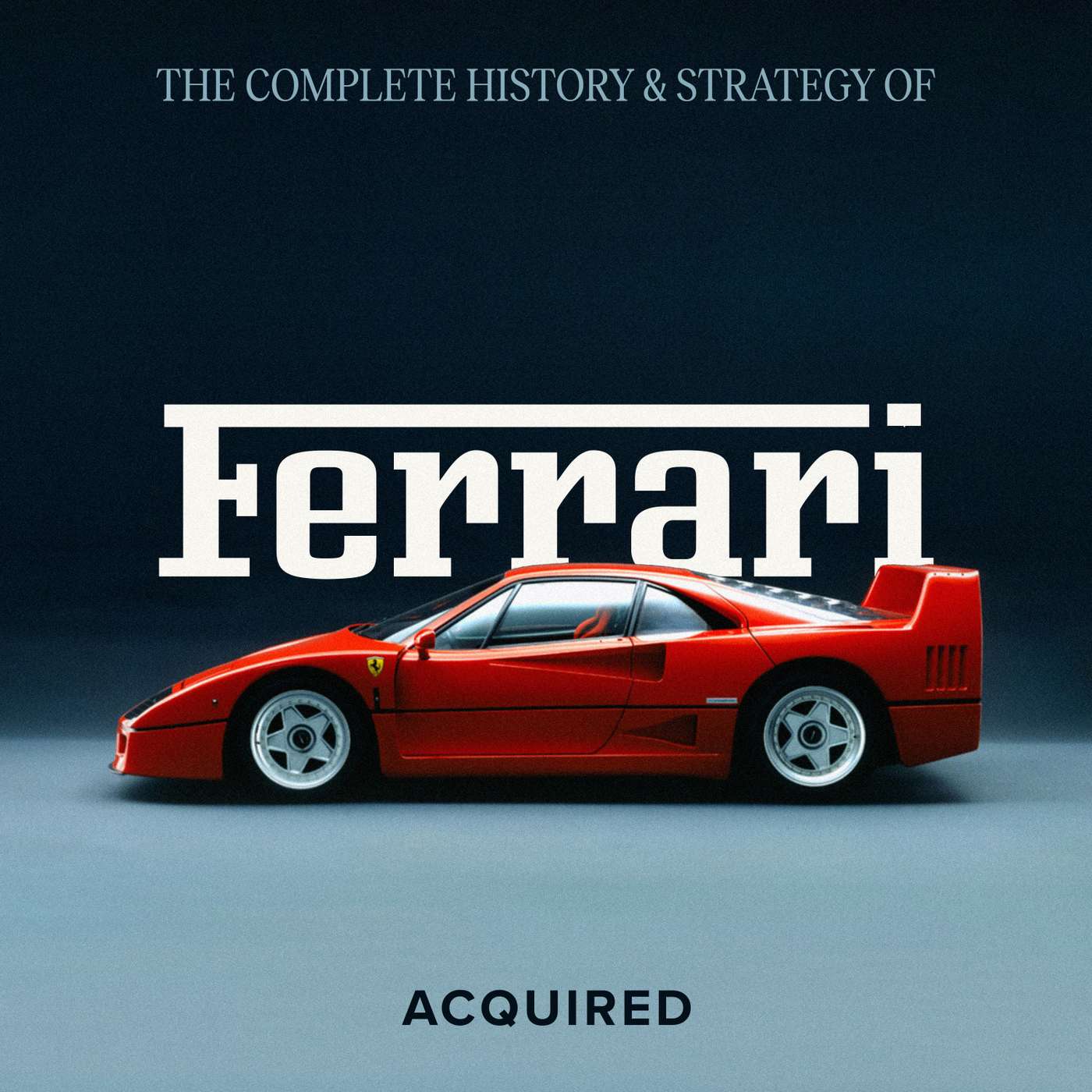
Overview of Ferrari (Acquired — Ben Gilbert & David Rosenthal)
This episode traces Ferrari’s history from Enzo Ferrari’s origins in Modena (1898) through the company’s creation as a unique fusion of racing team, car constructor, and bespoke services, to its modern incarnation as an ultra‑luxury, extremely high‑margin publicly traded company. Ben and David tell the story as equal parts opera and business case: death, design, myth-making, clever business mechanics, strategic deals (and fights), a near‑sale to Ford, a turnaround under Luca di Montezemolo, Fiat/Chrysler-era financial engineering under Sergio Marchionne, an IPO, then the modern challenge of electrification (the Luce) and global growth.
Key people & timeline (highlights)
- Enzo Ferrari (b.1898) — racing driver → Alfa Romeo stable manager → founded Scuderia Ferrari → Auto Avio Costruzione → first road cars in 1947–48. Built the brand, prancing horse crest (from WWI ace Francesco Baracca), Rosso Corsa identity.
- Luigi “Luigi Canetti” — brought Ferraris to the U.S.; early U.S. customers helped create demand.
- Pininfarina (Battista & Sergio) — coachbuilder partnership (61 years) that defined Ferrari styling.
- Major tragic milestones shaping Enzo and the brand: repeated driver deaths, death of Enzo’s son Dino (1956), 1957 Mille Miglia crash (many fatalities) — all reinforced the Ferrari mystique.
- Ford vs Ferrari (1963–66) — failed sale to Ford; Ford’s GT40 beat Ferrari at Le Mans 1966 (but the saga amplified Ferrari’s myth).
- Sale to Fiat (1969): Fiat bought 50%; agreement to transfer more on Enzo’s death; Piero Ferrari kept 10%.
- Luca di Montezemolo — Enzo’s protégé, took over F1 team in 1970s (revived success), returned as Ferrari chairman in 1990s to turnaround product, brand, and F1 dynasties (Schumacher era).
- Sergio Marchionne — led Fiat/Chrysler turnaround, engineered Ferrari IPO (2015) and related financial moves.
- Current CEO (as of recording): Benedetto Vigna — ex‑semiconductor/tech executive; spearheading electrification (Luce EV) and tech-forward moves.
The paradox & business model
- Extremely small volume, massive cultural reach:
- Ferrari produces ≈14,000 cars/year (roughly Toyota sells that many every 10 hours).
- Only ~180,000 owners globally (Ferrari says ~90k active owners + ~90k owners who haven't bought in 5 years).
- 80%+ of new car deliveries go to existing Ferrari owners (repeat customers); fewer than ~3,000 new Ferrari customers/year.
- Scarcity + spectacle = outsized brand value:
- Ferrari reaches enormous brand recognition while being extremely exclusive.
- The company deliberately limits volume to protect desirability — “we will always deliver one car less than market demand” (famous Enzo line/legend).
- Integrated model (unique historically):
- Racing team (Scuderia Ferrari / F1), constructor of race/road cars, and a full service/support ecosystem for private clients, all in Maranello.
- Many rivals are platform/parts integrators; Ferrari makes bespoke engines, casts, bodywork on-site (high vertical integration).
Product, design & manufacturing
- Product tiers today:
- Range cars (≈85% of units) — sports and GT models; typically $280k+ baseline.
- Special Series (~10%) — performance‑focused limited editions (analogue of “M/AMG” but bespoke Ferrari).
- Icona series (~small %; $2M+ each) — retro/tribute limited editions (e.g., Daytona SP3).
- Supercars / Halo cars (1–5% of units; e.g., F80) — extremely high ASPs ($3–5M), outsized profit contribution.
- Manufacturing & process:
- Highly vertical and bespoke: in‑house engine casting, body panels, leather, final assembly on one campus; flexible lines that can build different models (mostly handcrafting).
- Low volumes, high customization: many cars are unique one‑offs; production typically begins after a customer order.
- Ferrari Classiche certifies authenticity for historic cars (helps secondary market, restorations).
Brand, myth & go‑to market
- Brand foundations:
- Prancing Horse crest (gift from Countess of Francesco Baracca), yellow Modena shield, Rosso Corsa red — genius early marketing by Enzo.
- The company sells a dream and an emotional experience more than transportation.
- Dual nature:
- Exclusive luxury brand AND a mass‑media sports team (the Tifosi — hundreds of millions of fans). This combination creates both scarcity and huge global fandom.
- Client ecosystem:
- Events, track days, factory tours, personalized deliveries, one‑off commissions, ownership clubs — many layers of engagement (the “pyramid” idea: broad public fandom at base; rare halo models at top).
- Merchandising/licensing:
- Expanded lifestyle and licensed products; carefully tightened partnerships post‑IPO (Luxottica, Puma, Richard Mille, etc.). Licensing yields high margins but carries brand dilution risk (e.g., the Acer netbook anecdote).
Financials & economics (recent figures)
- 2025 figures (approx, as cited):
- Deliveries: 13,640 cars.
- Revenue: $8.2B.
- EBITDA: $3.2B (≈38.8% EBITDA margin).
- Average selling price (ASP): ≈$500,000 (up from $350k in 2022).
- Profit per car (average gross profit): ≈$170k per unit.
- Supercar economics:
- Example F80: 799 units × ~$4M ASP ≈ $3.2B retail; after dealer cuts, Ferrari still captures very large revenue — a single supercar model can represent ~15% of annual revenue and an outsized share of profits (estimates suggest supercars/Icona can represent 30%+ of annual profits in launch year).
- Valuation & ownership:
- IPO (2015): ~10% floated; initial market cap ≈$9.8B (raised nearly $1B).
- Market cap subsequently rose into the tens of billions (peaked near ~$90B), then softened; trading often reflects luxury multiples rather than auto multiples.
- Current (post‑IPO) ownership: public ≈68% of shares, Exor (Agnelli family) ≈20%+ and Piero Ferrari ≈10% — Exor + Piero control ≈49% voting power when acting together (retains effective influence).
- Margin contrast vs other automakers:
- Ferrari gross margin ≈50% (range varies by model).
- Typical large automakers: Ford ~7% gross margin, GM ~10%, Mercedes/BMW/VW mid‑teens; Porsche higher but still below Ferrari on average.
- Ferrari’s per‑unit gross profit is far above typical automakers.
Strategic moves & ownership history (short)
- 1963: attempted sale to Ford — collapsed; Ford’s Le Mans challenge ensued.
- 1969: partial sale to Fiat (50%); eventual Fiat control increased; Piero retained 10%.
- 1970s–80s: ups/downs; Enzo sells majority control to Fiat (Enzo retained racing authority initially).
- 1990s: Luca di Montezemolo returns; cuts production, revamps F1 and road cars (355, etc.), reestablishes luxury/service strategy.
- 2004–2014: Fiat turnaround under Sergio Marchionne; Fiat buys Chrysler; high debt load leads to Ferrari IPO in 2015 as financial maneuver to reduce group debt.
- 2015 IPO: 10% floated; Fiat (later FCA → Stellantis) monetized stake; Ferrari becomes an independent public company with Exor and Piero still influential.
- Post‑IPO: disciplined product diversification (range, special series, Icona, supercars), strict scarcity controls (e.g., Purosangue capped at 20% of volume), intensified licensing/lifestyle push.
Strategic analysis: Seven Powers (high level)
- Branding power — Very strong. Ferrari’s myth, history, and visual language (horse, red, Scuderia) are core durable assets.
- Network economies — Strong: global Tifosi, owner communities, events, track programs (social value).
- Scale economies — Unique “Goldilocks” scale: big enough to invest in F1, factories, and bespoke production; small enough to preserve exclusivity. This is a strategic sweet spot.
- Cornered resources — Yes: Enzo heritage, Maranello roots, continuous F1 operation since F1’s start, Pininfarina legacy, unique manufacturing know‑how.
- Switching costs — Low for purchasers (you can buy another brand), but psychological/social switching costs can be high for collectors.
- Counter‑positioning — Limited: Ferrari’s integrated racing+road model is rare, but rivals exist (McLaren, Porsche, Lamborghini) — none fully replicate Ferrari’s combination of myth, services, and scale.
- Process power — Present but not dominant: in‑house vertical manufacturing & customization are a differentiator, though not a classic process moat like Amazon logistics.
Risks, tensions & the near future
- Electrification (Luce): Ferrari’s first EV — the Luce (LoveFrom/Jony Ive collaboration).
- Bull case: reinvents Ferrari’s emotional & tactile experience in EV form; expands audience; Ferrari can create an EV that still delivers a unique driving thrill and high margins.
- Bear case: gasoline‑engine purists (collectors/Enzo devotees) may balk; China/EV markets may commoditize performance; customer job to be done (emotion/experience vs speed) is different with EVs.
- Dependence on ultra‑limited supercars and Icona for outsized profits — they drive margins but are episodic.
- Market exposure: China swings and EV tastes; brand licensing (over‑commercialization risks) vs the need to monetize the fan base.
- Public ownership dynamics: Wall Street expectations (predictable growth) can conflict with luxury scarcity strategy; IPO proceeds and financial engineering solved Fiat/Chrysler problems but created governance and pressure realities.
- Brand dilution: too many units / careless licensing could erode myth; Luca historically cut production to preserve brand.
Notable quotes & lines from the episode
- Enzo Ferrari: “I sell engines and the car I throw in for free.”
- (Attributed strategy) “Ferrari will always deliver one car less than the market demand.”
- Enzo about himself: “I am an agitator of men.”
- Henry Ford II, after the failed sale: “We will go to Le Mans and beat his ass.”
- Benedetto Vigna (CEO): “We don’t sell a car; we sell a dream.” (echoes Luca’s luxury framing)
Main takeaways
- Ferrari is a unique hybrid: a luxury brand, a sports team, and a bespoke engineering atelier all in one. That combination is the core of its defensibility.
- Scarcity + spectacle = huge margins. Ferrari’s economics rely on tight supply, high ASPs, and lucrative halo cars.
- The company’s value has been built over generations of myth, drama (including tragedy), and deliberate brand management (Enzo’s early marketing instincts were foundational).
- Effective stewardship matters: Luca di Montezemolo’s turnaround (team, technology, myth) and Sergio Marchionne’s financial engineering were both essential and at times in tension.
- The biggest current challenge is balancing brand preservation with growth and technological transition (EVs). The Luce EV is Ferrari’s most consequential product bet in decades.
- Ferrari’s model (limited volume, ultra‑high margins, deep services/support) is hard to imitate: it requires a rare combination of heritage, racing credibility, manufacturing setup, and fan infrastructure.
Further reading / media referenced
- Enzo Ferrari (biography) by Luca Del Monte — definitive Enzo biography (primary source for episode).
- Go Like Hell — book that inspired the movie Ford v Ferrari.
- Ford v Ferrari (2019) — dramatized film of the Ford vs. Ferrari Le Mans saga.
- Acquired episodes referenced: Porsche, Rolex, Hermes, LVMH, Formula One episode for context.
If you want an extremely concise elevator summary: Ferrari is not a car company in the conventional sense — it’s a highly engineered luxury ecosystem that monetizes a global dream built on racing legend, scarcity, and a vertically integrated artisan manufacturing model. The company’s profits depend less on units sold and more on brand, bespoke execution, and periodic hyped halo models — and its next major test is turning that magic into the EV era without losing the myth.