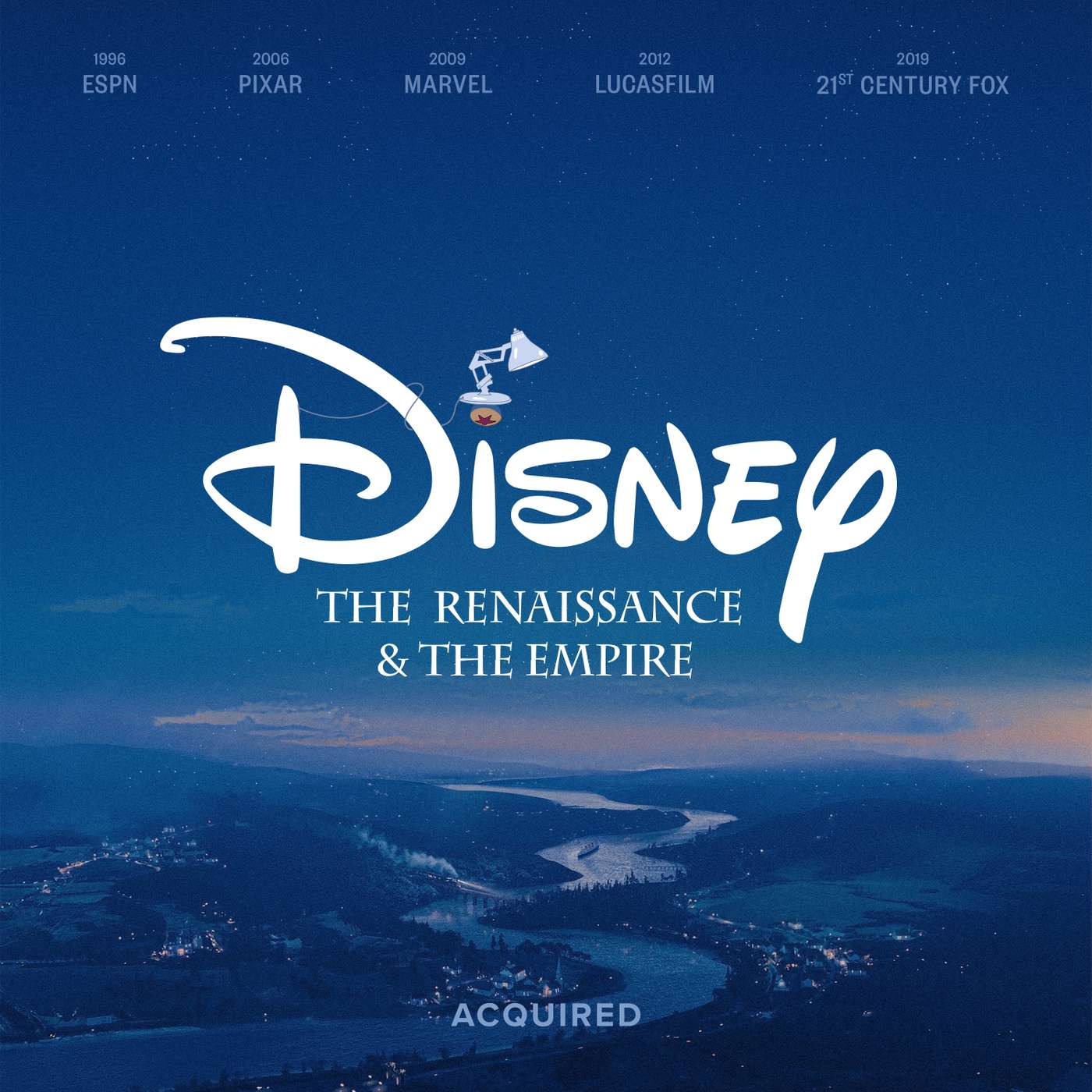
Overview of Disney: The Renaissance and the Empire
This episode traces how Disney went from a post-Walt crisis in the early 1980s to a peak-era media empire, then into today’s streaming transition. The story centers on three major transformations: the Disney Renaissance in animation, the acquisition-fueled expansion into cable and sports with ABC/ESPN, and the later pivot to streaming under Bob Iger. The main theme is that Disney’s best businesses have always been the ones that turn beloved characters and stories into enduring IP that can be reused across theaters, home video, parks, merchandise, TV, and now streaming.
From Near-Collapse to the Disney Renaissance
The company in crisis
By 1984, Disney was in rough shape:
- Animation had become nearly worthless as a business.
- Epcot was over budget and underwhelming.
- The company was vulnerable to corporate raiders.
- Internal family conflict was intense, with Roy E. Disney helping force out CEO Ron Miller.
- The film and TV business was basically break-even, while parks and consumer products carried the company.
Eisner, Wells, and Katzenberg arrive
Disney turned around by hiring an outsider dream team:
- Michael Eisner from Paramount
- Frank Wells from Warner Bros.
- Jeffrey Katzenberg from Paramount
Their early playbook included:
- Raising park prices
- Using park cash flow to fund more movies
- Applying a “high-concept,” “singles and doubles” movie strategy
- Moving animation aside at first while they modernized the rest of the studio
The real turnaround: animation becomes musical again
The episode argues that the heart of the Disney comeback was not the executives, but the creative team rebuilt around animation:
- Talent pipeline from CalArts and classroom A113
- Howard Ashman and Alan Menken turning Disney animation into stage-like musicals
- Films like:
- The Little Mermaid
- Beauty and the Beast
- Aladdin
- The Lion King
The key insight: Disney stopped making “cartoons with songs” and started making true Broadway-style musicals in animated form.
Technology helped too
Disney also modernized production with CAPS (Computer Animation Production System), which improved coloring and enabled more complex camera moves. Pixar helped with some of the underlying technology, including 3D-rendered elements in Disney films.
Disney’s Flywheel Gets Bigger
The classic Disney flywheel was:
- Create beloved characters and stories
- Monetize them in theaters
- Extend them into home video, merchandise, parks, and re-releases
- Reintroduce them to new generations
Under Eisner, that flywheel expanded dramatically.
Home video
Disney overcame internal resistance and began releasing classics like Pinocchio and Cinderella on VHS. This became a massive profit engine and transformed Disney into a home entertainment giant.
Disney retail stores
Disney opened hundreds of mall stores, turning its characters into a year-round consumer-products business.
Broadway
Disney entered Broadway with:
- Beauty and the Beast
- The Lion King
The Lion King became one of the highest-grossing entertainment properties ever created.
Parks became resorts
Eisner also reshaped the parks into full vacation resorts:
- Hotels
- Timeshares
- New lands and parks
- Destination-style packaging
This helped turn parks into one of Disney’s most reliable profit engines.
The ABC and ESPN Deal: Disney Becomes a Media Empire
The Capital Cities acquisition
Disney’s biggest structural change came when it bought Capital Cities/ABC in 1995. That deal brought in:
- ABC
- A broader TV business
- And most importantly: ESPN
ESPN became the hidden jewel
ESPN evolved into one of the most powerful businesses in media because it figured out how to extract value from cable bundles:
- Affiliate fees from cable operators
- Must-have sports rights
- High leverage over distributors
- Stable, recurring cash flow
The episode emphasizes that ESPN ended up being less about Disney’s original IP flywheel and more about a separate, highly profitable cable annuity business.
Why this mattered
ESPN gave Disney the cash to fund:
- Animation
- Parks expansion
- Resorts
- Later acquisitions
It also made Disney far more complex. The company was now a mix of two very different models:
- A creative IP flywheel
- A cable affiliate-fee machine
The Pixar Story and Bob Iger’s Disney
Pixar as Disney’s spiritual successor
The episode re-tells Pixar’s origin story as the true heir to Walt’s animation vision:
- John Lasseter was fired from Disney for pushing computer animation too early.
- Ed Catmull came from the world of academic computer graphics.
- Steve Jobs bought Pixar after it was spun out of Lucasfilm.
Pixar’s approach was radically different:
- Story first
- Heavy iteration
- Story reels before full animation
- Technology in service of storytelling
Disney and Pixar were competitors, then partners, then one company
Pixar’s first deal with Disney was initially unfavorable, but it worked because Toy Story was a huge success. Over time, the relationship deteriorated because Steve Jobs and Michael Eisner clashed over value, control, and creative quality.
Iger’s first great move: buy Pixar
When Bob Iger became CEO in 2005, he recognized that Disney animation had lost its soul and that Pixar had effectively become the center of excellence Disney needed. Disney bought Pixar in 2006.
That deal:
- Restored Disney animation
- Put Pixar leadership in charge of Disney animation culture
- Kept Pixar intact as a creative studio
- Helped revive the company’s core brand
The episode treats this as one of the greatest acquisitions in media history.
Marvel, Lucasfilm, and the Modern Franchise Machine
Iger then followed the Pixar playbook:
- Marvel in 2009
- Lucasfilm in 2012
The thesis was the same:
- Buy elite IP with room to grow
- Give it a bigger canvas
- Extend the franchise across films, parks, merchandise, and eventually streaming
This made Disney’s IP portfolio enormous, but also more dependent on a few mega-franchises.
Streaming, Disney+, and the Current Era
Disney goes direct-to-consumer
Disney launched Disney+, Hulu growth accelerated, and ESPN moved toward streaming as cable declined. The logic was:
- Disney needed control over distribution
- Streaming would preserve access to the IP library
- A direct relationship with consumers would support parks and merchandising
The tradeoff
The episode is skeptical that streaming was fully compatible with Disney’s classic model:
- Streaming needs a constant content treadmill
- Disney’s strength was scarcity and eventization
- The old model depended on theatrical windows, home video re-releases, and cable economics
ESPN remains crucial, but weaker
ESPN is still a giant cash generator, but the bundle is shrinking. Sports rights are also more expensive because tech companies can outbid legacy media.
Disney today
Disney is now a company where:
- Parks and cruises are the biggest profit center
- ESPN still generates major cash flow
- Streaming is profitable but not as lucrative as cable once was
- Theatrical revenue is a surprisingly small part of the whole business
Main Takeaways
- Disney’s power comes from exceptional IP that can be monetized repeatedly.
- The Disney Renaissance showed that story and music can revive a brand when the creative engine is healthy.
- ESPN was the secret financial engine that funded much of Disney’s expansion.
- Pixar saved Disney animation and re-established the company’s creative core.
- Streaming was necessary, but it is a worse business model than the old cable-plus-theatrical system.
- Disney today is still viable because its brands are durable and its parks remain powerful, but the easy growth era is over.
Bottom Line
The episode’s core argument is that Disney’s history is a series of reinventions driven by great IP, changing technology, and the ability to package stories into new business models. The company went from animation studio to theme park empire, to cable and sports giant, to streaming platform. Its future probably won’t look like the 1990s again—but Disney’s enduring characters, parks, and franchise power mean it remains one of the most important media companies in the world.