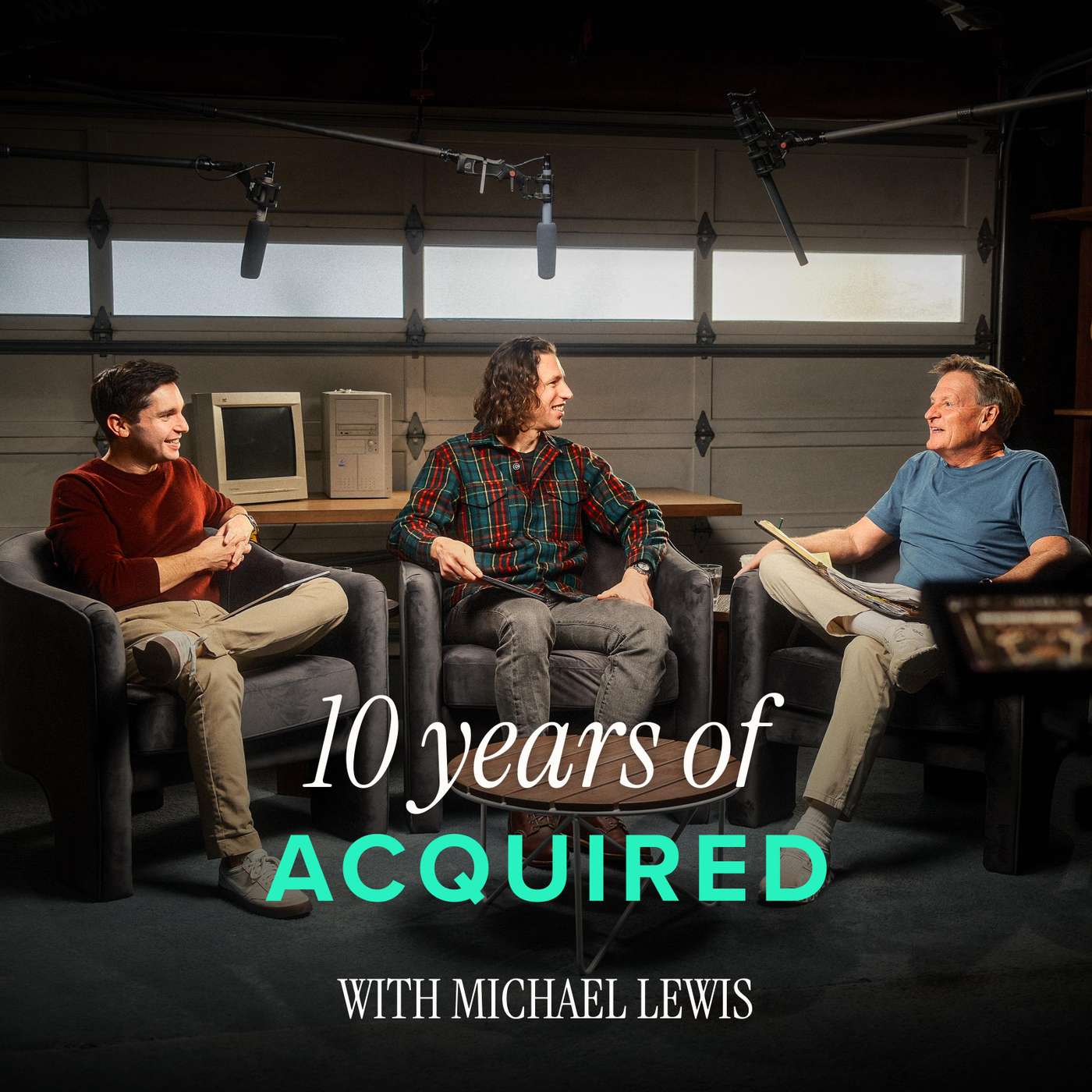
Overview of 10 Years of Acquired (with Michael Lewis)
This special 10-year anniversary episode of Acquired is a wide-ranging conversation recorded in the original Google garage. Hosts Ben Gilbert and David Rosenthal bring Michael Lewis (author of Moneyball, The Undoing Project, etc.) to reflect on why Acquired worked when most podcasts don’t. The discussion mixes origin stories, production process, editorial philosophy, business model, lessons learned from episodes, and concrete advice for creators and founders.
Episode context & logistics
- Hosts: Ben Gilbert and David Rosenthal. Guest: Michael Lewis.
- Venue: Google’s original garage (tied to Acquired’s season that covered Google).
- Format: long-form interview / meta-episode — analyzing Acquired itself: editorial choices, growth, commerce, research, and craft.
- Recurring production partner noted: audio editor (“Stephen”) who performs heavy editing; tools include Descript.
- Sponsors mentioned during the episode: JPMorgan Payments, WorkOS, Sentry, Shopify (examples of how Acquired structures sponsor relationships).
Main themes
- Why Acquired succeeded: product scarcity, handcrafted episodes, partnership chemistry, and durable subject selection.
- How the show evolved: from short, cautious episodes about acquisitions → IPOs → broader company histories and strategic narratives → very long, highly produced episodes.
- Process and craft: research discipline, separate prep docs to preserve surprise, improvisation during recording, heavy post-production.
- Business model: selective sponsors, direct selling (no agencies), events/spectacles, and even investing in sponsors.
- Long-term thinking: prioritizing durability, compounding reputation, and the “too-hard pile” (what to defer).
Key lessons / takeaways (condensed)
-
Scarcity & craftsmanship (inspired by NFL/Hermès)
- Fewer, rarer episodes that are highly produced creates an event quality and preserves listener trust.
- Scarcity enabled brand differentiation and higher perceived value.
-
Positive framing: study “what worked”
- Starting from “why did this succeed?” (not “why did it fail?”) yielded actionable playbooks and a constructive POV aligned with their VC background.
-
The “too‑hard pile” (Berkshire lesson)
- It’s OK to decline attractive but distracting opportunities (e.g., Hollywood, the Fed) and hold a large “too-hard” pile to protect scarce resources.
-
Durability and timelessness
- Pick subjects that will remain valuable years later; aim for episodes that are ~80% relevant five years out.
-
Partnership chemistry is the core product
- The magic “exists between” Ben and David; their dynamic (surprise, disagreement, emotion) is as valuable as the reporting.
-
Surprise & improvisation in performance
- Keep some research hidden from each other so recording contains genuine surprise and energy — add structure via a production meeting to preserve flow.
-
Research methodology evolution
- Start by reading everything; became much more interview-driven around 2023 (do the phone calls only after you’ve mastered public materials).
-
Production workflow & editing discipline
- Raw sessions are long (8–9 hours), edited down by an expert into a release candidate; hosts then perform multiple rounds of cuts. Heavy editing is a competitive advantage.
-
Commercial model: selective, strategic sponsorships
- They sell a low ad load, write custom host reads, avoid agencies, and choose B2B/sponsor partners that align with audience LTV. They sometimes invest in sponsors — full-circle alignment.
-
Live events / spectacle (NFL lesson applied)
- Occasional large, theatrical events (Chase Center, Radio City, NFL Innovation Summit) amplify brand and create cultural peaks beyond episode drops.
-
Founder control & long-term orientation
- Avoid chasing short-term monetization that dilutes brand. Treat content slots as scarce and high-leverage.
-
Narrow SKU (Costco metaphor)
- Few, high-quality offerings (few episodes, few sponsors, few ad slots) increases per-item value and operational focus.
How Acquired researches and produces an episode
- Phase 1: Read/compile canonical sources (books, articles, transcripts). Build a “spider web” of references.
- Phase 2: When comfortable with public material (50%+), start cold-calling knowledgeable insiders and on‑the‑record / background interviews — became central around 2023.
- Preparation: Separate documents per host to preserve surprise; one host focuses more on story, the other on analysis.
- Recording: Semi‑structured but intentionally unpredictable to capture spontaneity and emotion.
- Editing: Editor (Stephen) turns ~8–9 hrs into a release candidate; hosts do intense multiple passes (cutting, tightening, removing throat-clearing) using tools like Descript.
- Deadline discipline: Episodes are never “done,” but ship against deadlines and are refined via iterative cuts.
Business model & commercial strategy
- Direct-sold sponsorships; low ad-load; bespoke, host-read creative.
- Sponsor selection bias: enterprise/B2B products with high LTV, “Switzerland” neutrality in contentious debates.
- Events: VIP/paid events create outsized marketing and sponsor ROI; event participation often locked with sponsors.
- Investment fund: Acquired began investing in some sponsors (small-scale), aligning editorial, commercial, and capital incentives.
- Principle: Long-term brand durability > short-term revenue maximization.
Seven Powers framework applied to Acquired (summary)
- Scale economies: Big subscriber base amortizes high-cost episodes, producing outsized leverage.
- Counterpositioning: Their format (very long, handcrafted, low ad load, highly curated) competitors can’t easily replicate at scale.
- Branding: Strong Acquired brand increases per-episode impact (the same episode by another show would be less valuable).
- Cornered resource: Hosts, editor, and process make the offering unique and hard to copy.
- Process power: Deep, repeatable, and refined production pipeline is an advantage.
- Network effects: Weak but present (water‑cooler buzz within companies / industries).
- Switching costs: Low for listeners (easy to click elsewhere), so trust and quality matter tremendously.
Notable quotes & insights
- “What they’re buying into is not the subject, but your interest in the subject.”
- “It’s okay to have a giant too‑hard pile.”
- “We are constantly terrified every time we make an episode.”
- “Do less, do deeper — make every episode handcrafted.”
- “Language is a lossy compression of thought” — explaining challenges in transferring process/skill.
Episodes, series and topics highlighted (worth listening)
- Google series (recorded in the garage)
- Berkshire Hathaway (3‑part)
- Costco (deep operational mechanics)
- LVMH / Hermes / Rolex (luxury scarcity playbook)
- NFL episode (scarcity and spectacle)
- TSMC / Morris Chang (supply-chain & semiconductor history)
- NVIDIA (research + Jensen interview)
- Trader Joe’s, IKEA, Microsoft, Nintendo, IPL (Indian Premier League)
- Renaissance Technologies (quant legend episode)
- ACQ2 interviews (Andrew Ross Sorkin, etc.)
Actionable recommendations for podcasters / creators
- Choose scarcity intentionally: fewer, better, handcrafted works better than lots of mediocre content.
- Build a unique duo/chemistry — the interaction between hosts can be the core product.
- Preserve surprise between hosts; prepare separately and plan structure, not verbatim script.
- Do deep research: read canonical materials, then call experts once you’re well-prepared.
- Invest in an exceptional editor and heavy post-production — this is a durable competitive advantage.
- Pick sponsors strategically (alignment, LTV), and consider events as a growth and branding lever.
- Protect your long-term brand: don’t chase short-term revenue opportunities that dilute your identity.
Final note
The conversation is both practical and philosophical: Acquired’s decade-long success is explained as a combination of editorial discipline, a durable thesis about how to tell business stories, an unusually strong host partnership, painstaking craftsmanship in production, and a selective commercial strategy built for the long run. For creators, the episode is a case study in how constraints, scarcity, and mastery of craft can create a compounding cultural and commercial asset.