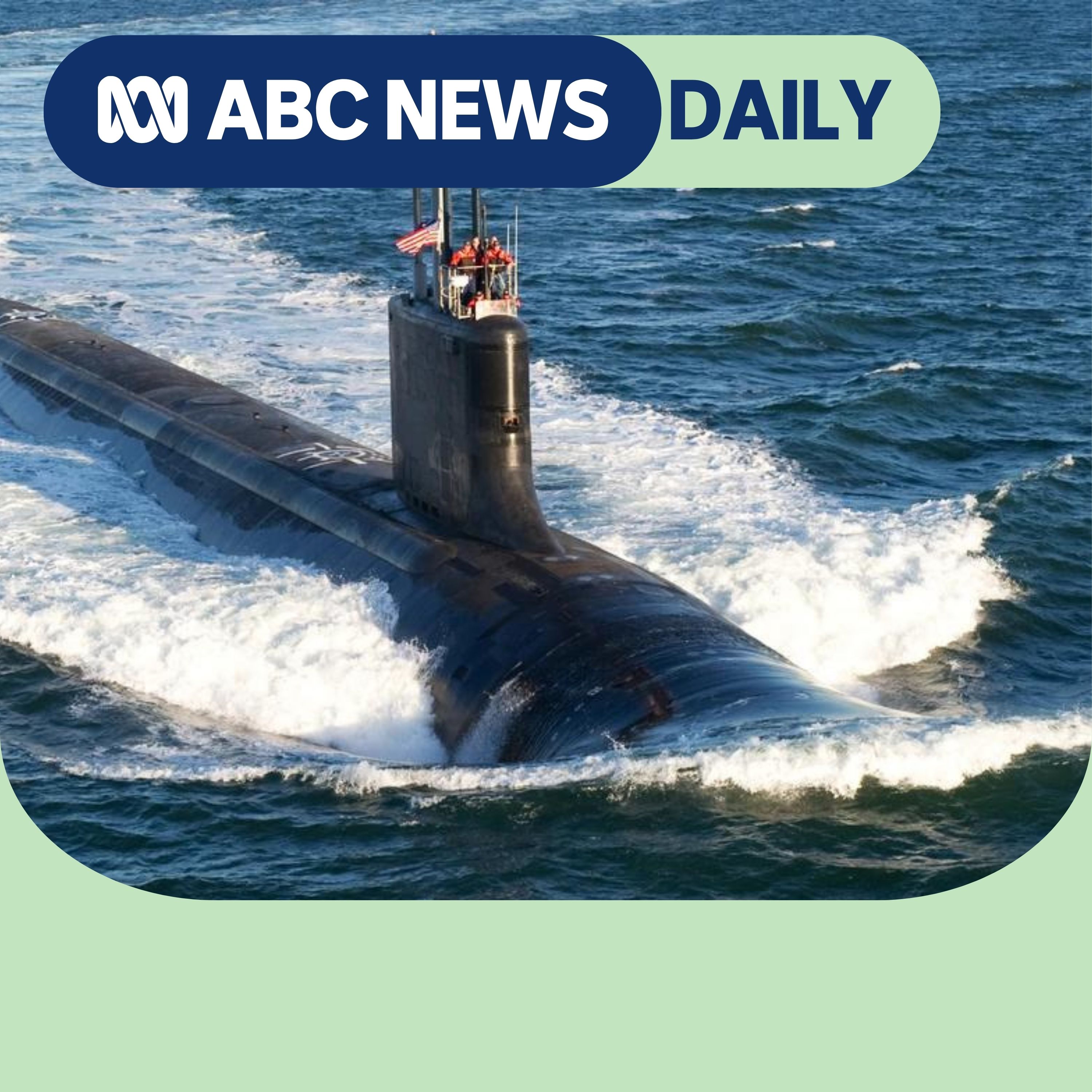
Overview of Why AUKUS delivers second-hand subs
This ABC News Daily episode examines Australia’s AUKUS submarine deal, why it remains controversial, and why the government has now shifted to receiving used U.S. Virginia-class submarines rather than a mix of new and second-hand boats. Host Sam Hawley speaks with Sam Roggeveen of the Lowy Institute about the deal’s origins, its rising cost and political scrutiny, and whether Australia should be building a backup plan in case the submarines arrive too late or not at all.
What the episode is about
The conversation centers on the future of Australia’s nuclear submarine strategy under AUKUS and the growing concern that the project may be too expensive, too slow, and too dependent on U.S. industrial capacity.
Main topics covered
- The cancellation of the French conventional submarine deal
- The strategic rationale — or lack of a clear one — behind choosing AUKUS
- Why Australia is now set to receive second-hand submarines from the U.S.
- Political scrutiny from both the left and right
- Whether Australia needs a Plan B for a potential capability gap
- What the submarines are actually intended to do in a conflict scenario
Key takeaways
1. AUKUS began with the abrupt cancellation of the French submarine deal
Roggeveen recaps that in 2021 Australia ditched the French-built diesel-electric attack-class submarine project in favor of U.S. nuclear-powered submarines, triggering a major diplomatic rift with France.
- The French deal was reportedly worth around $90 billion
- Australia was later estimated to have lost about $3.4 billion in cancellation costs
- Roggeveen argues no Australian government has yet given a fully convincing strategic explanation for the switch
2. The AUKUS program is extremely expensive and still uncertain
The total price tag discussed is up to $368 billion over decades.
Australia’s expected submarine package includes:
- Eight nuclear-powered submarines
- The first three to five from the United States
- The remaining three to five as the planned SSN-AUKUS class, to be designed mainly in the UK and built partly in Adelaide
Roggeveen notes that the SSN-AUKUS is still only a paper design, with real design and construction only just beginning.
3. The shift to second-hand U.S. submarines reflects production problems
The government has now changed the plan so that all three early U.S. submarines will be used boats, rather than two used submarines plus one new one.
According to Roggeveen:
- This simplifies the fleet by avoiding multiple Virginia-class variants
- The cost savings are likely modest
- The real driver is probably that the U.S. is struggling to meet its own submarine production targets
He suggests Washington is prioritizing newer submarines for itself while passing older ones to Australia.
4. Criticism is growing across the political spectrum
The episode highlights a widening base of concern:
- Peter Garrett has crowdfunded an inquiry into the AUKUS deal
- Labor voices and union figures have raised doubts
- Even some on the political right are becoming uneasy
- Opposition defence spokesman James Paterson has suggested Australia should consider other military capabilities in case of delay
- Former Liberal Treasurer Joe Hockey has said he is “a little nervous” about whether the Virginia-class subs can be delivered on time
Roggeveen says more scrutiny is welcome, especially because parliamentary scrutiny has been limited.
5. Australia should have a Plan B
Roggeveen argues that Australia should not think only about submarines, but about the capabilities submarines provide.
If there is a delay or gap, he suggests Australia can invest in:
- Aircraft capable of launching anti-ship missiles
- Surface ships as anti-ship platforms
- Undersea drones and related technologies
His view:
- A submarine gap would not be ideal
- But it would not be “the end of the world”
- Australia should build a broader, more flexible military network
6. The strategic logic should be more defensive
Roggeveen says AUKUS appears aimed at enabling Australia to operate alongside the U.S. far from home, including near China’s coast. He argues that this is the wrong approach.
His preferred logic:
- Australia should focus on defence closer to home
- The country’s geography is an advantage
- Rather than trying to “compress” the distance to China, Australia should use that distance strategically
Notable insights
- Roggeveen questions whether AUKUS has ever had a fully coherent public strategic case.
- He suggests the U.S. is getting a very good deal commercially, because Australian money is flowing into American shipyards and defence industry.
- He argues that political support for AUKUS may persist partly because of Australia’s long-standing fear of alienating the United States.
- The switch to used submarines is presented less as a triumph of simplicity than as evidence that U.S. production is under strain.
Bottom line
The episode presents AUKUS as a massive, uncertain, and politically fraught defence project that is increasingly running into practical limits. While the government frames the move to second-hand submarines as a simplification, Roggeveen suggests it more likely reflects U.S. production bottlenecks and growing pressure on the deal’s credibility. His broader message is that Australia should prepare alternatives, invest in complementary capabilities, and rethink whether AUKUS matches its long-term defensive needs.