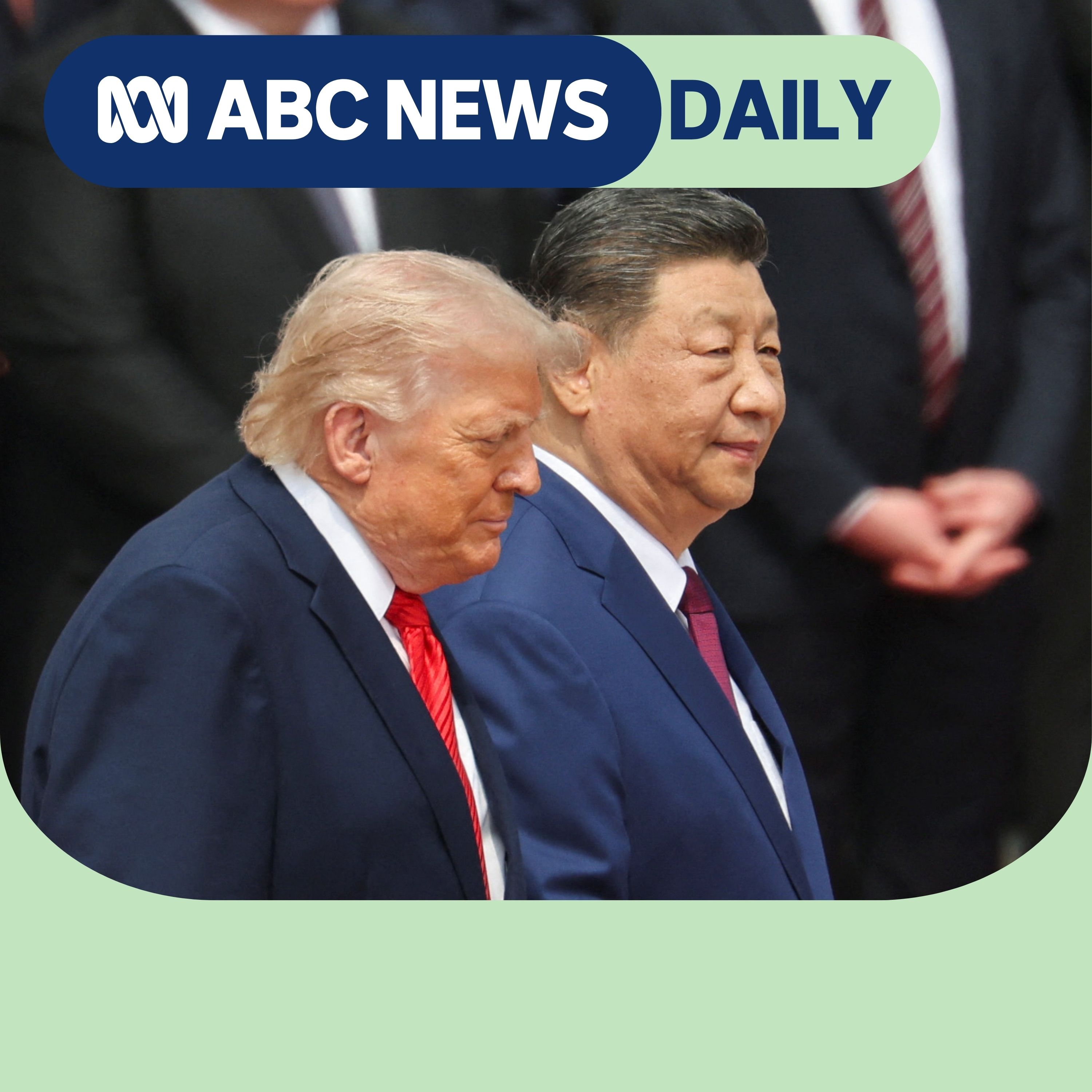
Overview of What Trump’s China trip reveals about the AI race
This episode examines how Donald Trump’s visit to Beijing highlighted the shifting balance in the U.S.-China AI race. Although AI chips were expected to be a major topic, the issue barely surfaced publicly. The discussion with China tech expert Selena Hsu explores why China is becoming less dependent on American chips like NVIDIA’s, how that changes Beijing’s strategy, and why rapidly advancing AI models are forcing both countries to think more seriously about regulation and security.
Main Takeaways
- AI was the “elephant in the room” during Trump’s Beijing visit, even though Jensen Huang of NVIDIA, Tim Cook, and Elon Musk were all present.
- NVIDIA’s China chip sales remain uncertain, despite Trump reversing some Biden-era export limits and allowing sales of the H200 chip.
- China’s domestic chip industry has made major gains, reducing reliance on U.S. hardware and weakening NVIDIA’s dominance in China.
- AI safety is becoming a bigger issue in the U.S., especially as more powerful models show cyberattack potential and other high-risk capabilities.
- The U.S. and China are pursuing different AI strategies: the U.S. is focused on frontier models and AGI, while China is emphasizing broad adoption and industrial use.
U.S.-China Chip Competition
NVIDIA’s fading leverage in China
- NVIDIA chips are central to AI development, which is why Jensen Huang’s trip mattered.
- However, despite U.S. policy loosening, China has not rushed to buy the H200 chips.
- One major reason: Chinese firms have stepped in to fill the gap, especially Huawei.
- According to the discussion, NVIDIA’s share of China’s advanced AI chip market has fallen sharply, from near-total dominance to much lower levels.
Why China is holding back
- China’s leadership increasingly wants technological self-reliance.
- The country appears more confident in its ability to build domestic alternatives than it was a few years ago.
- That shift means U.S. export controls may be less effective than Washington hoped.
AI Safety and Security Risks
Why the new models worry policymakers
- The episode highlights a powerful new model from Anthropic, described as capable of advanced coding, cyber defense, and even sustained cyberattack-style behavior.
- Because of that potential misuse, the company reportedly restricted public access while companies test defenses.
Worst-case scenarios discussed
- The guest warns that highly capable AI could be used by:
- lone hackers,
- terrorist groups,
- or even small states
- The concerns extend beyond cyberattacks to critical infrastructure, power grids, banks, pathogens, and even accidental nuclear escalation.
The regulatory shift in the U.S.
- The Trump administration initially favored a light-touch, pro-innovation approach.
- But new model capabilities are pushing officials toward more serious safety measures, including:
- voluntary pre-deployment testing,
- stronger oversight,
- and possibly formal government protocols.
China’s AI Strategy
Different priorities from Silicon Valley
- China is not focused on AGI in the same way as U.S. labs.
- Chinese policymakers are more concerned with:
- labor disruption,
- child safety,
- AI companions,
- and regime stability.
“AI plus” over frontier dominance
- China’s approach is described as embedding AI across industries, not necessarily racing first to superintelligence.
- Its models are often:
- open source, which accelerates adoption,
- and compute-efficient, because Chinese firms have fewer chips.
- That may make China slower on frontier breakthroughs, but better at scaling AI across the economy.
Who Is Ahead?
Current estimate
- Selena Hsu says the U.S. is about six to eight months ahead in frontier AI capabilities.
Bigger picture
- The U.S. has the edge in:
- advanced chips,
- capital,
- and large-scale AGI ambitions.
- China may lag in raw model power, but it could win on:
- deployment speed,
- cost efficiency,
- and real-world adoption.
Bottom Line
The episode’s central argument is that the U.S. and China are not running the same race anymore.
- The U.S. is pushing toward AGI and superintelligence.
- China is focused on practical integration, domestic independence, and industrial deployment.
That divergence matters because the AI competition is no longer just about who has the smartest model — it’s also about chips, cybersecurity, regulation, and how quickly AI can be made useful, safe, and widespread.