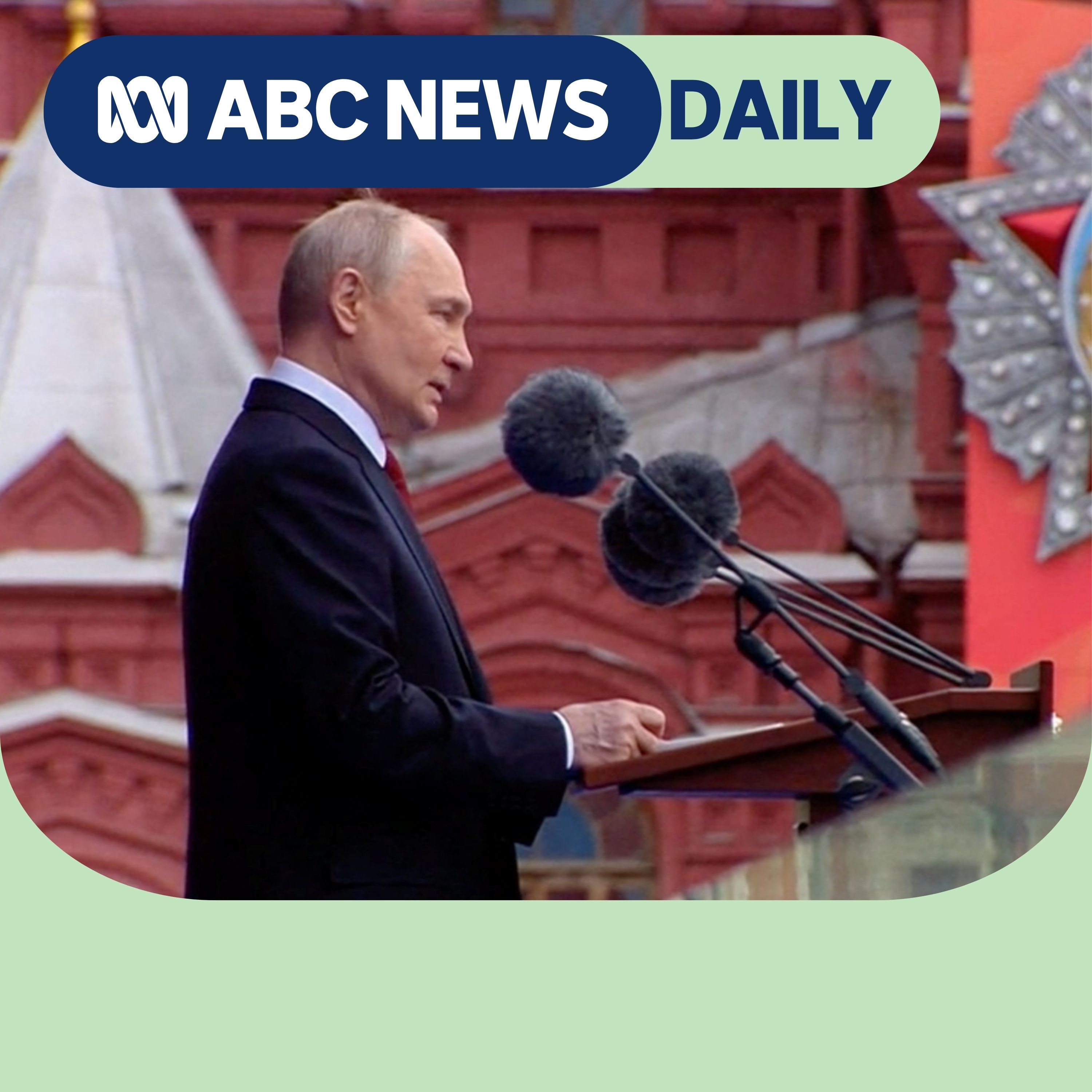
Overview of Is Putin right to be paranoid?
This episode of ABC News Daily examines whether Vladimir Putin’s growing security fears are justified, using Russia’s scaled-back Victory Day parade in Moscow as the backdrop. Russia expert Matt Sussex argues that Ukraine’s ability to strike deep inside Russian territory, Russia’s worsening economic and military strain, and the political fragility around Putin all point to a leader whose power is showing real signs of wear.
Key Takeaways
- Putin scaled back Victory Day celebrations because Russia could not guarantee the security of a large parade in Red Square.
- Ukraine’s long-range drone and missile capabilities have increased pressure on Russian infrastructure, especially oil facilities.
- Putin appears more isolated and cautious, with reports suggesting a shrinking inner circle and heightened fear of assassination or coup plots.
- The war is hurting Russia badly: economically, militarily, and politically.
- No coup seems imminent, but Sussex says this feels like “the beginning of the end” for Putin’s rule.
- Donald Trump is no longer seen as a decisive factor, and Ukraine/Europe increasingly do not take him seriously as a mediator.
Victory Day Parade: A Symbol of Weakness
What changed this year
In a normal year, Victory Day in Red Square is a huge display of Russian military power, featuring:
- troops and tanks
- missile systems
- military hardware on display
- foreign leaders in attendance
This year, however, the parade was heavily reduced:
- it lasted only 45 minutes
- there were no tanks or mobile military columns
- few foreign leaders attended
- parliament members were reportedly barred
- instead of a full parade, Russia showed videos of military technology
Why it was scaled back
Sussex says Russia’s concern was that Ukraine could use drones or missiles to disrupt the event. The key issue is that:
- Ukraine has deep-strike capability
- Russian air defenses are not reliable enough
- Putin could not be sure the parade site was safe
The result was a public sign that Russia’s capital is not as secure as it wants to appear.
Putin’s Paranoia and Political Isolation
Signs of growing fear
According to Sussex, reports from European intelligence leaks and wider observations suggest Putin is:
- keeping a lower profile
- visiting fewer official residences
- allowing fewer people near him
- narrowing the circle around him
The concern is that he fears:
- a Ukrainian drone strike
- an assassination attempt
- a coup
Is he actually being paranoid?
Sussex is careful not to overstate it. He suggests this is less about an imminent overthrow and more about a general “vibe shift”:
- the war is going badly
- Putin’s usual image of control is fraying
- his “Teflon-coated” rule is showing wear
Why regime security matters
In Russia, Sussex argues, the key issue is not just national stability but Putin’s personal security. His safety and the security of the regime are effectively one and the same.
Could There Be a Coup?
Sussex says probably not yet.
Why Sergei Shoigu is unlikely to lead one
The transcript mentions leaked claims that former defense minister Sergei Shoigu might be a potential coup figure, but Sussex rejects that as implausible because Shoigu:
- no longer controls the defense ministry
- lacks support from the armed forces
- does not control the key levers of power
What a successful coup would require
In Russia, a coup would need control of:
- the guns
- the jails
- the information
Sussex says Shoigu has none of these.
The Prigozhin warning
He points to Yevgeny Prigozhin’s Wagner mutiny as a previous sign of weakness. The fact that Wagner got close to Moscow without a strong defensive response showed how vulnerable Putin could be under pressure.
Trump, Ukraine, and the Changing Balance
Trump’s influence has faded
The episode argues that Donald Trump is no longer in a position to shape the war meaningfully. Sussex says Trump spent too much early political capital trying to pressure Ukraine into making concessions based on a false assumption that Russia was winning.
Why that no longer works
Now:
- Ukraine has more leverage
- Europe is not buying Trump’s framing
- Ukrainians view Trump and his negotiators as effectively pro-Russian
- Trump no longer has credible pressure points
The Cost to Russia
Economic strain
Sussex describes Russia’s economy as increasingly troubled:
- inflation is high
- interest rates are around 23%
- consumer spending is weak
- the economy shows signs of stagflation
Military losses
The human cost is also enormous. Sussex estimates:
- about 1.4 million casualties
- at least 400,000 dead
He says this amounts to the destruction of “the next generation” of Russians.
Public Support for Putin
Sussex cautions that polling in Russia is not a reliable measure of genuine approval because:
- people may fear consequences for speaking honestly
- the state can punish dissent through job loss, jail, or conscription of family members
So while Putin may still appear popular on paper, Sussex suggests that support is at least partly a product of fear and coercion.
Bottom Line
The episode’s central argument is that Putin has reasons to be paranoid. Ukraine is increasingly able to hit inside Russia, the war is draining Russian resources, and Putin’s aura of control is weakening. While a coup does not seem imminent, Sussex believes the Kremlin leader is entering the beginning of the end of his rule.
“I definitely think it’s the beginning of the end for Putin.”
He adds that, given the system Putin has built, the only way he ultimately leaves the Kremlin may be “in a box.”