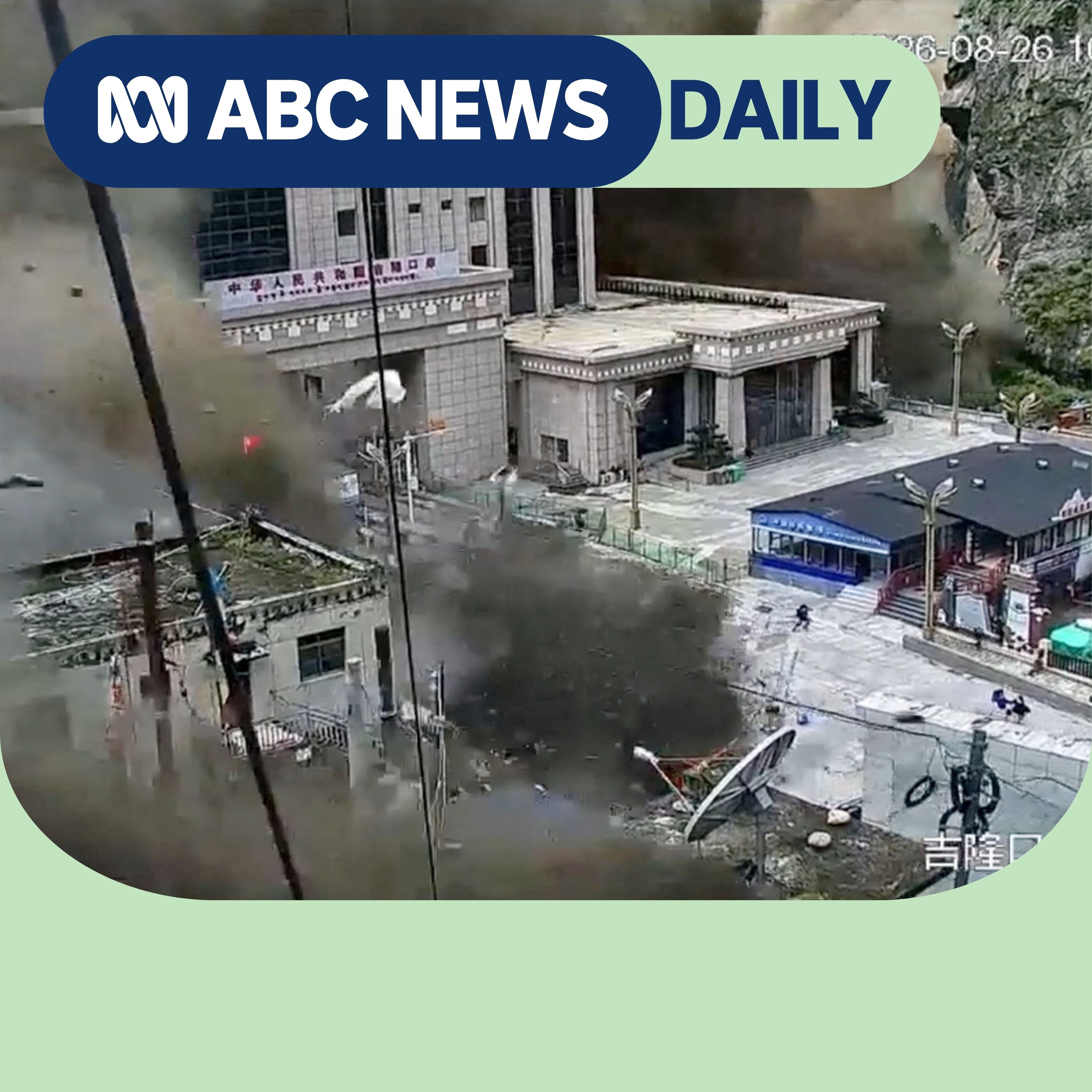
Overview of ABC News Daily — “An avalanche survivor on the melting Himalayas”
This episode follows mountaineer and climate scientist Dr John All as he reflects on the deadly flooding and glacier collapse in Nepal and Tibet, where hundreds have died and thousands remain missing. Drawing on his own near-fatal avalanche and crevasse accident while researching in the Himalayas, All explains how warming temperatures and pollution are accelerating glacier melt, making the region more dangerous for both local communities and climbers.
Key Takeaways
-
The recent Himalayan disaster is part of a worsening pattern
- A flash flood near the Nepal–Tibet border swept away infrastructure and people, with the death toll climbing above 950 and more than 4,000 people unaccounted for.
- Rescue efforts are extremely difficult, and officials warn another deluge could strike.
-
Dr John All says the event was surprising, but not inexplicable
- He expected catastrophic glacier failures at higher altitudes.
- Instead, the collapse occurred in a lower, 5,000-meter area where glaciers are already rapidly disappearing.
-
He has personal ties to the area
- All has worked with Sherpa brothers and local mountain partners for decades, and one of them was at the border station destroyed in the flood.
- He believes the human toll could ultimately reach into the thousands.
-
He survived a terrifying research accident in 2014
- While conducting glacier research, he fell into a crevasse and broke 15 bones, including six vertebrae, and dislocated his arm.
- Despite that, he returned to the Himalayas in 2019 to keep collecting climate data.
What Dr John All’s Research Shows
Why he collects ice, snow, and vegetation samples
- He studies both:
- High-altitude vegetation to track long-term climate and environmental change.
- Snow and ice samples to detect what pollution and particles are being deposited on glaciers.
What the snow reveals
- Snow acts like a collector, trapping airborne material over time.
- His team has found:
- Heavy metals
- Arsenic
- Lead
- In the Himalayas, especially black carbon from:
- forest and agricultural fires
- fossil-fuel combustion
Why black carbon matters
- Black carbon darkens ice and increases heat absorption.
- All says glaciers near polluted areas can melt about twice as fast as cleaner ones.
Why the Flooding Was So Destructive
- The glacier collapse created a massive cascade of ice, water, and debris that dropped more than 1,000 meters.
- That descent converted potential energy into heat, instantly turning ice into water and amplifying the flood.
- The narrow valley in Nepal made the disaster even worse:
- water was funneled and accelerated
- people had little or no escape route
- the terrain magnified the force of the flood
Can the Melting Be Stopped?
Short answer: not really
- All says the decline cannot be stopped while fossil fuel use continues.
- The focus now must be on adaptation, not just prevention.
What adaptation looks like
- Nepal is beginning to recognize the danger of building in flood plains.
- Historically, people lived higher up the slopes and went down only for farming.
- Tourism and development have moved hotels, restaurants, and infrastructure closer to rivers—right where disasters are most likely.
- The government is reportedly considering:
- restoring flood boundaries
- restricting development in high-risk zones
Future Risks and Outlook
- All says 5,000-meter glaciers may disappear within 10–20 years.
- The next concern is how long 6,000-meter and 7,000-meter glaciers can survive.
- Because the Himalayas are a mid-latitude region receiving significant pollution deposition, glacier instability is likely to worsen.
Final Message
The episode uses Dr John All’s experience to show that the Himalayan disaster is not just a tragic one-off—it is a warning about climate change, pollution, and unsafe development in vulnerable mountain regions. His core message is that while the melting cannot be reversed quickly, better data, smarter planning, and relocation away from flood-prone areas can save lives.