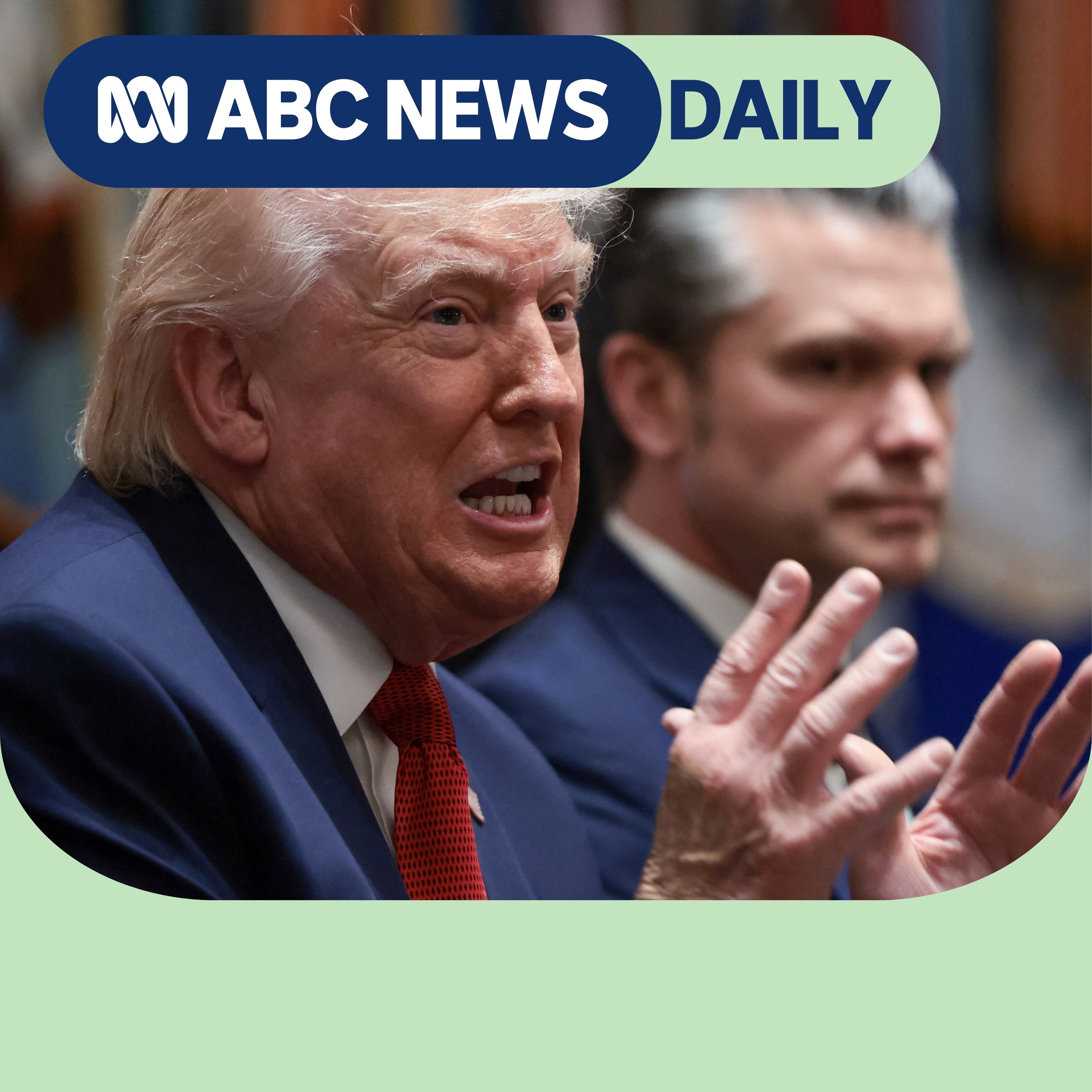
Overview of ABC News Daily — "Will Trump escalate or end the war?"
This episode of ABC News Daily (host Sam Hawley) features Kelly Greco, a defence and strategy expert at the Stimson Center, discussing the strategic choices facing US President Donald Trump after recent strikes and blockade activity around the Strait of Hormuz. The conversation focuses on two broad paths available to the US administration: trying to negotiate an end and "declare victory," or escalating the conflict (including limited ground operations) to reopen the strait and regain leverage.
Guests and context
- Host: Sam Hawley (ABC News Daily)
- Guest: Kelly Greco, Senior Fellow, Stimson Center (Washington, D.C.)
- Produced by Sydney Pead; audio production Sam Dunn.
- Central issue: US policy options after Iran effectively closed or restricted passage through the Strait of Hormuz and the broader military/diplomatic fallout.
Key takeaways
- The administration appears divided: public messaging vacillates between claiming success/“regime change” and threatening further military escalation.
- Walking away now would likely leave the US with a strategic loss: closed or toll-claimed strait, angry Gulf partners, and limited lasting gains.
- Escalation (troop deployments, naval buildup, possible ground operations) is feasible but risky, costly, and unlikely to be decisive quickly.
- Any ground operation would face significant logistical, air/missile, and casualty risks; it could lengthen the conflict substantially.
- Diplomacy via intermediaries (China, Russia) is plausible; Iranian responses so far suggest nuance — no public formal talks, but they engaged with counter-proposals to the US 15-point plan.
Topics discussed
- US claims of regime change in Iran and the credibility of those claims.
- The significance of the Strait of Hormuz: its closure, economic impacts, and the difficulty of military reopening.
- US troop movements: marine expeditionary units, elements of the 82nd Airborne, and the limits of those forces for a major invasion.
- Possible ground objectives: seizing strategic islands (transcript refers to "Karg Island" — likely meaning strategic islands in/near the Strait of Hormuz such as Qeshm/Abu Musa), smaller strait islands, or targeted special operations to secure buried nuclear material.
- Allied reactions (UK, Australia) and Trump's public criticism that allies should "fight for themselves."
- Longer-term strategic consequences for freedom of navigation and global trade.
Military options and practical challenges
Naval and island seizures
- Reopening the Strait of Hormuz by force is technically possible but would be long, costly, and expose forces to mines, fast-attack craft, missiles, and drones.
- Seizing an island (the transcript’s "Karg Island"/other strategic islands) could aim to disrupt Iranian oil exports but would face intense air/missile threats given proximity (~25 km) to the Iranian mainland.
- Logistics, resupply, and casualty risk are major constraints.
Special operations and deeper strikes
- Limited special-operations missions to recover nuclear material are highly complex: material has reportedly been dispersed/buried, and extraction would take time and be risky.
- Large-scale invasion of Iran is not supported by the deployed force levels discussed; current deployments are modest relative to invasion requirements.
Diplomatic and strategic implications
- If the US declares the conflict over without reopening the strait, it risks a strategic loss similar to aspects of Iraq/Afghanistan: tactical wins without strategic stability.
- A closed or effectively tolled Hormuz undermines freedom of navigation and creates long-term economic costs (higher fuel prices, rerouting, insurance/tolls).
- US credibility with Gulf partners could be damaged if Washington withdraws after urging them to act — a messaging inconsistency noted by Greco.
- Russia may receive indirect relief from US distraction; China and Russia could play roles as intermediaries pushing Tehran toward a deal.
Notable quotes
- “There are no good military options for reopening the strait.” — Kelly Greco
- Trump messaging sampled in the episode: “We’ll be leaving very soon… finishing the job,” juxtaposed with threats to “obliterate” (the transcript’s reference to a strategic island).
- Greco: “If the United States walks away, it’s a strategic loss.”
Indicators to watch (what will tell you which path is being taken)
- Whether formal or semi-formal negotiations proceed (direct or via intermediaries such as China/Russia).
- Changes in troop numbers and the arrival of heavier logistics or sustained deployments (indicates possible escalation commitment).
- Allied commitments: naval escorts through Hormuz, monetary/operational contributions.
- Iranian public statements vs. private offers — whether Tehran moves from intermediated counter-proposals to formal talks.
- Incidents at sea (mine-laying, attacks on commercial ships) and insurance/market reactions (spikes in oil/insurance premiums).
Expert judgement (Greco's view)
- Greco believes the administration would take a negotiated deal if one is available — but Tehran must be willing. If not, the US faces two unappealing options: declare the conflict over (and accept strategic costs) or escalate militarily, which risks a longer, more dangerous war.
Bottom line
The episode frames the US choice as binary but grim: accept a strategically costly withdrawal that leaves the Hormuz problem unresolved, or escalate into a risky ground-and-sea campaign that is likely costly, dangerous, and could prolong the conflict. Diplomacy (largely indirect) remains the least costly path, but whether Tehran will accept terms that satisfy US objectives is unclear.