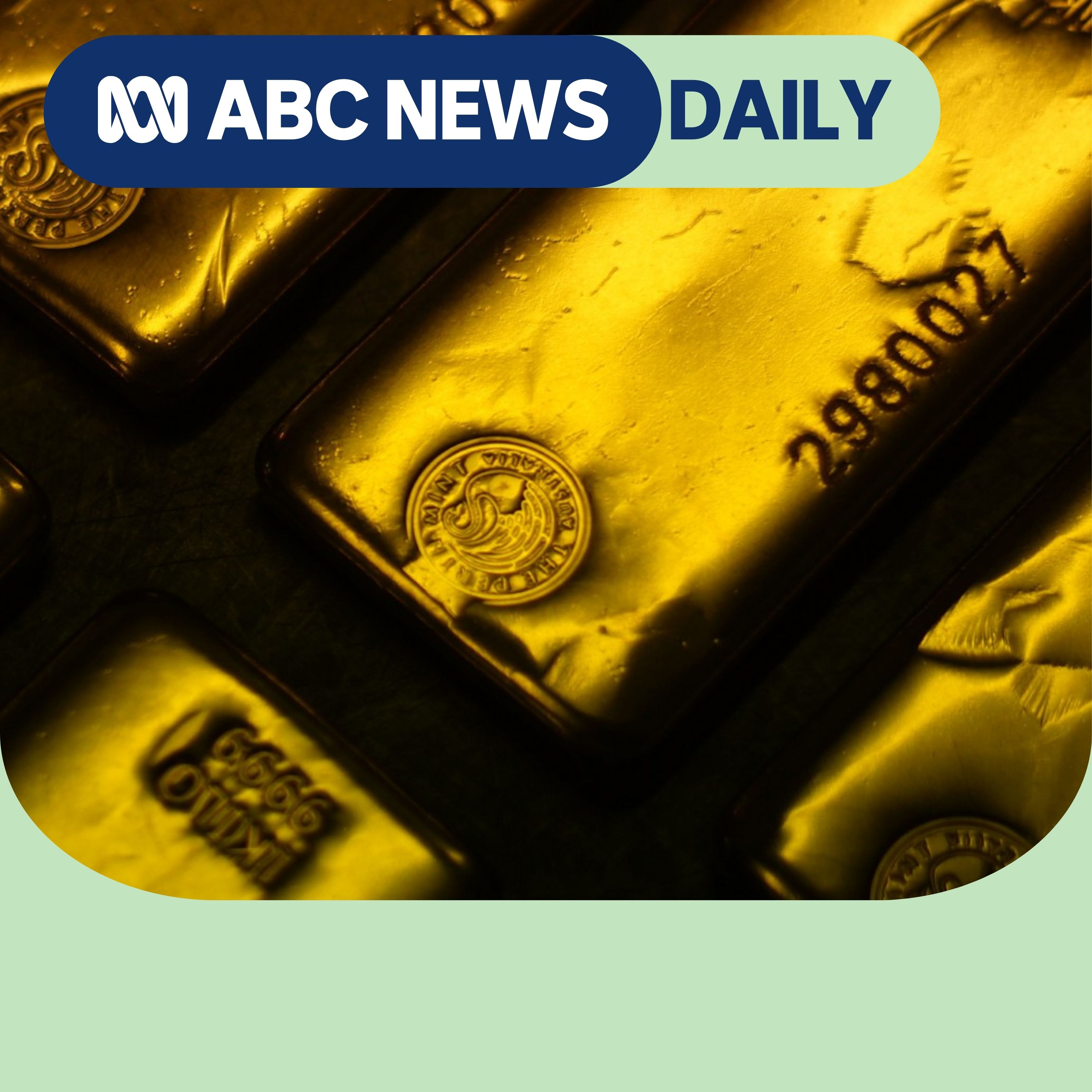
Overview of Why the gold price has gone crazy
This ABC News Daily segment (host Sam Hawley; business correspondent David Taylor) explains the dramatic rise—and recent fall—in gold and silver prices. It covers who's buying, how and where people transact in Australia, the political and economic triggers behind the surge (notably actions and rhetoric from Donald Trump), the subsequent correction tied to US monetary policy signals, and what to watch next. The piece emphasizes speculation via trading apps, central-bank buying, geopolitics, and high market volatility going forward.
Key takeaways
- Gold surged roughly 80% over the prior year in US dollar terms, reaching record highs (past US$5,000/oz and peaking ~US$5,600/oz in January 2026).
- Triggers for the run-up: US tariff announcements in 2025, geopolitical shocks, heavy central-bank purchases, and large retail/speculative buying via trading apps.
- The rally was punctured when markets priced in a hawkish new US Fed pick (Kevin Walsh), pushing the US dollar up and gold down about 20% from its peak—its largest fall since the early 1980s.
- Silver experienced even bigger moves than gold because it had proportionally more speculative retail buying.
- Expect continued high volatility across metals, currencies, bonds and equities; forecasters disagree widely (some predict gold to US$6,000/oz, others to US$2,500/oz).
Who is buying and how
- Retail customers queued at bullion dealers (e.g., ABC Bullion in Martin Place, Sydney) to buy physical gold and silver; purchases can be for bullion bars, coins, jewelry.
- Buyers are diverse: from wealthier customers buying gold to others buying silver as an accessible store of value.
- Transactions can be in-person with vault storage options, or increasingly via smartphone trading apps enabling instant speculative purchases.
- Dealers offer secure vaulting so buyers need not carry large bars home.
Timeline and key drivers
- April 2025: Trump announces reciprocal tariffs, triggering market turbulence and a fall in confidence in the US dollar; initial lift for gold.
- Mid–late 2025: Central banks (including China, Japan and some others) increase gold purchases, supporting higher prices.
- Late 2025 – Jan 2026: Continued record-breaking prices as retail speculation and geopolitical headlines pile up.
- Davos episode (early 2026): Another wave of market fear after aggressive US rhetoric (including about Greenland), pushing gold toward its peak (~US$5,600/oz).
- Early 2026 correction: Announcement that Kevin Walsh was likely to replace Jerome Powell (perceived hawk) caused the US dollar to strengthen and gold/silver to fall sharply (gold ≈20% drop; silver steeper).
Markets dynamics explained (concise)
- Inverse USD relationship: Gold often rises when the US dollar weakens; it tends to fall when the dollar and/or real yields rise.
- Central-bank demand: Official sector buying reduces available supply and supports prices.
- Retail/speculative demand: Easy app-based access amplified momentum, producing a speculative “bubble” effect—particularly for silver.
- Policy cues (Fed appointments, inflation outlook) and geopolitics produce fast, large moves.
Risks and what to watch next
- Monetary policy signals: Fed appointments, rate-hike expectations, and real yields are primary near-term drivers.
- US political events and trade policy statements (any major Trump announcements) can quickly shift risk sentiment and currency moves.
- Central-bank buying or selling of gold.
- Continued retail/speculative flows from trading apps.
- Watch currency moves (USD/AUD) and bond yields as leading indicators for precious metals.
Practical notes / investor cautions
- Physical bullion can be bought in person or online and is often stored in dealer vaults rather than carried home.
- High volatility: sharp gains can be followed by steep drops (e.g., ~20% correction in gold, larger in silver).
- The segment does not provide financial advice—buyers should be aware of market risk and the speculative component of recent moves.
Notable quotes
- Trump (as quoted in the segment): “April 2nd, 2025 will forever be remembered as the day that we began to make America wealthy again.”
- On Greenland (quote indicative of market shock): “You can say yes and we will be very appreciative or you can say no and we will remember.”
Credits
- Reporter: David Taylor (ABC business correspondent)
- Host: Sam Hawley
- Production: Produced by Sydney Pead; audio production by Sam Dunn; supervising producer David Cody.