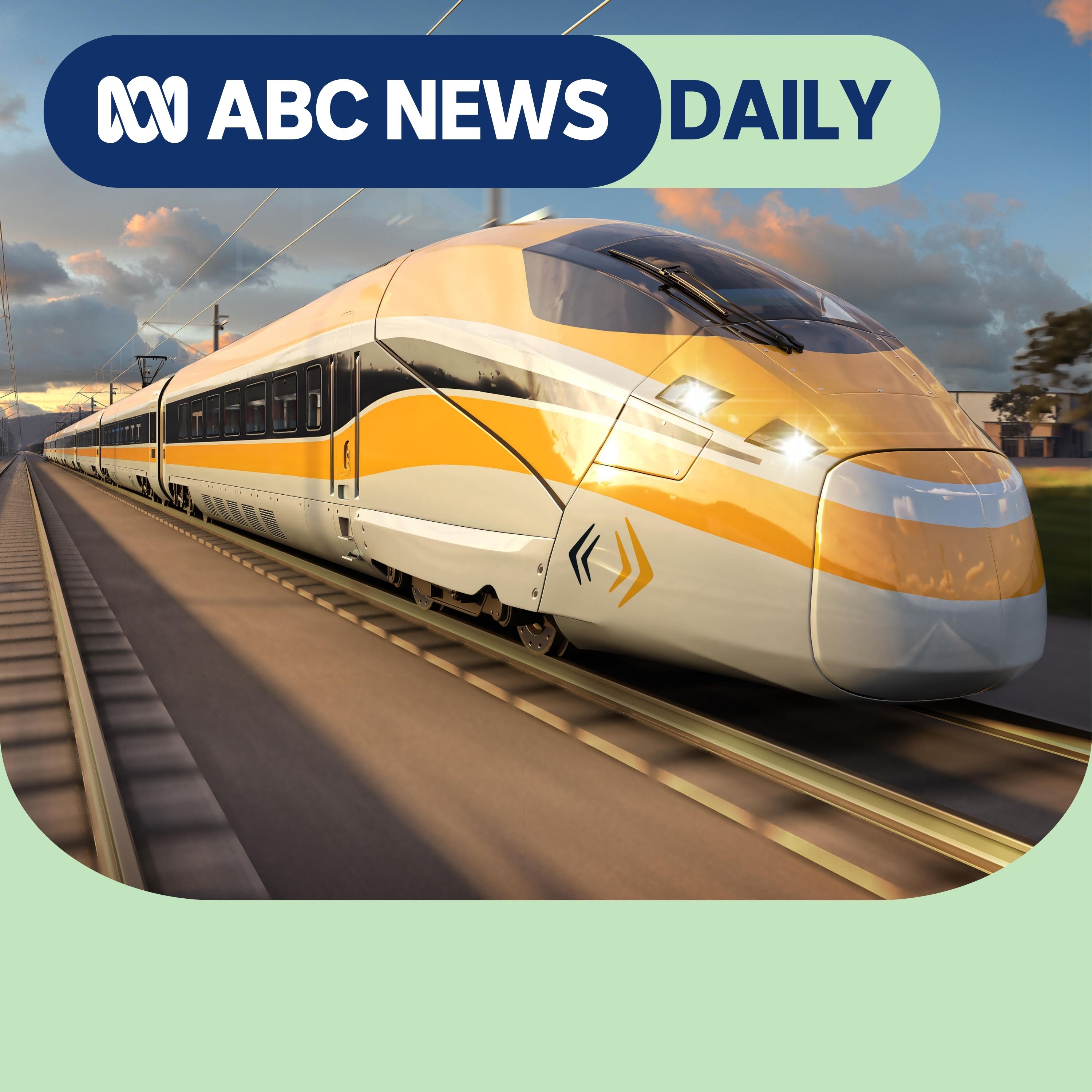
Overview of Why it’s finally time for high speed rail
This ABC News Daily episode (host Sam Hawley) interviews urban planner Jo Langley (member of the Australian High Speed Rail Association) about renewed momentum for Australia’s long-discussed high‑speed rail (HSR). The conversation covers the project’s decades‑long history, the federal government’s current two‑year detailed‑design funding, proposed route and timetable for the first leg (Newcastle–Sydney), cost and technical specifications, the arguments for and against building HSR, and the political and delivery risks ahead.
Key developments discussed
- Federal government has committed more than A$200 million to detailed design for the first HSR section (Broadmeadow/Newcastle → Sydney), led by the High‑Speed Rail Authority.
- The Authority’s mandate: two‑year development phase to produce a robust business case and a “shovel‑ready” project for a final investment decision by ~2028.
- Government timeline presented: construction could begin within two years (if approved) and the first leg could be operational by around 2039.
- First leg estimated cost: about A$90 billion (in today’s dollars). Previous whole‑network estimates vary (Phase 2 study ~A$114 billion).
Historical background (brief)
- High‑speed rail has been proposed and studied in Australia since the 1980s (CSIRO chairman Dr. Paul Wild proposed Sydney–Canberra in 1984).
- Repeated pauses/cancellations across governments primarily due to expected high public subsidies and cost.
- Earlier major studies (1990s, early 2000s, 2012–13 Phase 2) showed significant costs and variable routes; none progressed to construction.
Project details
Route and scope
- First proposed leg: Newcastle (Broadmeadow) → Lake Macquarie → Gosford → Sydney Central (and eventual connection to Western Sydney Airport).
- Much of the Gosford→Central section would be underground (reportedly ~60% of the first leg underground), a major driver of cost.
Timeline
- Two‑year detailed design and investigation phase (to 2028 for final investment decision).
- Construction could follow if approved; operation of initial segment targeted by ~2039.
Cost and funding
- First‑leg cost: ~A$90 billion (current dollars), with risk of cost escalation.
- Federal government currently funding design; NSW government not yet committed funds. Funding model and cost‑sharing to be negotiated.
Speed and technology
- Target operating speed: ~320 km/h (comparable to conventional bullet trains). Speeds may reduce in tunnels (e.g., to ~250 km/h).
- Maglev or ultra‑high speeds (e.g., 500 km/h) are not proposed.
Arguments in favor (Jo Langley’s points)
- Australia’s east coast population density and geography make HSR feasible: most people live along a corridor comparable in density to countries (e.g., Spain) that have built HSR.
- Long‑term national benefits: unlocking regional growth, addressing housing and congestion pressures by dispersing population away from concentrated capitals, and delivering a transport asset intended to last 100+ years.
- Incremental network build: start with Newcastle–Sydney and expand to Melbourne, Canberra, Brisbane for greater returns and network effects.
- The current two‑year detailed design approach is cautious and intended to produce more robust cost estimates and reduce unknowns.
Criticisms and risks raised
- High capital cost and political difficulty of sustaining multi‑decade projects across election cycles.
- Cost overruns are common for major underground infrastructure; unknown underground conditions can increase costs.
- Critics (e.g., Grattan Institute) have argued funds may be better spent on improving existing transport or that short‑term cost‑benefit analyses (typically 30‑year horizons) do not favor HSR.
- State–federal cooperation and clear funding commitments are unresolved; NSW’s reluctance to commit money is a key political barrier.
Next steps & recommended watchpoints (from the discussion)
- Monitor the High‑Speed Rail Authority’s two‑year detailed design outputs and revised cost estimate.
- Watch for NSW state government funding decisions and any federal–state cost‑sharing agreement.
- Look for the final investment decision targeted around 2028 and any formal construction start announcements.
- Track how the business case models long‑term benefits beyond the typical 30‑year appraisal window used by some critics.
Notable quotes
- “We’re the only inhabited continent on earth that doesn't have high‑speed rail.” — (referenced in the episode)
- “What high‑speed rail does is offer another solution… that disperses our population and allows us to take advantage of the huge landmass.” — Jo Langley
Episode credits
- Host: Sam Hawley
- Guest: Jo Langley (urban planner; member, Australian High Speed Rail Association)
- Produced by: Sydney Pead and Sam Dunn
- Audio production: Cinnamon Nippard
- Supervising producer: David Cody
Final takeaway: The federal government’s funding for detailed design has moved HSR from repeated study‑phase limbo to a concrete planning phase. Whether the project reaches construction depends on the 2028 investment decision, reliable cost estimates, and crucially, state–federal funding commitments and political will to sustain a multi‑decade national infrastructure program.