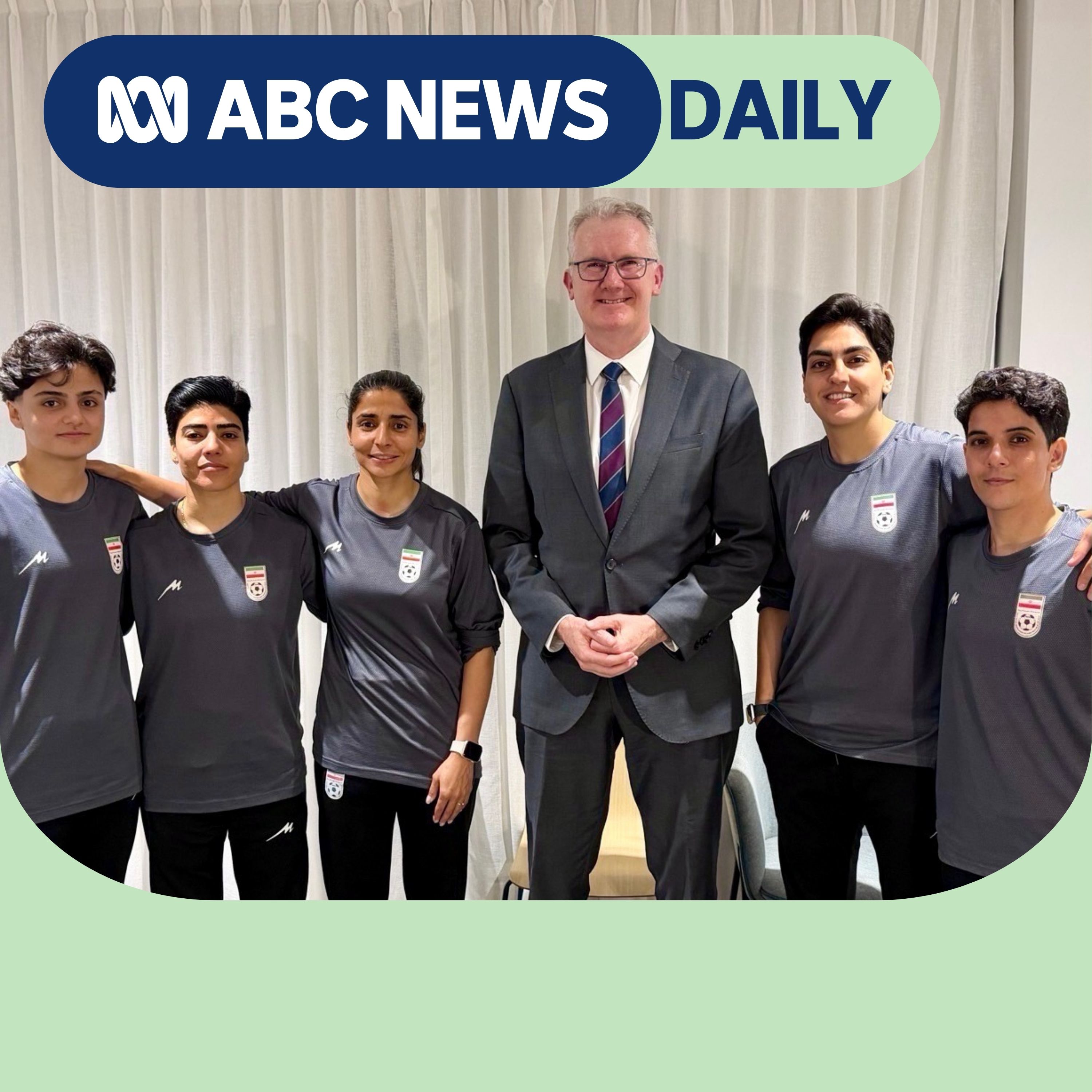
Overview of The brave escape of the Iranian soccer players
This episode (ABC News Daily) explains how five members of the Iranian women's national soccer team, who competed in the Women's Asian Cup on the Gold Coast, sought and were granted humanitarian visas in Australia after refusing to sing the Iranian national anthem, being labelled “traitors” on Iranian state TV, and signalling for help amid fears of reprisals. The piece covers how the events unfolded, the roles of Australian authorities and international actors, the risks to the players and their families, criticism of sporting bodies, and parallels with past asylum cases.
Key facts and timeline
- Event: Iranian women’s soccer team appeared to silently protest by not singing the national anthem before their match against South Korea on the Gold Coast.
- State response: Iranian state TV labelled the players “traitors,” with commentators saying “traitors during wartime should be dealt with severely.”
- Subsequent matches: Players mouthed the anthem and some saluted after apparent pressure; one player made an SOS hand signal while on a team bus.
- Asylum actions:
- Five players asked for and were granted humanitarian visas in Australia; they were moved to a safe house (reported in Brisbane) and celebrated when visas were confirmed.
- Tony Burke (Minister for Immigration and Border Protection) flew to the Gold Coast to meet the players and offered assistance; Australian Federal Police moved them to a safe location.
- Other team members were reportedly offered the opportunity to seek refuge as well.
- One Iranian Football Association applicant’s visa was rejected due to links with a group classified by Australia as a terrorist organisation.
- International reaction: Former US President Donald Trump contacted Prime Minister Anthony Albanese and publicly praised Australia’s actions; commentators noted the US may have leverage via the upcoming Men’s World Cup (US/Canada/Mexico) to pressure Iran.
- Comparisons: The situation was likened to the 2021 Afghan women’s cricket team evacuation and visa support.
Main takeaways
- The players used visible, non-verbal protest (not singing, saluting, SOS hand sign) that, in Iran’s current domestic context, was immediately treated as a political crime with potentially severe punishment.
- Australia responded quickly — ministerial engagement, visa grants, and relocation to a secure site — but the situation remains fluid and dangerous.
- The biggest immediate risk is reprisals against family members left in Iran; at least one player reportedly knows family members have been detained to force returns.
- Sporting bodies (FIFA, AFC, Football Australia) have faced criticism for not doing enough or issuing strong formal statements in support, despite human-rights frameworks tied to event hosting.
- International leverage (notably by the US) could be useful in pressuring Iran to protect players and families, especially given sporting event ties.
Stakeholders and roles
- Players: Five granted humanitarian visas; others offered help. Under intense surveillance and control while in Australia (mindors/security).
- Australian government: Tony Burke and PM Anthony Albanese engaged; visas granted; AFP provided relocation and protection.
- Iranian regime and state media: Publicly denounced players as traitors, creating credible threats of severe punishment.
- FIFA / Asian Football Confederation / Football Australia: Criticised for muted response and insufficient protective measures despite human-rights commitments linked to event hosting.
- United States: Political actor with potential leverage (diplomatic and via Men’s World Cup) and vocal public support from Donald Trump.
- Legal/mental-health/NGO community: Needed to support players in asylum decisions and trauma recovery.
Risks and implications
- Immediate personal risk to players and potential detention, prosecution, or worse of family members remaining in Iran.
- Long-term asylum decisions are complicated by trauma, family separation, and safety concerns for relatives.
- Sporting governance bodies may face increased pressure to adopt enforceable human-rights protections for athletes and ensure safeguards during tournaments.
- Diplomatic tensions: asylum decisions by host countries can escalate political pressure between nations and may involve larger geopolitical considerations (e.g., US–Iran dynamics).
Notable quotes
- Iranian state TV: “Traitors during wartime should be dealt with severely.”
- Donald Trump (reported): “God bless Australia” and that PM Albanese was “on it” regarding granting asylum.
- Tony Burke (reported): expressed empathy and said he personally told the players they had been granted humanitarian visas; “our hearts are with the Iranian team” (commentary attributed).
Comparisons and precedents
- Afghan women’s cricket team (2021): Similar humanitarian visa support and relocation; contrast drawn with teams that were evacuated without their families, creating long-term trauma. The speaker (Catherine Ordway) previously helped secure visas for the Afghan women's team and families.
Criticisms and recommendations highlighted
- Criticism: FIFA, AFC, and Football Australia have not publicly and formally supported the Iranian women strongly enough, despite human-rights obligations tied to hosting and competition.
- Recommendations implied by the interview:
- Sporting bodies should strengthen protections and rapid-response protocols for athletes at risk.
- Governments hosting international sport should prepare contingency plans for at-risk delegations and ensure legal, mental-health and family-reunification support.
- International pressure (diplomatic leverage, high-profile sporting events) should be used to secure protections for athletes and their families in repressive states.
What to watch next
- Whether remaining team members request asylum and how many will be granted visas.
- Any diplomatic moves or pressure from the US or other governments tied to the Men’s World Cup or broader relations with Iran.
- Statements or policy changes from FIFA, AFC, and Football Australia regarding athlete protection and human-rights compliance.
- Developments concerning the players’ families in Iran, including reports of detentions or retribution.
Produced by ABC News Daily — interview with sport integrity lawyer Catherine Ordway (UNSW visiting scholar).