Overview of Should neo-Nazis be banned from protesting?
This ABC News Daily episode (host Sam Hawley) explores why a neo‑Nazi rally — organised by the National Socialist Network (NSN) and presented as the “White Australia Political Party” — was allowed to take place on the steps of the New South Wales Parliament, whether existing laws and policing powers are adequate, and whether such groups should be banned. Extremism expert Josh Roos (associate professor, Deakin University) outlines the group’s tactics, recent related incidents, legal constraints, and policy options for preventing such movements from normalising or entering formal politics.
What happened
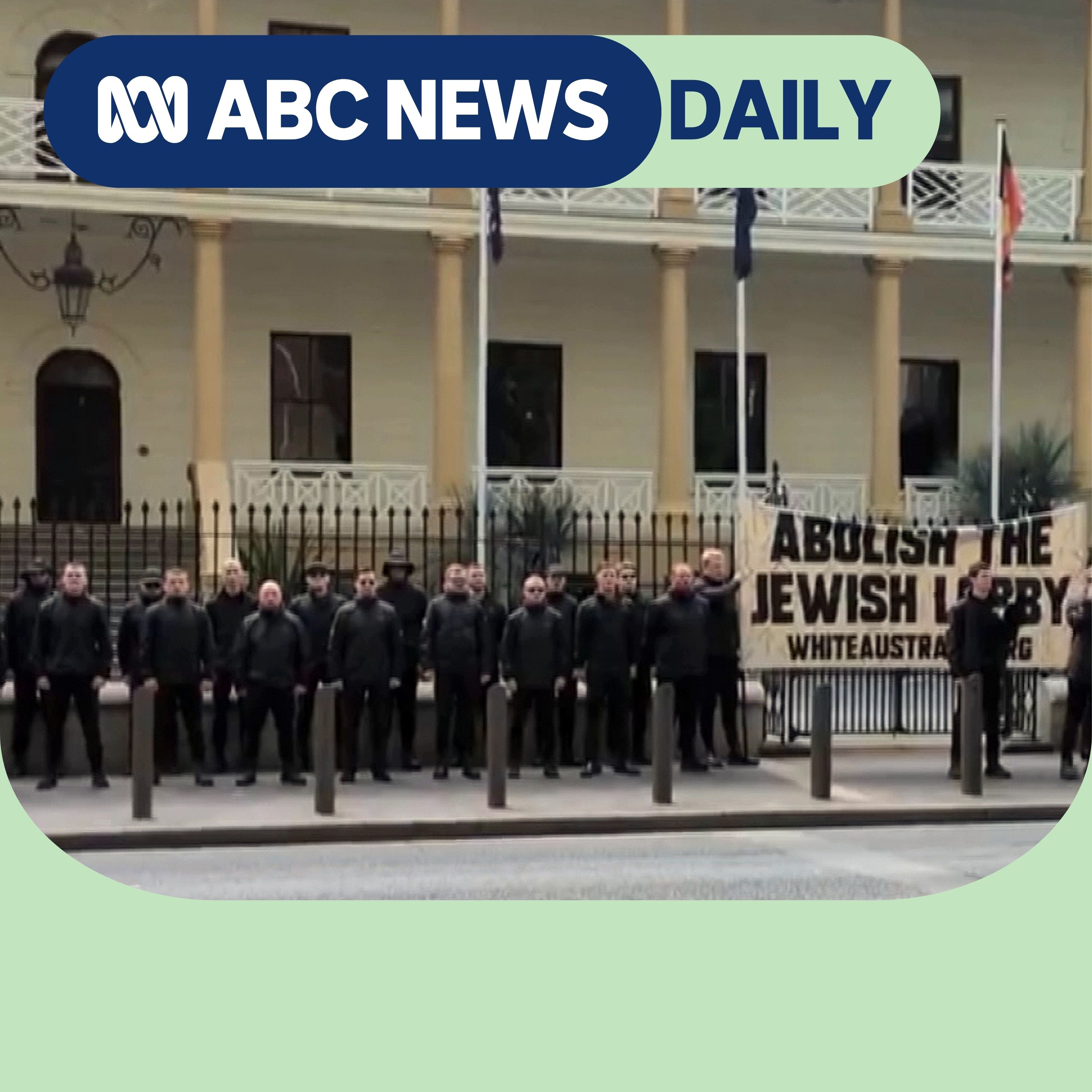
- About 60 people from the NSN gathered outside NSW Parliament on Macquarie Street, dressed in black and holding a banner calling for the “Jewish lobby” to be “abolished.”
- The 20‑minute rally included speeches using classic anti‑Semitic conspiratorial tropes.
- Police allowed the rally to proceed; NSW police leadership later faced questions about that decision.
- Two federal MPs (Allegra Spender and Kellys—transcript name “Kelly Sloan”) who condemned the rally received death and rape threats afterward.
- The NSN has a recent violent history: attempts to disrupt Australia Day celebrations in Sydney, and a violent attack on an Indigenous encampment in Melbourne following a march.
Key takeaways and risks
- The NSN is rebranding and attempting to form a political party (the “White Australia Political Party”) to contest elections.
- Their public messaging often uses “shades of grey” — rhetoric that implies eradication or violence (e.g., “abolish the Jewish lobby”) without explicit calls to murder — which complicates pre‑emptive police intervention.
- Extremism authorities (including ASIO, per Josh Roos’s summary of its director) warn that even non‑terrorist hateful propaganda increases the risk of spontaneous violence and can radicalise others.
- Existing reactions (police moving on some protest groups but not NSN on this occasion) have raised public concern about inconsistent enforcement and the definition of public safety.
Legal and policing framework
- Current law cited: Summary Offences Act — provides for notification/authorisation and allows police to seek court prohibition orders on public safety grounds.
- The system is primarily reactive: police can oppose or seek to prohibit assemblies if a risk to public safety is demonstrable, but cannot ban groups solely because of their ideology.
- Past use: authorities have successfully banned NSN from parts of Sydney (e.g., Australia Day 2024) when an immediate public safety risk was established.
- Registering as a political party: to be registered federally they would need to meet membership and administrative requirements (e.g., ~1,500 members). Legal challenges would likely follow any attempt to refuse registration based on extremist activity.
Why banning is complicated
- Democracies often tolerate extreme speech under a “marketplace of ideas” principle; the legal threshold for prohibition is usually behaviour that amounts to incitement, harassment, violence or terrorism.
- Banning a group prompts legal challenges, lengthy court processes, and requires strong evidentiary grounds that the group crosses the legal line into threats, incitement or violence.
- Comparative approach: other countries have banned some extremist groups; Australia has generally been more cautious (example: Hizb ut‑Tahrir has not been banned federally despite debate elsewhere).
Expert view (Josh Roos) — main arguments
- NSN’s history of violence, hate propaganda and attempts to intimidate critics justify stronger action.
- The group is intentionally exploiting legal freedoms and “grey” rhetoric to grow; allowing that to continue risks normalising hate politics.
- Australia needs to examine international best practice, build an evidence base and decide how tolerant it will be of organised intolerance — “to what extent are we prepared to tolerate intolerance?”
- Practical steps will require legislative clarity, enforcement readiness, and preparation for court contests.
Notable quotes
- “If you give these racists an inch they’re going to take a mile.” — Josh Roos (paraphrased)
- ASIO (as relayed in the episode): the NSN’s “hateful, divisive rhetoric and increasingly violent propaganda” heighten the risk of spontaneous violence.
Policy options and recommended actions (summary)
- Use existing prohibition powers more proactively where public safety risk can be established (gather and present evidence of past violence and incitement).
- Strengthen legislative tools or clarify thresholds for banning organisations that engage in sustained advocacy of racial or religious eradication or have violent histories — while preparing for legal scrutiny and court challenges.
- Monitor and disrupt recruitment/funding channels; build an evidence base from policing, intelligence and comparative international practice.
- Protect and support public figures and communities targeted by hate campaigns (threat reporting, policing resources).
- Public and political consensus: develop bipartisan standards on extremist group registration and political participation.
Credits
- Guest/expert: Josh Roos, associate professor in politics, Deakin University
- Host: Sam Hawley
- Producers: Sydney Pead, Jessica Wukinov; audio production: Cinnamon Nippard; supervising producer: David Coyne
- Show: ABC News Daily
If you want a one‑line summary: the episode argues that neo‑Nazi groups like the NSN exploit legal grey areas and democratic freedoms to spread hateful rhetoric and sometimes violence, and that Australia must decide whether to strengthen laws and enforcement — and build legal evidence — to prevent these groups from normalising and entering formal politics.