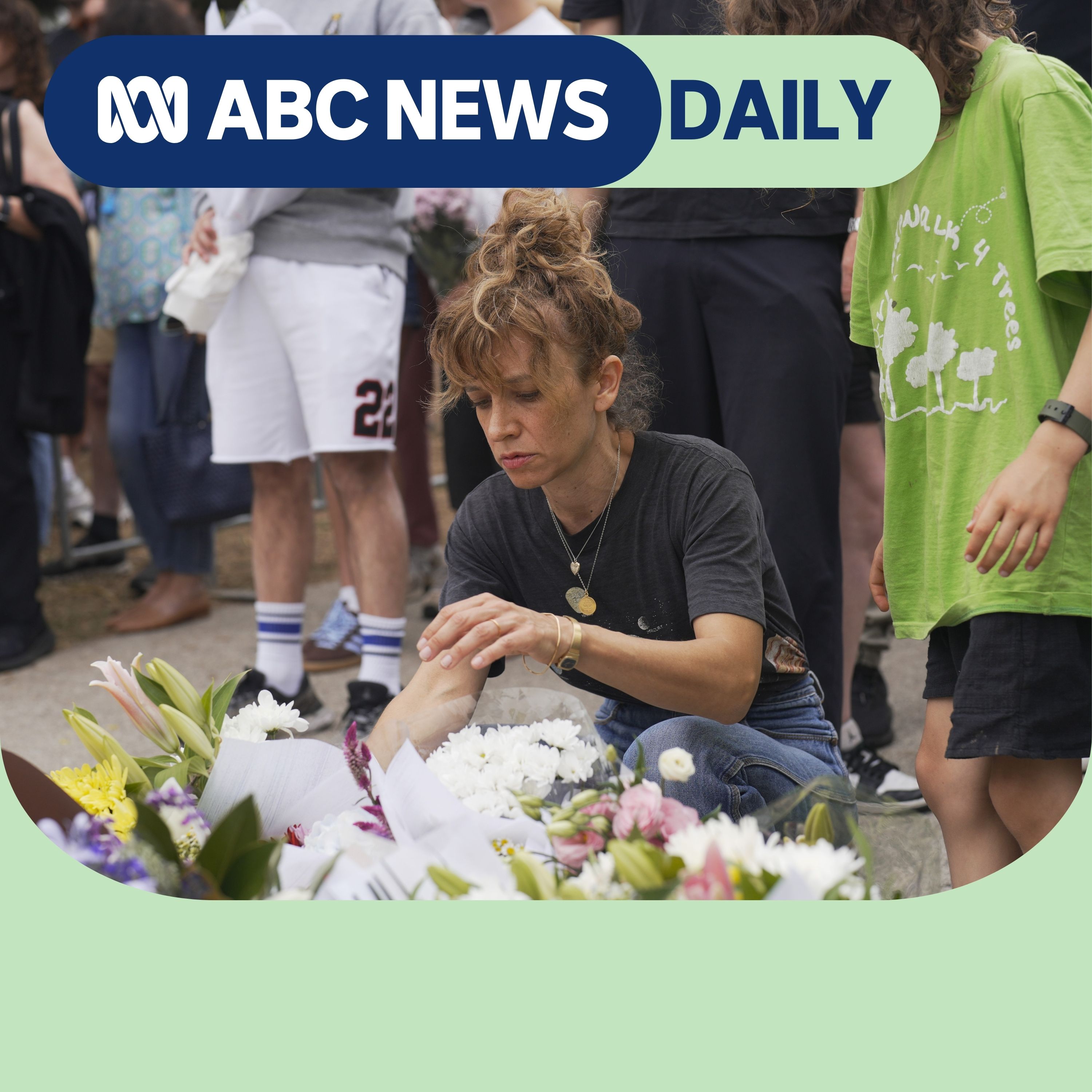
Overview of Life for a Bondi survivor weeks after the attack
This ABC News Daily episode (hosted by Sam Hawley) features two main interviews on the aftermath of the Bondi Beach mass shooting (December 14): Jessica Chapnick-Kahn, who survived the attack while at the petting zoo with her young daughter, and Michael Vasanti, commissioning editor of The Jewish Independent, who discusses the Jewish community’s response and the political fallout. The episode was broadcast on a National Day of Mourning and explores personal trauma, community anger, and expectations for political and institutional change.
Key takeaways
- Survivors continue to experience intense, ongoing trauma: hypervigilance, physical recovery, intrusive terror and difficulty feeling safe in public.
- Personal accounts (like Jessica’s) highlight chaotic, harrowing moments during and after the shooting and the surreal impact of seeing oneself re-presented in the media.
- The Jewish community feels anger and disappointment, particularly over the federal government’s initial response and the Prime Minister’s delay in calling a Royal Commission.
- New laws (hate speech/hate-crime provisions and gun controls) have been introduced, but their long-term effectiveness—especially in addressing antisemitism—remains uncertain.
- The community calls for transparency and public acknowledgment that warnings about rising antisemitism were real and serious.
- A sense of bipartisan unity and national solidarity is seen as critical for genuine change; political division has undermined that potential.
Survivor’s account (Jessica Chapnick-Kahn)
- Context: Jessica was at the Bondi petting zoo with her young daughter when the attack occurred.
- Immediate actions: She instructed her daughter to shield her eyes, picked her up, and ran; parents around them also told children “don’t look” and people threw themselves on top of children to protect them.
- Photo: A widely circulated New York Post photo captured Jessica running with her daughter—seeing it felt surreal and made the event feel externally witnessed rather than a dream.
- Psychological and physical aftermath:
- “I still carry a lot of terror” — experiences sudden bouts of terror and hypervigilance in public.
- Physical recovery is ongoing.
- Feels conflicted internally (guilt, fear, searching for a sense of safety) and often mentally told not to dwell in non-constructive spaces.
- Describes movement during the escape as “zombie-like”; she asked a policeman “what do I do?” and was told “run home.”
- On politics: Jessica is focused on personal recovery and not engaging deeply in political debate, though she recognizes important issues need addressing.
Community response and politics (Michael Vasanti)
- Emotional tone in Jewish community: ongoing shock and profound anger; many feel prior warnings about rising antisemitism were not heeded.
- Political critique:
- Strong criticism of the Prime Minister’s delay in calling a Royal Commission; this delay fueled perceptions the government was not fully committed or empathetic.
- The environment has become politicized quickly: fractured responses, public disputes, and even the Jewish community’s decision not to invite the Prime Minister to funerals.
- Legislation:
- Gun-control measures were broadly welcomed but seen by some as secondary to addressing hate and antisemitism directly.
- Hate speech/hate-crime provisions generated mixed reactions within the community and broader society.
- Expectations from the Royal Commission: primary demand is transparency—show clearly that concerns voiced by Jewish leaders were legitimate and serious, and that pre-existing threats were real, not exaggerated.
- Outlook: Vasanti expresses cautious skepticism that true, lasting change will occur given the polarised political climate, but hopes the Day of Mourning helps restore some unity.
Notable quotes
- Jessica: “I still carry a lot of terror that catches me by surprise on the streets… my body's still really recovering.”
- Jessica describing the chaos: “I walked like a zombie… I literally said to him ‘what do I do’… and he just said ‘run home.’”
- Michael Vasanti: “The overwhelming feeling… is shock, but anger… a sense in which the broader community has not listened to the warnings of Jewish leaders.”
Practical resources and credits
- If you need support: Lifeline 13 11 14 (Australia).
- Production credits: Produced by Sydney Pede; audio production by Sam Dunn; supervising producer David Cody; host Sam Hawley.
Actions and implications
- For policymakers: prioritize transparent inquiry and clear communication to rebuild trust; ensure hate-crime measures are enforceable and resourced.
- For communities: foster bipartisan, cross-community solidarity to reduce polarization and support survivors.
- For the public and media: recognize survivor trauma in reporting; avoid retraumatizing coverage while ensuring truthful, contextualized reporting of antisemitism and hate.
This summary captures the personal, communal, and political dimensions discussed in the episode, and highlights the immediate needs (support for survivors, transparency, unity) raised by both interviewees.