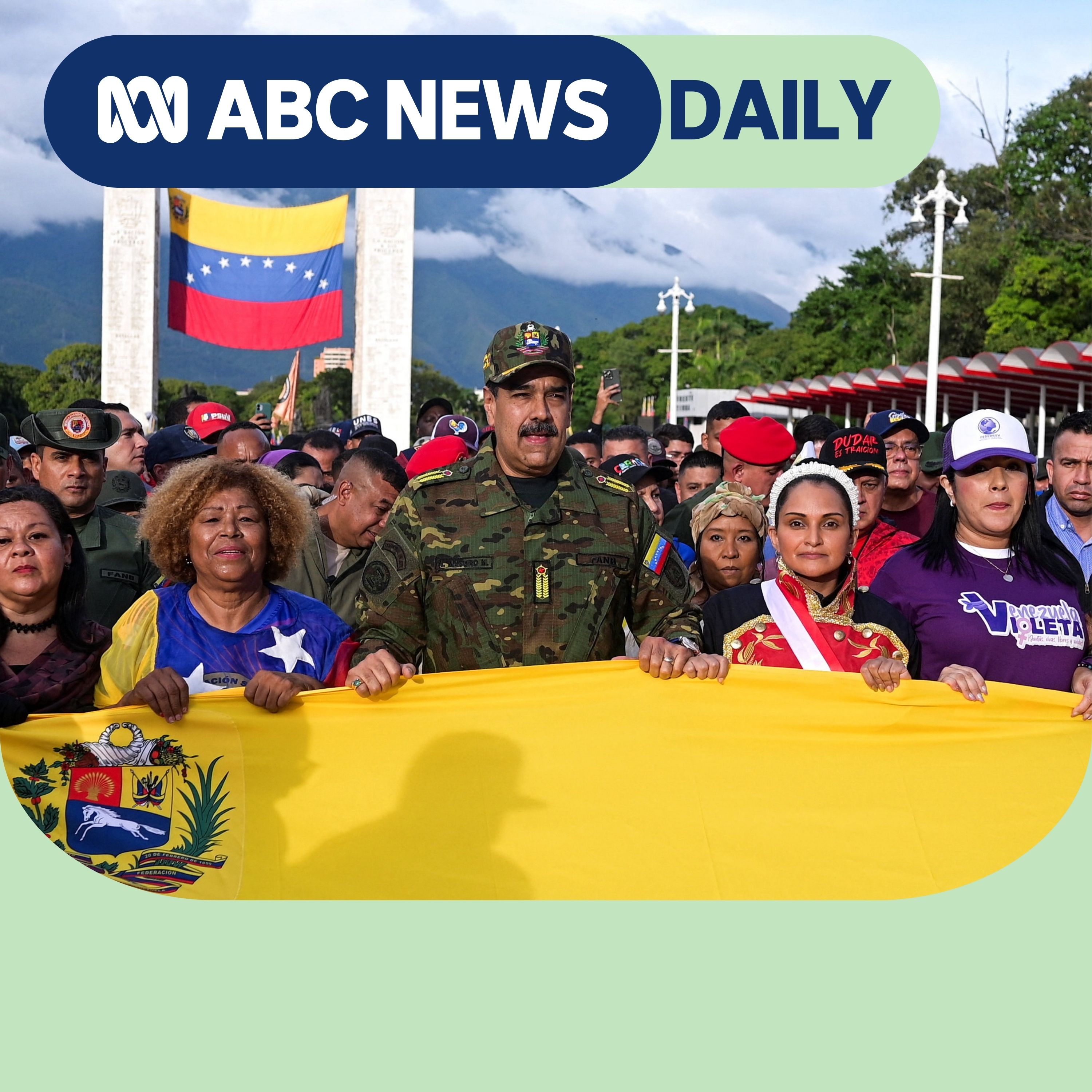
Overview of "Is Trump about to go to war with Venezuela?"
This ABC News Daily episode (host: Sydney Pead) examines the sharp escalation in US–Venezuela tensions: deployment of roughly 15,000 US troops and a carrier strike group to the Caribbean, 20+ US lethal strikes on suspected drug boats since September that have killed more than 80 people, and reporting that President Trump gave Venezuelan President Nicolás Maduro an ultimatum to leave office. Latin America expert Orlando Pérez (University of North Texas) explains what the actions mean, the legal and humanitarian concerns, Maduro’s domestic capabilities, likely US options, motivations behind Washington’s moves, and the risks of escalation.
Key takeaways
- The US has significantly expanded its military presence in the Caribbean — the largest build-up in the region since the Cuban Missile Crisis — alongside ongoing maritime strikes on suspected drug vessels.
- US strikes on boats: more than 20 lethal strikes since early September; reportedly 80+ killed. UN rapporteurs and legal scholars call some attacks extrajudicial; the US administration defends them as lawful counter-narcotics/self-defense.
- A reported Nov 21 phone call between Trump and Maduro allegedly ended with Trump giving Maduro a short ultimatum to leave. Maduro offered amnesty and safe passage in return for sanctions relief; reportedly rejected.
- Militarily removing Maduro would be costly and complex: a credible invasion + stabilization force would likely start around 50,000 troops and entail years of stabilization, high financial cost, and the risk of insurgency and chaotic aftermath.
- A full-scale invasion is seen as unlikely; more probable near-term options are coercive signaling, air/drone strikes on inland targets, and expanded maritime interdiction — moves that could nonetheless slide into broader regime-change operations.
- Motives: the drug narrative is politically convenient, but experts point to broader aims — control of regional influence, limiting Russian/Cuban/Chinese footholds, and access to Venezuelan resources — and domestic political calculations (tensions within the MAGA coalition between isolationism and hawkish nationalism).
What has happened so far (factual summary from the episode)
- Troop & naval deployment: ~15,000 US troops sent and a carrier strike force positioned near Venezuela.
- Maritime strikes: Over 20 attacks on boats in Caribbean and eastern Pacific, resulting in 80+ deaths. Some strikes reportedly involved follow-up (“double-tap”) strikes on survivors in the water.
- Diplomatic interaction: Reported Nov 21 phone call where Trump gave Maduro an ultimatum; Maduro reportedly offered to leave in exchange for amnesty, sanctions relief, dropping of ICC case, and interim leadership arrangements — offers largely rejected.
- Public messaging: Trump said the airspace over Venezuela “should be considered closed” and threatened land strikes on drug trafficking targets.
Legal and ethical concerns
- Extrajudicial killing allegations: UN special rapporteurs and legal scholars argue drug trafficking does not automatically convert interdictions into armed conflict; treating all vessel occupants as combatants raises serious legal questions.
- False positives in interdictions: The guest cited Coast Guard data indicating 20–25% of interdicted “suspected” drug vessels had no drugs, implying lethal strikes risk killing non-traffickers.
- “Double-tap” strikes: Follow-up strikes that target survivors are flagged by the Pentagon's law-of-war guidance as potentially illegal.
- Attribution and command responsibility: Debate over who authorized specific strikes (military commanders vs. civilian leadership) raises accountability issues.
Maduro, Venezuela’s internal situation, and why intervention is hard
- Regime structure: Maduro presides over an authoritarian, “coup-proofed” system combining regular armed forces, the National Guard, intelligence agencies, and paramilitary colectivos, interconnected with criminal economies (gold, smuggling, drug logistics).
- Humanitarian crisis: Venezuela is in deep humanitarian collapse with about 8 million Venezuelans displaced abroad — any external use of force would act on top of fragile social conditions.
- Entrenched actors: Criminal networks, paramilitaries, and foreign intelligence ties (Cuban advisers, reported Russian connections) complicate any post-regime-change stabilization.
- Stabilization needs: Dislodging the regime risks a fragmented security landscape, insurgency, and long-term occupation/stabilization commitments similar in complexity (though not identical) to Iraq or Libya.
Likely US options and escalation pathways
- Most likely near-term actions: expanded maritime interdiction, precision air or drone strikes on inland trafficking nodes, and continued naval/air coercive posture to degrade perceived regime-linked logistics.
- Least likely: large-scale ground invasion with sustained occupation — militarily feasible but politically costly and diplomatically fraught, requiring a sizable and long-term stabilization force (~50,000+).
- Escalation risk: Framing counter-narcotics actions as military operations increases the odds of mission creep from law-enforcement-style interdiction to kinetic strikes against regime infrastructure, potentially nudging toward regime-change dynamics.
Why the Trump administration might be acting
- Public justification: Framed as a border defense/counter-narcotics effort aimed at stopping drugs (cocaine, fentanyl) flowing to the US.
- Strategic motives: Weakening a government aligned with adversaries (Russia, Cuba, China), reshaping regional power dynamics, and controlling oil/resource leverage are plausible underlying motives.
- Domestic politics: The MAGA coalition contains both anti-war isolationists and hawkish punitive elements; the administration attempts to reconcile this by portraying actions as an extension of border enforcement rather than traditional foreign wars.
Notable quotes and soundbites from the episode
- “This really breaks… encourages military solutions to law enforcement problems.” — Orlando Pérez on the shift in US practice.
- “A minimally credible invasion and stabilization force starts at 50,000.” — Pérez on scale required to topple and stabilize Venezuela.
- Trump (as quoted in reporting): “I want those boats taken out. And if we have to, we'll attack on land also, just like we attack on sea.”
- Legal/ethical critique: UN rapporteurs and legal scholars calling some strikes “extrajudicial executions.”
What to watch next (actionable signals)
- Further troop and carrier movements in the Caribbean and off Venezuela’s coast.
- Any announced or reported air/drone strikes on inland Venezuelan targets.
- Official US statements shifting from “counter-narcotics” language to explicit regime-targeting language (or vice versa).
- International responses (Latin American neighbors, OAS, UN) and diplomatic/court actions (ICC developments).
- Domestic US political signals: public opinion, Congressional reactions, and internal administration jockeying over authorization and legal justification.
Bottom line
The situation is highly fraught: enhanced US military presence plus a campaign of lethal maritime strikes has created plausible pathways for escalation. While a full invasion appears unlikely, air and drone strikes and continued coercive pressure are probable near-term options — moves that carry significant legal, humanitarian, and geopolitical risks. Any kinetic campaign risks sliding from counter-narcotics into attempts at regime weakening, with complex stabilization challenges that would be expensive and dangerous to manage.