Overview of Is it time to ration petrol and diesel?
This ABC News Daily episode (host Sam Hawley) interviews David Leaney, an international supply‑chain expert at ANU, about how the Iran–US conflict is disrupting global oil flows and driving petrol and diesel shortages and price spikes in Australia. The discussion explains why shortages are largely distribution- and demand-driven (not an absolute absence of fuel), what the government has already done, practical rationing options, longer-term resilience ideas, and how long recovery would take even if the conflict ends.
Key takeaways
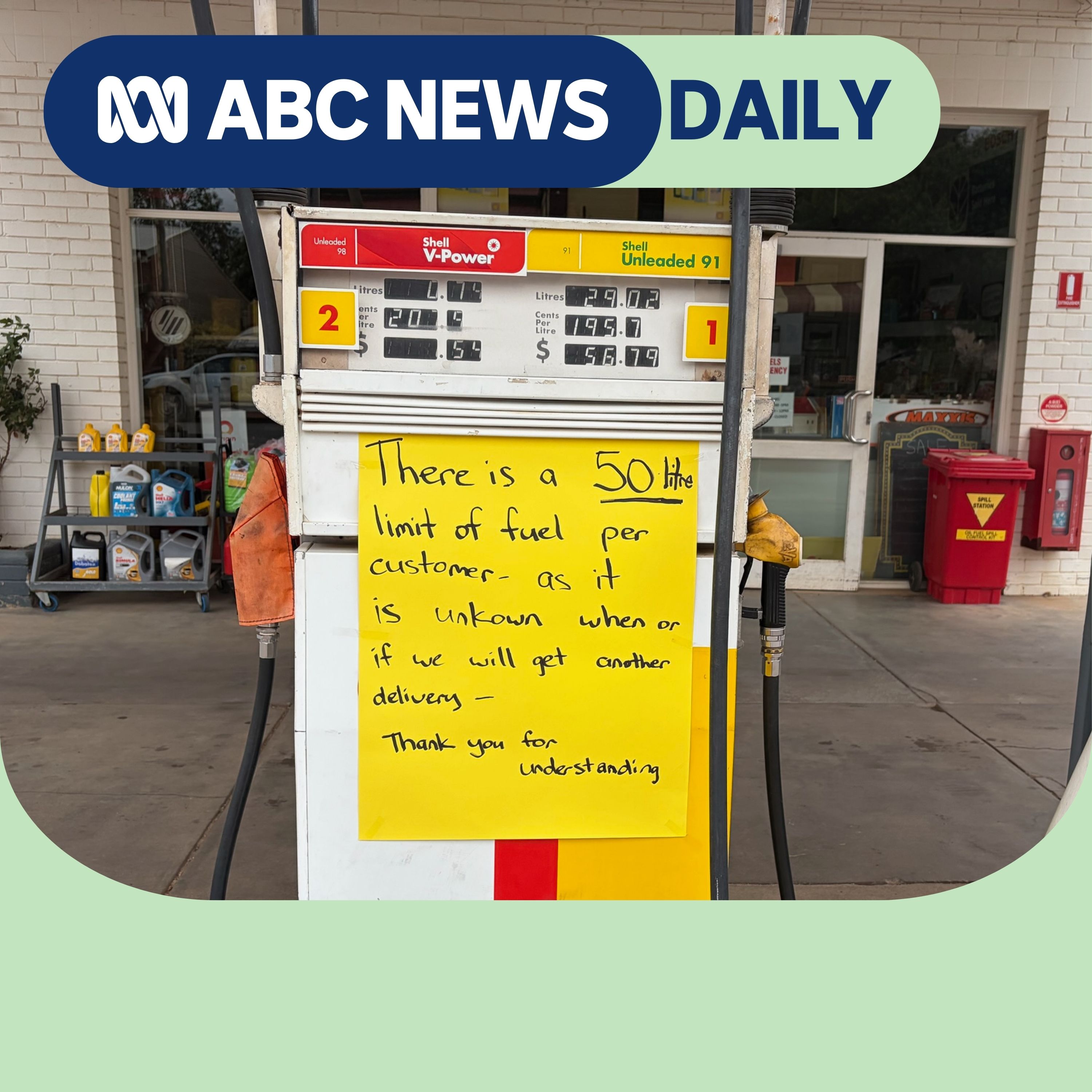
- Australia holds roughly 30–36 days of fuel nationally, but that stock is unevenly distributed — some towns have only about a week’s supply and some are already out of fuel.
- Main causes of current problems: reduced global flows through the Strait of Hormuz, supply-chain disruption inside Australia (flood‑stranded trucks), and panic buying by consumers.
- Government actions so far: release of strategic reserves (about six days’ petrol, five days’ diesel), temporary relaxation of some fuel emission standards so more refined product can be used domestically, and ongoing logistics responses.
- Short‑term fixes recommended by the expert: purchase limits and prioritized access (emergency services, farmers, regional communities), rather than relying on markets alone to stabilise supply.
- Even if the conflict ends tomorrow, global fuel flows and prices would take about two months to normalize.
How the supply chain is affected
- Global choke point: ~20 million barrels/day usually transit the Strait of Hormuz (~20% of world oil). Current re‑routing through a Saudi east–west pipeline reduces that to ~4 million b/d.
- Australia’s fuel: much is refined in Asia (Singapore) and shipped to multiple Australian ports. Australia has only two domestic refineries; a lot of local refinery output is normally exported because it doesn’t meet strict Australian emission specifications.
- Domestic disruption: recent floods in northern Australia have stranded trucks and inventory, creating mismatches between where fuel physically is and where it’s needed.
Current stocks, prices and government response
- Stocks: ~30–36 days nationwide (including contractual offshore access), but unevenly located; recommendation from the expert to move toward 60 days in‑country plus 30 days offshore access.
- Government measures: release of strategic fuel reserve, temporary relaxation of fuel emission standards to redirect products, and logistical coordination.
- Prices: significant increases in a short time — examples include E10 up to $2.62/L (average ~ $2.07/L), Perth saw increases ~60c/L; Darwin highest average price, Canberra the lowest. Diesel prices have risen dramatically.
- Market dynamics: recent inventory purchased at lower prices is still being sold; newer arrivals are more expensive — companies responding to market signals and shareholder obligations, which can exacerbate price spikes.
Proposed rationing and prioritisation options
- Small, simple purchase limits (e.g., ~80 L per vehicle; higher caps for trucks) to curb panic buying and hoarding.
- Odd/even number‑plate restrictions or day‑of‑week limits as a more formal rationing mechanism.
- Priority access for essential users: emergency services, farmers, regional communities, and freight/transport providers.
- Drawbacks: rationing can increase public anxiety and requires careful communication and enforcement.
Geopolitical and security context
- Iran has attacked tankers, used mines, drones, missiles and remote explosive vessels — attacks are low‑cost to execute and high‑risk to defend against.
- Military intervention to reopen shipping lanes is complicated and risky; hundreds or thousands of mines may make transit dangerous.
- Removal of some sanctions on Russian oil (referenced in the episode) is aimed at easing pressure on Europe and can reshuffle global flows and pricing, but does not meaningfully affect Australia’s direct supply due to geography.
Timeline to recovery and practical implications
- Even if hostilities stop immediately, supply chains and prices likely need ~two months to return to a smoother state.
- Short‑term implications: expect continued higher prices and localized shortages; distribution fixes and consumer behaviour (avoiding panic buying) are crucial.
- Long‑term implications: expert argues for larger in‑country strategic reserves and greater self‑sufficiency (but acknowledges complexity and cost).
Notable quotes
- “At any given time, Australia only has about a month’s worth of fuel.” — David Leaney
- “The problem we have isn’t simply supply — it’s distribution and panic buying.” — David Leaney (paraphrase)
- “If we solve this problem magically tomorrow … it will take another two months before the global supply chain is running again.” — David Leaney
- “The responsibility of the fuel companies is not to look after the public. The responsibility of fuel companies is to provide a return on investment to their shareholders.” — David Leaney
Action items / recommendations
For consumers
- Don’t panic buy or hoard fuel — it worsens shortages and raises prices for everyone.
- Fill only what you need and follow any temporary purchase limits introduced.
For government and industry (as recommended/argued in the episode)
- Implement temporary purchase caps and prioritisation for essential services and regional users.
- Increase on‑shore strategic fuel reserves (expert suggests ~60 days in‑country + 30 days offshore access).
- Improve domestic distribution resilience and consider diversification of refining and storage capacity.
- Communicate clearly to reduce public anxiety and avoid unintended panic.
Producers / transport operators
- Coordinate logistics to reallocate stocks to high‑need areas and communicate timelines publicly to reduce panic behaviour.
Produced by Sydney Pead; interview guest David Leaney (ANU).