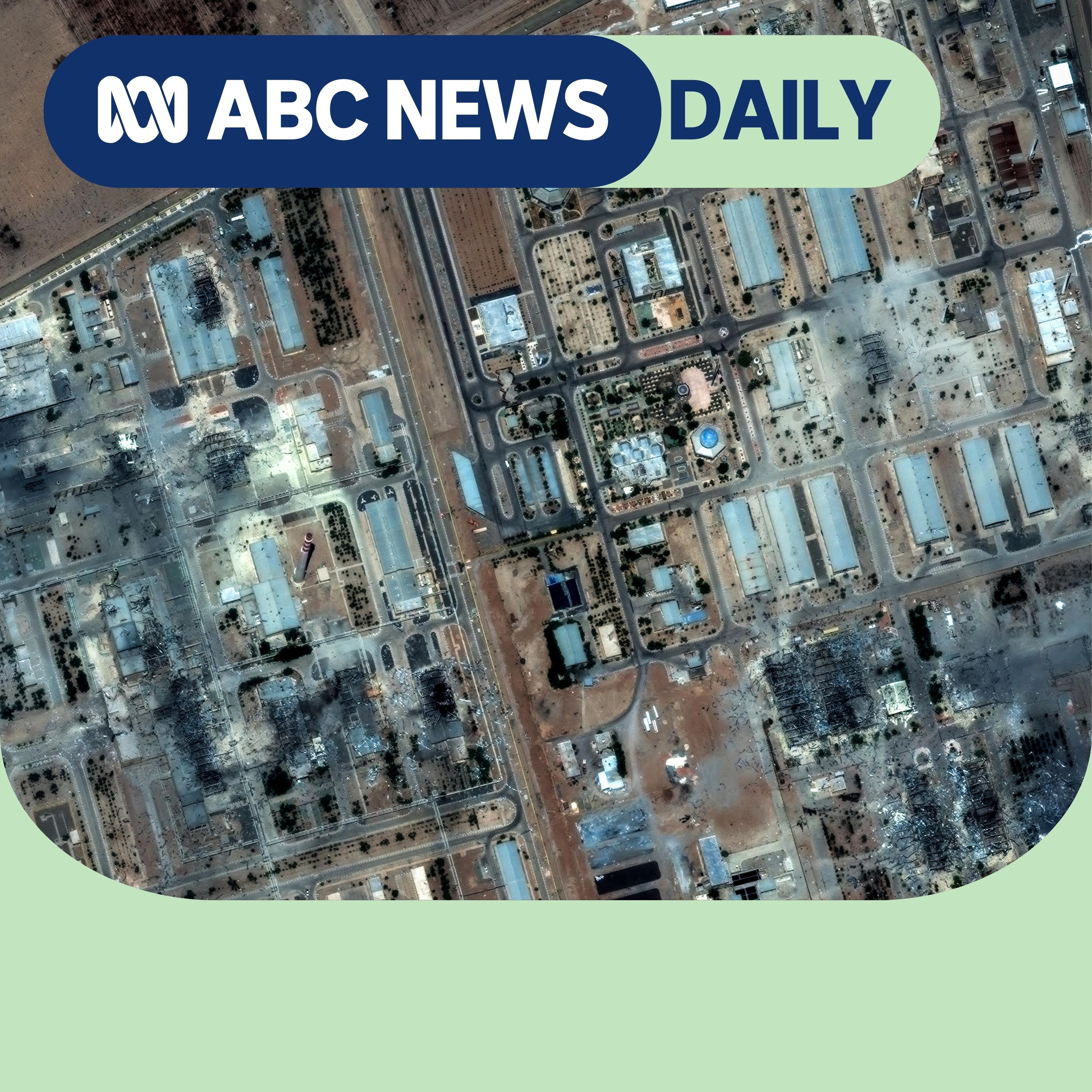
Overview of How the Iran war increases the global nuclear threat
This ABC News Daily episode (host Sam Hawley) interviews Kelsey Davenport, Director of Non‑Proliferation Policy at the Arms Control Association, about how recent U.S. and Israeli strikes on Iran’s nuclear facilities—including major attacks in June 2025—affect global nuclear proliferation. The conversation evaluates damage to Iran’s program, the risks created by disrupted monitoring and stored enriched uranium, and the broader geopolitical signal that could push other states toward nuclear weapons.
Guest and context
- Guest: Kelsey Davenport, Director of Non‑Proliferation Policy, Arms Control Association.
- Context: U.S. and Israeli strikes on Iranian sites (notably Natanz, Fordow, and tunnel entrances at the Esfahan complex) in mid‑2025; follow‑on strikes and ongoing conflict have interrupted IAEA monitoring and raised proliferation concerns.
- Program: ABC News Daily, producer credits noted.
Key points and main takeaways
- The June 2025 strikes damaged parts of Iran’s nuclear infrastructure but did not “obliterate” the program; key materials, technologies and expertise likely remain.
- U.S./Israeli strikes appear targeted to limit access to sites (e.g., Natanz) and damage some buildings, not to fully prevent weaponization.
- Iran had stockpiles of uranium enriched to ~60%—below weapons grade (≈90%) but closer than typical peaceful levels; stored canisters are small and concealable.
- Active IAEA on‑site monitoring has been disrupted by the strikes, increasing risks of diversion to covert facilities.
- A direct strike on stored highly enriched material could risk an unintended fission/dispersion event (not a full nuclear weapon detonation but potentially dangerous).
- The conflict erodes perceptions of U.S. credibility in non‑proliferation negotiations and extended deterrence, which may encourage other states to seek their own nuclear deterrents.
What this means for other countries and global proliferation
- The war sends a potentially dangerous signal: Iran’s brinkmanship did not prevent attacks by nuclear‑armed states, so some nations may conclude that only actual possession of nuclear weapons guarantees deterrence.
- Davenport identifies a shift in likely future proliferators: not just isolated or pariah states (past cases like Iran, Syria, Libya) but closer U.S. allies/partners (examples raised: South Korea, Saudi Arabia) and renewed discussion in parts of Europe.
- France’s announced nuclear expansion (President Macron’s pledge to increase warheads) fits into a wider reassessment of deterrence, partly driven by doubts about U.S. commitments—this predates the current war but is reinforced by it.
Possible Iranian trajectories and risks
- If the current regime survives:
- Immediate overt weaponization is unlikely (would invite further attacks), but Iran may pursue covert parallel programs, reconsider doctrine, or eventually withdraw from the NPT—raising medium/long‑term risks.
- If the regime falls:
- A hardline military/IRGC takeover could increase the likelihood of weaponization (some military factions have been pro‑weaponization).
- Even a new liberal government might pursue nuclear weapons if it feels insecure in a hostile neighborhood.
- Overall: regime outcome does not guarantee elimination of proliferation risk.
Monitoring, verification, and short‑term risks
- Disrupted IAEA access is a critical near‑term problem: without inspections, material diversion or covert relocation becomes harder to detect.
- Stored enriched uranium (e.g., 60% canisters) is a target vulnerability—both for theft/diversion and dangerous strikes.
- The episode stresses the need to watch for covert facilities, stockpile movements, and signs of doctrinal change.
Notable quotes and perspectives
- Trump’s June claim (as quoted in the episode): “Iran's key nuclear enrichment facilities have been completely and totally obliterated.” (Guest: this was inaccurate.)
- Emmanuel Macron (quoted): “I have ordered an increase in the number of nuclear warheads in our arsenal. To be free, therefore, one must be feared, and to be feared, one must be powerful.”
- Davenport’s assessment: “More nuclear weapons makes us all less safe.”
Action items / Watchlist (what to monitor next)
- Restoration and continuity of IAEA monitoring access inside Iran.
- Evidence of covert enrichment facilities or movement of enriched material (canister tracking, procurement networks).
- Policy/diplomatic moves by U.S. to reassure allies (extended deterrence) or restart credible non‑proliferation negotiations.
- Statements or capability decisions by regional actors (South Korea, Saudi Arabia, Israel) and European states regarding nuclear policy.
- Domestic shifts in Iran (regime survival, IRGC influence) that could change nuclear doctrine.
Bottom line
The strikes have not eliminated Iran’s nuclear capability and have increased short‑, medium‑ and long‑term proliferation risks by disrupting monitoring, threatening stored material, and undermining U.S. credibility. That combination may encourage a new wave of proliferators—including some U.S. allies—making the world less safe according to the episode’s expert guest.