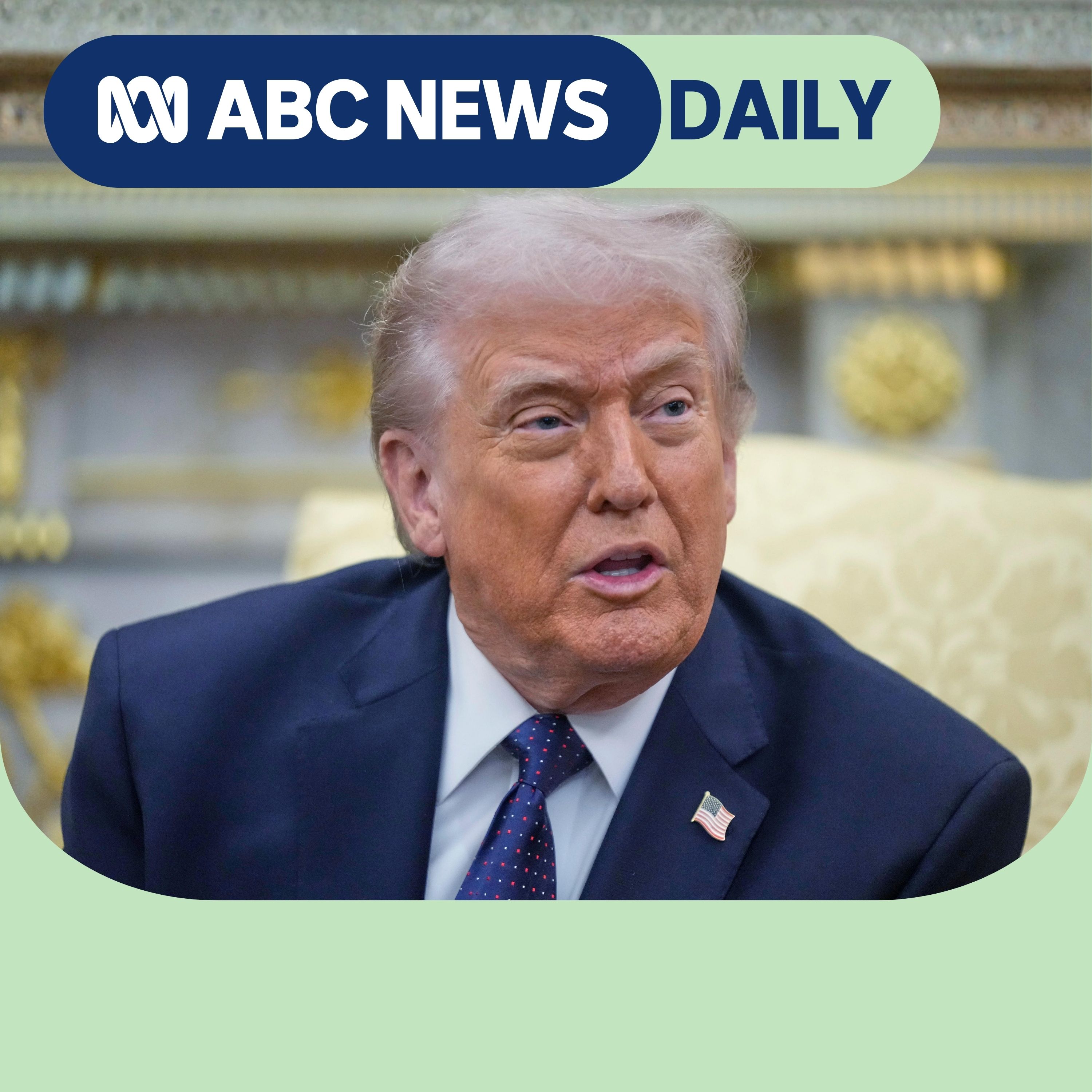
Overview of How Donald Trump caught 'victory disease'
This ABC News Daily episode (host Sam Hawley) features Tom Nichols (staff writer, The Atlantic) explaining why the Trump administration’s approach to the war with Iran appears strategically incoherent and how President Trump is exhibiting “victory disease.” Nichols argues that tactical military successes and theatrical messaging have masked the absence of a clear strategic objective, producing dangerous miscalculations and mixed signals at home and abroad.
Main takeaways
- Trump has offered many shifting rationales for the campaign against Iran (regime change, destroying missiles, eliminating nuclear capacity, stopping proxy terrorism), but no consistent, clearly defined strategic end state.
- The administration lacks deep national-security and foreign-policy expertise; decisions often prioritize media optics over sober strategy.
- “Victory disease” describes leaders who mistake battlefield wins for achieving strategic goals; Nichols says Trump shows classic symptoms of this.
- The U.S. military is operationally competent, but tactical success does not guarantee strategic victory; errors (e.g., outdated maps, a strike that hit a school, friendly-fire incidents) highlight limits and risks.
- Trump’s mixed public messaging—oscillating between “we’ve won” and “this could go on”—is partly aimed at different audiences (markets, voters) and reflects uncertainty rather than a coherent plan.
- Glory-seeking and legacy ambitions (being seen as a liberator) appear to be driving some decisions; talk of further interventions (e.g., Cuba) shows a tendency to “move on” to new targets once a perceived win is achieved.
- Predicting Trump’s next move is difficult; Nichols suspects he may seek an off-ramp if domestic economic pressure mounts, but he could also deepen involvement rather than pull back.
What is "victory disease"?
- Definition: A historical pattern where leaders conflate a string of battlefield or tactical wins with overall strategic success, prompting them to pursue ever-larger objectives until overreach produces disaster.
- Historical examples Nichols cites: Napoleon’s Russian campaign, Xerxes in Greece (Salamis), Axis powers in WWII.
- How it applies to Trump: A history of relatively small, publicized “wins” (limited strikes, political victories in places like Venezuela) may have convinced him larger, riskier campaigns (e.g., collapsing Iran’s regime) would be similarly easy.
Evidence and examples discussed
- Shifting objectives: Trump’s public statements on goals (missile stockpiles, naval destruction, nuclear sites, regime change) change frequently.
- Tactical vs strategic: US airpower executed many precise strikes, yet tactical effectiveness hasn’t translated to a clear strategy or political outcome.
- Operational errors: Preliminary inquiries point to U.S. responsibility for a strike that hit a school with heavy civilian casualties; friendly-fire and allied mishaps (e.g., Kuwaiti forces downing U.S. aircraft) underline the fog of war.
- Iranian resilience: Nichols notes Iran has long prepared for U.S. attack and has not behaved as if it will surrender—attacking Gulf shipping and leveraging the Strait of Hormuz to disrupt oil markets.
Messaging, audiences and domestic politics
- Mixed messaging serves multiple audiences: calming markets, reassuring supporters, and rallying domestic political bases.
- Nichols says Trump is “congenitally incapable” of taking responsibility publicly for bad outcomes and frequently pivots or denies knowledge.
- Market sensitivity could be a constraint: economic fallout and volatility may push Trump toward an earlier end if markets signal distress.
Risks and wider consequences
- Strategic: Continuing to equate tactical successes with strategic victory risks long-term overcommitment and escalation, potentially drawing the U.S. into a protracted conflict.
- Political: Glory-seeking and public talk of further interventions (Cuba, broader regime-change aims) can undermine diplomatic options and inflame regional tensions.
- Human cost: Civilian casualties and operational mistakes erode moral standing and increase domestic and international backlash.
Notable quotes (paraphrased/highlighted)
- “There’s simply no strategy here. It’s not just a bad strategy — there’s no strategy at all.”
- “Victory disease… you start to believe that winning battles is the same thing as winning the war.”
- “If he can’t get a peace prize, he’ll launch a lot of wars and knock off a lot of bad regimes and someone will build a statue to him.”
Likely outcomes (Nichols’ view)
- Unpredictable: Trump may seek an off-ramp because he grows bored or because market pressures mount, but he could also escalate.
- Short-to-medium term: Not likely to drag into an indefinite grinding war, according to Nichols, but much depends on internal briefings, domestic pressures, and how costly backing down would appear politically.
Implications for listeners / policymakers
- Don’t confuse battlefield success with strategic clarity—demand explicit objectives and exit strategies.
- Watch for mixed public signals that reflect different domestic priorities (markets vs. military vs. political base).
- Recognize the risk of leader-driven, legacy-seeking decision-making when institutional expertise and dissenting views are sidelined.
Credits: Interview with Tom Nichols (The Atlantic); host Sam Hawley; produced by Sydney Pead and Cinnamon Nippard; audio production Anna John; supervising producer David Cody.