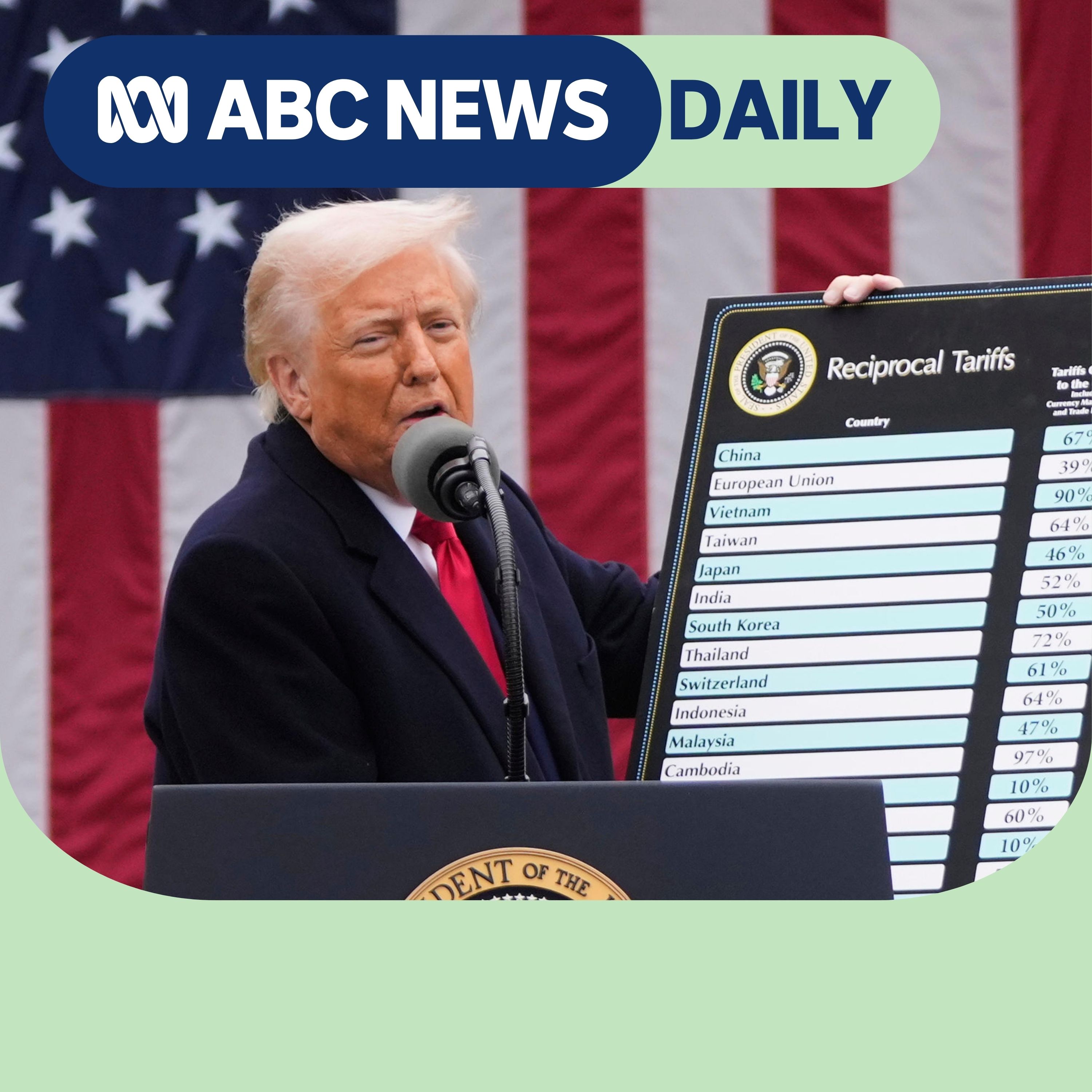
Overview of Are Trump’s tariffs wrecking the US economy? (ABC News Daily)
This episode interviews Yale economist Penny Goldberg about the economic effects of the tariffs announced by President Trump in April 2025. Goldberg explains why the immediate damage has been smaller than many feared, what the tariffs are actually raising in revenue, how they interact with inflation and Fed policy, and why the bigger worry is long‑run uncertainty and geopolitical fallout rather than an imminent recession.
Key takeaways
- The initially announced tariffs were unusually large, targeted broadly (including allies), and scaled to bilateral trade balances — an unusual criterion that produced some extreme rates.
- Many of the announced tariffs were rolled back, paused or reduced after markets reacted; implemented tariff levels are generally lower than originally threatened.
- Short run: U.S. importers have absorbed much of the cost so far (margins compressed), and consumer prices have not shown large increases yet.
- Long run: persistent tariffs would likely lead to higher consumer prices, reduced investment, and efficiency losses.
- Tariff revenue has risen materially — projected around $190 billion by end of 2025 — but that’s small relative to U.S. federal deficits and insufficient to fund broad payments like a $2,000 per person “tariff dividend.”
- The Fed has been cautious: inflation is around 3% (above the 2% target), and the Fed has cut rates twice this year while weighing tariff-driven inflation risks.
- Near term recession is considered unlikely; U.S. resilience (plus optimism around AI and strong equity markets) supports that view. The larger risk is long‑term damage from increased uncertainty and strained international relationships.
How the tariffs have behaved and immediate impacts
- April 2, 2025 announcement framed as a major industrial revival; initial rates were high and volatile (examples cited: China at 67% initially, then discussion of 34% reciprocal discounted rate; threats up to 145% were later walked back).
- Tariff levels have changed frequently — sometimes weekly — and were often presented as negotiation starting points rather than final policy.
- Market reactions (including an initial stock market crash after the announcement) prompted rollbacks and pauses, which reduced the realized economic shock.
- Short‑term pass‑through: historical evidence (2018–19) and early data show input prices rise for importers but consumer price pass‑through has been limited so far because importers cut margins and used inventories.
Fiscal impact — how much revenue are tariffs generating?
- Tariff revenue roughly doubled compared to the prior year.
- Projection cited: about $190 billion in tariff revenue by the end of 2025.
- Despite sounding large, this is a small share of federal receipts and cannot materially reduce the trillion‑plus dollar budget deficit.
- Promises to distribute tariff “dividends” (e.g., $2,000 per person) would likely exceed the revenues collected and thus are implausible as announced.
- Tariffs are regressive: lower‑income households are more likely to bear the economic burden.
Inflation, the Fed, and monetary policy
- Inflation is around 3% — above the Fed’s 2% target — which constrains how aggressively the Fed can cut rates.
- The Fed has trimmed rates twice this year; additional cuts are possible but depend on incoming data and inflation risks tied to tariffs.
- Tariffs create a policy tradeoff: they can raise inflation long term, complicating the Fed’s job of stabilizing prices while also facing political pressure to ease.
- Fed independence concerns are highlighted as politically sensitive but economically important.
Long‑term risks and geopolitical effects
- Goldberg’s main concern: political and geopolitical costs exceed immediate economic costs.
- Unpredictable trade policy increases global uncertainty, discouraging long‑term investment and planning.
- Other countries are likely to build resilience, diversify supply chains, and reduce reliance on the U.S., shifting long‑run economic and bargaining power.
- Timing is uncertain — effects may unfold over years (e.g., 5–6 years), contingent on other countries’ responses and whether tariffs persist.
- Short‑term resilience (strong markets, AI optimism) masks these longer‑term structural risks.
Notable quotes
- “The tariffs were high and they were also unique in two ways… they targeted allies and non‑allies in similar ways.”
- “In the short term, firms can sell out of inventories. They’re willing to take some cut in their profit margins. But in the long run, eventually, they will adjust.”
- “The political cost of the tariffs has been substantially higher than the economic cost.”
What to watch next (actionable indicators)
- Official tariff schedules and any further rollbacks/changes (frequency and scope).
- Tariff revenue reports (quarterly and end‑of‑year totals vs. the $190B projection).
- Consumer price inflation (CPI) and producer/import price indexes for signs of pass‑through.
- Fed statements and meeting outcomes — rate changes, forward guidance, and commentary on trade risks.
- Investment trends (business capex) and corporate commentary on supply‑chain shifts.
- International responses: trade policy moves, diversification strategies, and bilateral negotiations.
Episode credits
- Guest: Penny Goldberg, Professor of Economics, Yale University
- Host: Sam Hawley
- Produced by: Sydney Peed and Jessica Wukyanov
- Audio production: Cinnamon Nippard
- Supervising producer: David Cody
For listeners wanting a quick conclusion: implemented tariffs so far have done less economic damage than the dire predictions because many rates were reduced or delayed and importers have absorbed costs. But sustained, unpredictable trade barriers risk higher consumer prices later, weaker investment, strained global relationships, and longer‑term erosion of U.S. economic influence.