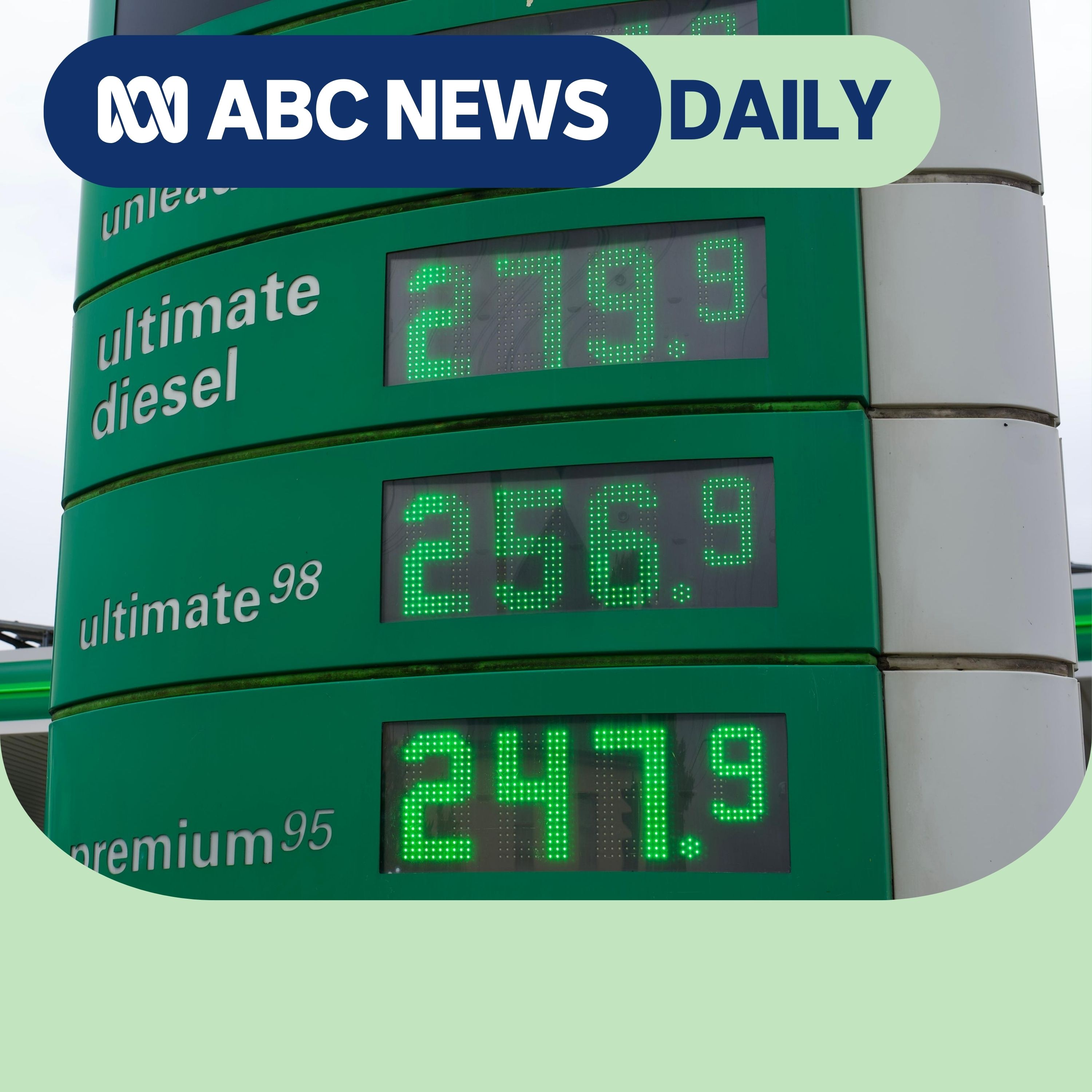
Overview of "Are the petrol stations ripping us off?"
This ABC News Daily episode (host Sam Hawley) investigates the recent sharp rise in petrol prices across Australia, questioning whether fuel companies are exploiting the situation and what—if anything—regulators and motorists can do. Economist David Byrne (University of Melbourne) explains how prices are set, why rapid price increases can occur, the limits of current enforcement, and which interventions have and haven’t worked in the past.
Key takeaways
- Petrol prices jumped rapidly in recent weeks—from roughly 150–160¢/L in major cities to about 230¢/L (≈70¢/L increase).
- Price spikes are worst in some regional areas where dependence on fuel is higher, amplifying cost pressure on households and businesses.
- Fuel firms don’t just pass on costs for fuel already bought; they also set prices based on expected future costs and market conditions.
- A common pattern in fuel markets is "rockets and feathers": prices rise quickly but fall slowly once costs fall—this asymmetry is a central concern.
- Proving deliberate price gouging or collusion is difficult because simultaneous price rises can reflect common cost shocks rather than anti‑competitive behaviour.
- Transparency tools can help—but results vary: WA’s FuelWatch appears to have allowed firms to increase margins (estimated +3–4¢/L), while NSW’s FuelCheck coincided with downward pressure where consumers actively used the app.
- The ACCC has convened emergency talks with major suppliers (Ampol, Chevron, BP, Mobil, United Petroleum, 7‑Eleven, etc.), and the Treasurer signalled tougher penalties for unreasonable price rises. Still, enforcement faces legal and evidentiary limits.
What caused the spike — short explanation
- International supply concerns (related to the Iran/Middle East conflict) pushed global oil prices up.
- Fuel retailers price not only on inventory costs but also on anticipated future costs and market positioning.
- Market structure (a few large players in some regions) can increase the chance of synchronized price-setting behavior, whether coordinated or not.
Regulatory and enforcement issues
- ACCC role: investigating, increasing surveillance, and warning suppliers. The Treasurer has threatened stronger penalties and will introduce legislation to increase fines.
- Legal challenge: To prosecute under competition law you must show unreasonable conduct or coordination (e.g., price-fixing is clearly illegal). Distinguishing collusion from parallel responses to common shocks is legally and evidentially hard.
- Price caps/regulation: Caps deliver short-term relief but risk supply shortages, station closures, and negative spillovers into other regulated sectors. They’re blunt instruments with longer-term costs.
- Data/visibility gaps: Regulators currently lack full transparency on fuel companies’ contracts, cost structures and timing—information that would help determine whether pricing is justified.
Past policy experiments — what worked and what didn’t
- FuelWatch (WA, introduced 2001): mandatory pre‑reporting of daily prices to a public portal/app. Intended to empower shoppers and increase competition.
- Research finding: while consumers could predict weekly price cycles and shop lower-priced days, firms used the transparency to raise average margins by ~3–4¢/L.
- FuelCheck (NSW, launched 2016): state-run price app. Evidence shows downward pricing pressure in NSW relative to states without similar tools when consumers actively used the information.
- Lesson: transparency can help—but its net effect depends on how firms react and how actively consumers use the information.
Recommendations and action items
For consumers:
- Use price‑comparison apps (FuelCheck, local equivalents) and shop around—consumer engagement can exert downward pressure on prices.
- Time your fills where feasible (some predictable weekly patterns exist in some markets).
For policymakers and regulators:
- Increase monitoring and require more granular transparency from suppliers about costs and contracts to enable more precise investigations.
- Consider targeted measures (enhanced surveillance, heavier penalties for proven anti‑competitive conduct) instead of blunt price caps.
- Invest in user‑friendly public price apps and promote consumer uptake; explore modern aids (AI price‑comparison agents) to automate shopping.
Notable quotes
- “Suppliers and retailers must not treat motorists as mugs.” — Treasurer Jim Chalmers
- “Prices tend to rise like rockets… and when the costs come down, they come down like a feather.” — David Byrne
- “It’s hard to say what’s too fast or too slow” without access to companies’ contractual and cost data. — David Byrne
Bottom line
Recent petrol price spikes are driven by global supply shocks and retailers’ pricing strategies. While quick enforcement action and higher fines are politically appealing, practical limits (legal proof, data gaps, market complexity) constrain regulators. The most practical short‑term lever is better transparency combined with consumer engagement—use price apps and shop around—while governments build stronger data access and targeted enforcement tools to deter and prosecute genuine anti‑competitive conduct.