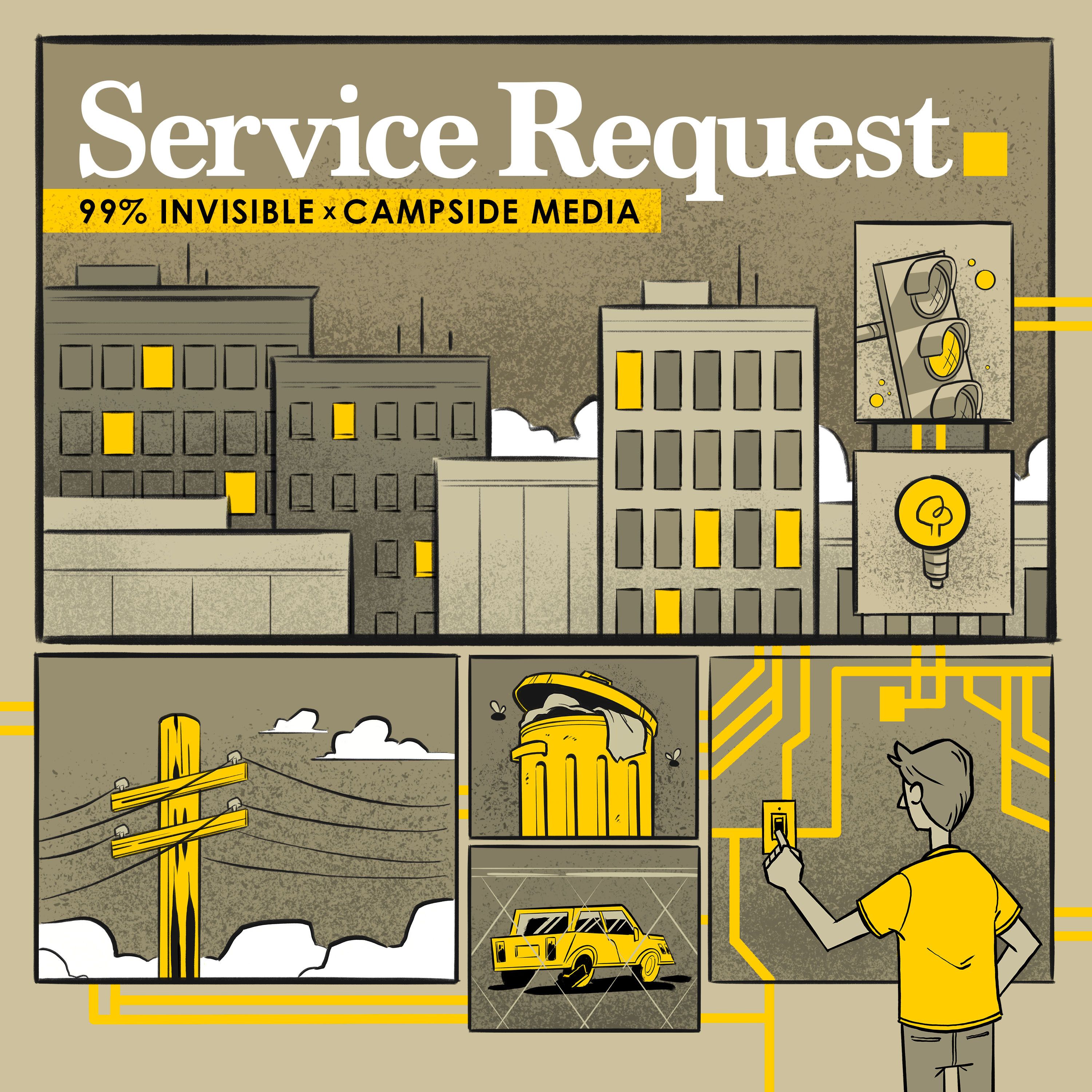
Overview of Service Request #4: How Does the Grid in Phoenix Work?
This episode of Service Request (99% Invisible) investigates how Phoenix’s electrical grid delivers life‑saving power during extreme summer heat. Host Delaney Hall walks through the physical and organizational machinery behind electricity delivery—generation, transmission, substations, distribution—then zooms into how Phoenix (within the Western Interconnection) plans for and responds to peak demand. Guests include Gretchen Bocke (author of The Grid) and Angie Bond‑Simpson (Senior Director of Resource Management, Salt River Project). The episode emphasizes the painstaking planning, real‑time operations, and vulnerabilities that determine whether air conditioning stays on during record heat.
Key points and main takeaways
- Phoenix depends on a complex, fast, tightly balanced electrical system—losing power in extreme heat can cause deaths.
- Electricity is generated, transmitted at high voltage, stepped down at substations, and distributed to homes; the system must maintain a synchronized 60 Hz frequency.
- The Western Grid (Western Interconnection) connects utilities across many states and parts of Canada/Mexico; SRP (Salt River Project) coordinates Phoenix’s supply within that grid.
- Planning occurs at multiple horizons: long‑term infrastructure planning (6–30 years), day‑ahead market stacking, and real‑time operations and trading.
- Renewable sources (solar, wind) are weather‑dependent (“rain”) while dispatchable resources (natural gas, hydro) are controllable (“faucets”); operators stack resources to meet both reliability and cost goals.
- Historically, the grid has little storage; electricity is effectively consumed the instant it’s produced. Grid‑scale batteries are growing but are still an emerging layer.
- Heatwaves stress the system because infrastructure components (transformers, plastics) degrade faster in high temperatures and demand remains high for long stretches—reducing the margin for error.
- Many outages are caused by mundane, local incidents (e.g., car hitting a pole, Mylar balloons, confetti from gender reveal parties). Large cascading blackouts are rarer but catastrophic when they occur.
- Building transmission and generation takes years (often 3–10+ years), while Phoenix’s population and large industrial loads (e.g., data centers) are growing rapidly—creating planning and siting challenges.
How the grid works — the basics (in plain terms)
- Generation: Power plants (coal, gas, nuclear, hydro, wind, solar) produce alternating current (AC) that oscillates ~60 times per second.
- Transmission: High‑voltage transmission lines move large amounts of electricity long distances. High voltage reduces losses but is lethal at full strength.
- Substations & transformers: Substations “step down” voltage to distribution levels; local transformers (on poles or pads) step it down again for safe use in homes.
- Distribution: Lower‑voltage networks deliver electricity to neighborhoods and buildings.
- Balance & frequency: Supply must match demand almost instantaneously to keep system frequency at 60 Hz; imbalances can cascade into outages.
- Storage: Historically minimal; now increasing grid‑scale battery deployment to smooth variability from renewables.
Who runs Phoenix’s electricity and how they coordinate
- Western Interconnection: One of three major U.S. grids; spans western Canada, western U.S., and parts of Mexico—an interconnected market and reliability region.
- Salt River Project (SRP): A major public power utility serving ~2.2 million people in greater Phoenix; responsible for planning, operations, trading, and emergency response.
- Teams & workflows:
- Long‑term planning team (years ahead): forecasts population growth, climate, EV adoption, infrastructure needs.
- Day‑Ahead team: prepares a resource “stack” (cheapest to most expensive) to meet next‑day demand forecasts.
- Real‑Time team: operates the supply & trading floor — buys/sells power in real time, and a grid operations subgroup monitors reliability and responds to contingencies.
- Control rooms: calm, screen‑filled rooms where operators monitor the system minute‑to‑minute.
Major challenges and risks
- Heatwaves: Prolonged extreme heat increases demand and stresses equipment; multiple consecutive extreme days reduce cushion operators normally plan for.
- Rapid growth: Population increases and large loads (data centers, industry) add demand faster than new infrastructure can be sited and built.
- Long lead times: Transmission and generation projects require years of permitting, siting, environmental review, and construction.
- Weather variability: Solar and wind are intermittent; mismatch between peak demand timing and renewable generation can complicate day‑ahead planning.
- Low historical storage: Limited on‑grid energy storage means real‑time balancing is essential.
- Local failure points: Many outages are caused by accidents or small, preventable incidents (Mylar balloons, vehicle crashes, etc.).
- Systemic failures: Rare but possible cascading blackouts (e.g., Iberian Peninsula example) are catastrophic and are prevented via layered oversight and operations.
Notable quotes & metaphors from the episode
- “Electricity is always very, very fresh.” — emphasizes real‑time nature of generation and consumption.
- Electrons “jiggling back and forth…60 times a second.” — simple image of AC.
- Weather resources are “rain”; dispatchable resources are “a faucet.” — helpful framing for intermittent vs. controllable generation.
- “The margin for error is small.” — on how thin the cushion becomes during prolonged heat.
- The grid is both “immense” and “weirdly local”—a physical system wrapped in many social, political, and economic relationships.
Practical recommendations & takeaways for listeners
- Avoid putting Mylar balloons or confetti near power lines — small actions can cause local outages.
- During heat waves: reduce nonessential electricity use during peak hours if possible (shift loads, stagger appliance use) to help ease system stress.
- Support local policies and investments in grid resilience: energy efficiency, demand response programs, and energy storage help reduce peak pressure.
- Know emergency plans: find local cooling centers and stay informed about outage procedures during extreme heat.
Episode credits & resources
- Host: Delaney Hall
- Guests: Gretchen Bocke (author, The Grid), Angie Bond‑Simpson (Senior Director of Resource Management, Salt River Project)
- Production: 99% Invisible & Campside Media; producers and editors credited in episode closing.
- Organizations mentioned: Salt River Project (SRP), Western Interconnection, and various regulatory acronyms (FERC, NERC, ISOs/RTOs) that govern markets and reliability.
If you want the short answer: Phoenix’s electricity arrives via the Western Grid, is coordinated locally by SRP through long‑term planning, day‑ahead stacking, and minute‑by‑minute control room operations, and is kept on during brutal summers by meticulous forecasting, redundancy, and real‑time trading—but the system faces growing strain from hotter summers, rising demand, and slow infrastructure build times.