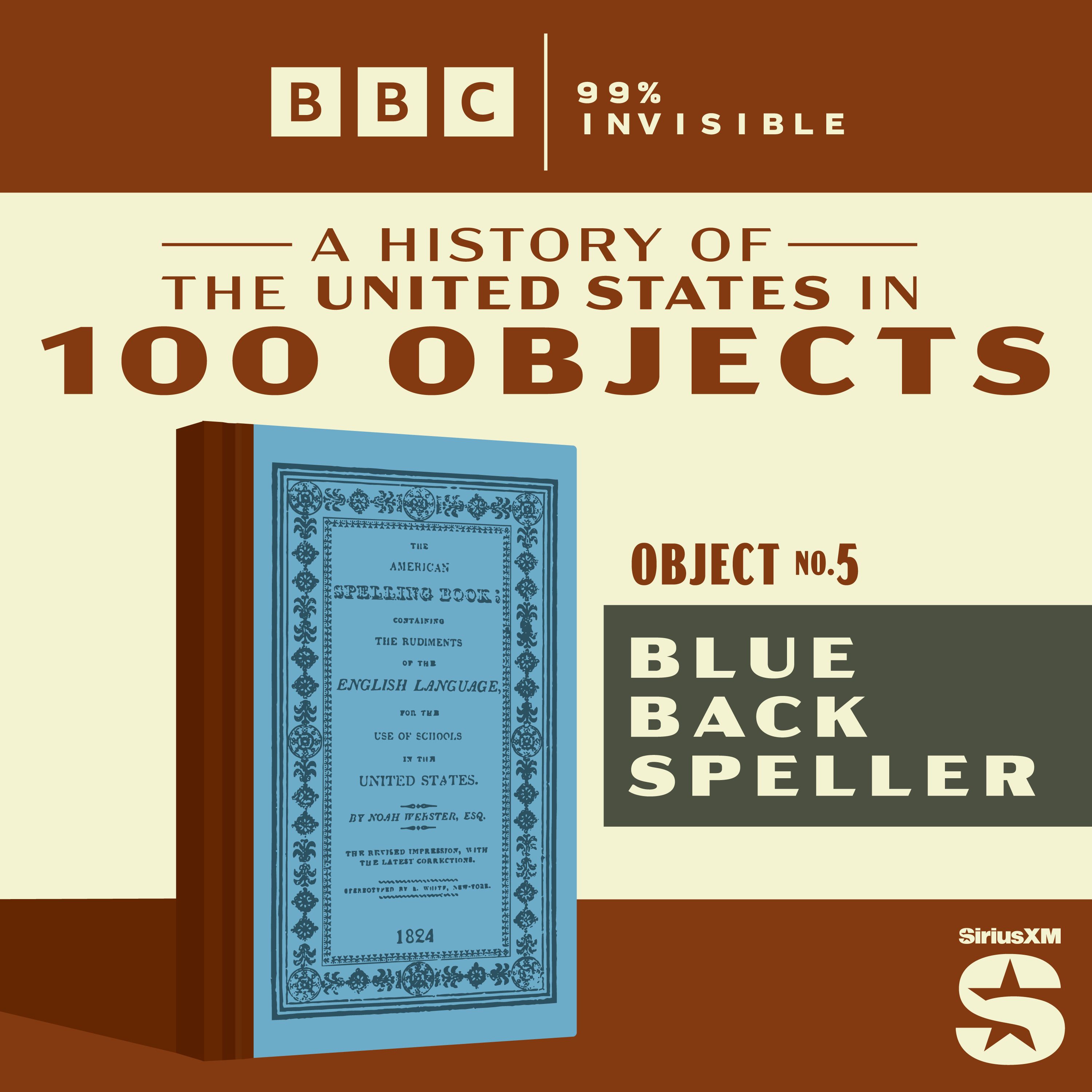
Overview of 100 Objects #5: Blue Back Speller
This episode of A History of the United States in 100 Objects explores Noah Webster’s Blue-Back Speller, a small schoolbook that helped define American literacy, standardize American English, and shape ideas about national identity. Though Webster intended it to build a more unified, distinctly American public, the book became even more significant in the hands of Black Americans—especially enslaved and formerly enslaved people who used it to teach themselves to read, claim intellectual freedom, and fight for full citizenship.
Main Takeaways
-
Noah Webster’s goal was nation-building through language.
- After the Revolutionary War, he wanted American classrooms to stop relying on British texts and create a more “American” way of learning.
- The Speller introduced simplified, Americanized spellings and a standardized approach to literacy.
-
The book was small, portable, and powerful.
- Its pocket-sized format made it easy to carry, hide, and use privately.
- That portability made it especially important for enslaved people, for whom reading was often forbidden and dangerous.
-
Black Americans transformed the Speller into a tool of liberation.
- People like Frederick Douglass used it to teach themselves to read.
- Literacy became a form of resistance, survival, and self-making under slavery.
-
The episode connects the Speller to the great Black education debate.
- Booker T. Washington and W.E.B. Du Bois both began with the Speller, but drew very different lessons from it.
- Their disagreement became a defining argument over what freedom required: economic self-help and patience, or direct confrontation for civil rights and political power.
Historical Arc
Noah Webster and the Making of an American Schoolbook
- In the early United States, education was disorganized and heavily reliant on British materials.
- Webster responded by creating the Grammatical Institute of the English Language, later known as the Blue-Back Speller.
- It taught phonics, pronunciation, spelling, and moral lessons, and became one of the most widely used schoolbooks in America.
Literacy as Resistance Under Slavery
- Enslaved people were often punished severely for learning to read.
- Because the Speller was so widespread, many still found ways to use it.
- For Douglass and others, reading opened the path to self-emancipation in mind and, eventually, in life.
After Emancipation: Schools, Danger, and Aspiration
- Freedpeople urgently sought education after slavery ended.
- Black soldiers, schoolchildren, and adults used the Speller in classrooms, camps, and homes.
- Schools for Black students were frequently attacked or burned, showing how threatening Black literacy was to white supremacy.
Booker T. Washington’s Path
- Washington learned to read with the Speller after emancipation.
- His experience shaped his belief in industrial education—practical training, labor, and self-sufficiency.
- His 1895 Atlanta Compromise speech made him a national figure but also signaled accommodation to segregation.
W.E.B. Du Bois’s Challenge
- Du Bois encountered the Speller later, while teaching in the South.
- His experience with Jim Crow and the loss of one gifted student, Josie, convinced him that Washington’s slow, accommodationist strategy was inadequate.
- In The Souls of Black Folk (1903), Du Bois argued for:
- Immediate civil and political rights
- Classical education for Black leadership
- The idea of the Talented Tenth
Why the Blue-Back Speller Matters
- It represents the power of access: a simple book that opened a world of literacy and possibility.
- It also reveals a core contradiction in American history:
- An object created to define who counted as American
- Used by Black Americans to insist that they counted too
- The Speller becomes a symbol of how marginalized people can take something not meant for them and turn it into a tool for liberation.
Notable Insights
-
Literacy was freedom in a society that denied freedom.
- For enslaved people, learning to read was both dangerous and transformative.
-
Education was never just about schooling.
- It was about power, citizenship, survival, and the future of the community.
-
Washington and Du Bois shared more than opposition.
- Both believed deeply in education as a vehicle for Black advancement.
- Their split was about strategy, timing, and the meaning of freedom.
-
The episode frames Du Bois and Washington as part of a larger American pattern.
- Young people, new ideas, and challenges to the status quo are essential to progress.
Bottom Line
The Blue-Back Speller was more than a primer: it was a foundation for American literacy, a hidden weapon of Black self-education, and a key artifact in the struggle over what education is for. In Roman Mars’s telling, the book embodies a larger American story—one in which Black Americans repeatedly took structures not designed for them and remade them into instruments of freedom.