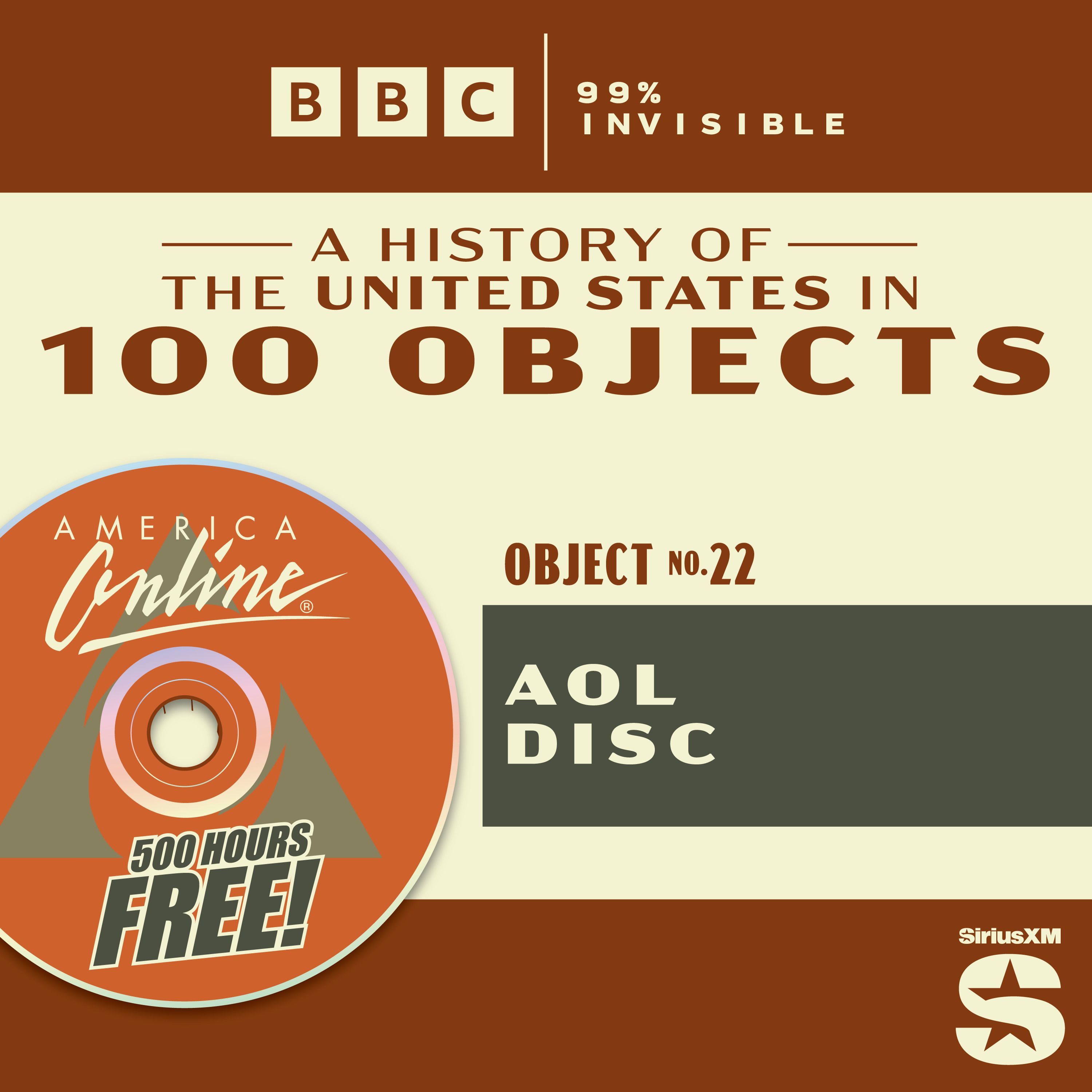
Overview of 100 Objects #22: AOL Disc
This episode of 99% Invisible explores the humble AOL CD/DVD as one of the most influential physical marketing objects in tech history. Through the work of marketer Jan Brandt, the story shows how a tiny disc delivered through mail, magazines, and product promotions helped introduce millions of Americans to the internet—and how AOL’s success both defined and ultimately failed to survive the changing shape of online life.
The AOL Disc as a Cultural Object
The AOL disc was not a music CD or software people sought out on purpose—it was a marketing tool disguised as a free sample.
What it did
- Contained AOL software for dialing into the internet
- Offered free trial hours to encourage sign-ups
- Turned a computer into a portal to AOL’s “walled garden” of chat, email, news, and forums
Why it mattered
- At its peak, AOL discs were everywhere:
- in magazine mailers
- cereal boxes
- bookstore and Starbucks displays
- airline snack packs
- Blockbuster promotions
- even Super Bowl seats and Omaha Steaks shipments
- At one point, AOL discs allegedly made up about half of all CDs produced worldwide
Jan Brandt and AOL’s Marketing Machine
Jan Brandt, AOL’s marketing lead in the early 1990s, is the key figure behind the disc campaign.
Her strategy
- AOL was struggling to explain what the internet even was
- Brandt realized people needed to experience the internet, not just hear about it
- She proposed mailing free disks to targeted audiences, starting with computer-literate magazine readers
Why the campaign worked
- Direct mail response rates were extraordinary:
- typical response: 1%–2.5%
- AOL test mailing: 12%
- some lists reportedly produced nearly 18% response
- AOL carefully tracked every campaign and knew exactly which audiences produced the best conversion
Scaling the effort
- The campaign expanded from tech-savvy users to families and mainstream consumers
- AOL eventually developed machinery just to insert discs into mailers fast enough
- The company’s aggressive distribution made it one of the largest mailers in the U.S.
AOL’s Rise: Selling the Internet Before the Internet Was Familiar
The episode emphasizes that AOL didn’t just sell a service—it helped define the internet for ordinary people.
AOL’s appeal
- Easy-to-use, colorful interface
- Curated news and content
- Chat rooms and community forums
- Email and shared interests
- A sense of belonging, especially before social media and always-on connectivity
The company’s philosophy
AOL organized itself around the “three C’s”:
- Communication
- Community
- Clarity
It was designed to feel less like software and more like a welcoming place to spend time.
The Collapse: Why AOL Couldn’t Hold Onto the Internet
The episode makes clear that AOL’s downfall came from misunderstanding the internet’s evolution.
Major challenges
- Broadband replaced dial-up: users no longer needed AOL to connect
- The web opened up: people could build their own sites and explore beyond AOL’s controlled environment
- The dot-com bubble burst: ad-driven internet businesses crashed, hurting AOL’s revenue
- The Time Warner merger failed badly: the companies had incompatible cultures and no clear integration plan
The result
- AOL’s growth stalled and then collapsed
- The company suffered massive losses
- The AOL-Time Warner merger became infamous as one of the worst business deals in history
- AOL was eventually sold off, restructured, and reduced to a much smaller player
Main Takeaways
- The AOL disc was one of the most effective marketing tools in tech history.
- AOL succeeded because it understood that people wanted connection, community, and ease of use.
- It failed because it bet too hard on a closed, curated internet just as the web became open, fast, and decentralized.
- The episode argues that AOL got half of the internet right:
- Right: people come online to find each other
- Wrong: people want open chaos more than a professionally curated garden
Notable Insight
AOL understood the internet as social—but not as open.
That distinction is the episode’s core lesson. AOL helped create the habits that later defined the internet, but it failed to adapt to the infrastructure and culture that ultimately made the modern web work.
Legacy of the AOL Disc
- Helped introduce millions of Americans to the internet
- Symbolized the transition from offline life to digital life
- Became a punchline, then a relic, but also a landmark in internet history
- Shows how a physical object can shape behavior at massive scale
In the end, the AOL disc is remembered not just as junk mail, but as the object that helped bring the internet into everyday American life.