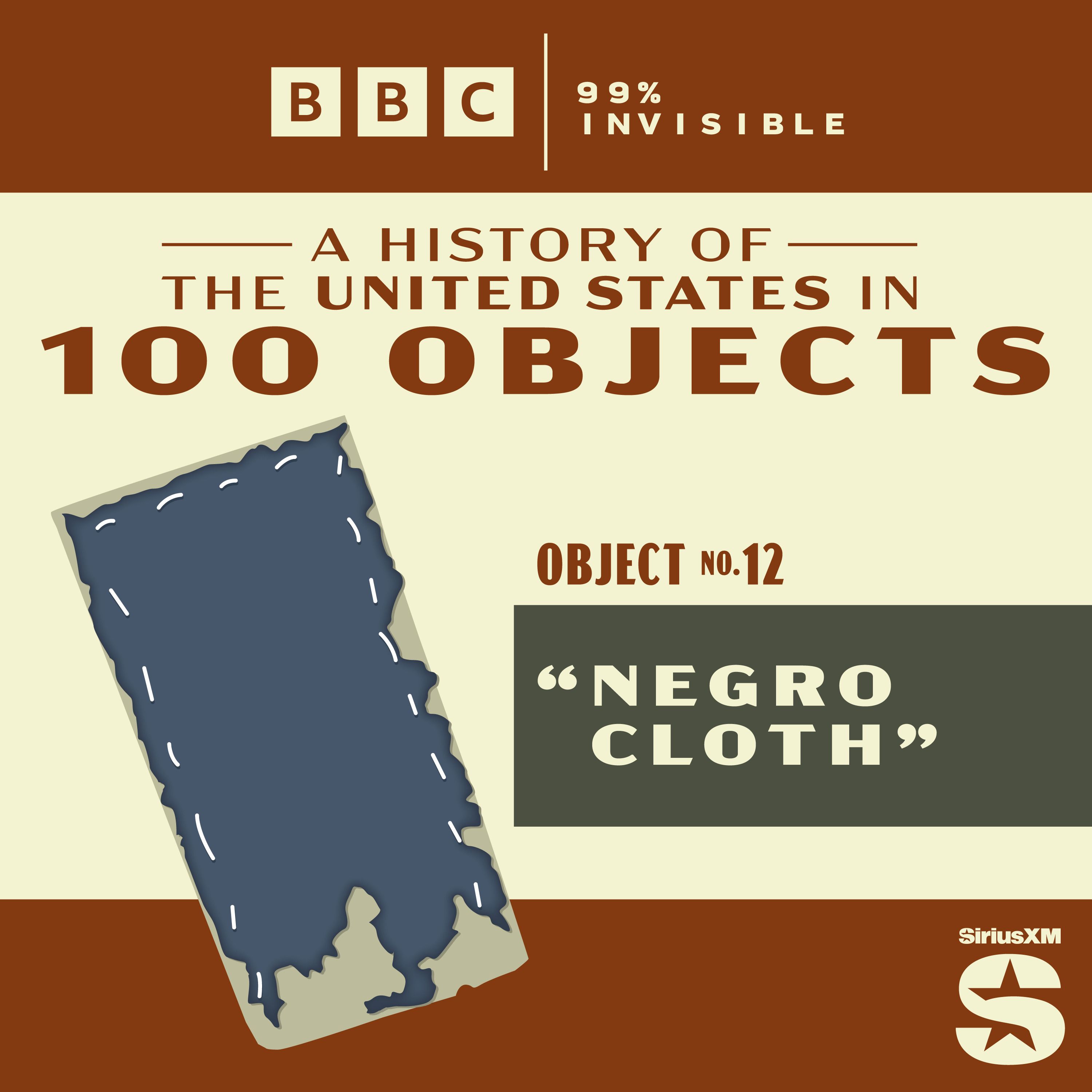
Overview of 100 Objects #12: "Negro Cloth"
This episode explores a tiny surviving fabric swatch—“Negro cloth”—as a window into the material economy of American slavery. Through historian Seth Rockman’s research, Roman Mars shows how a seemingly ordinary textile reveals the deep interdependence between Northern industry and Southern plantation slavery, and how ordinary consumers, workers, and manufacturers rationalized their participation in that system.
What “Negro Cloth” Was
A trade name, not a single fabric
- “Negro cloth” was a market category for durable, inexpensive textiles made for enslaved laborers.
- It was not one specific material: the same kind of cloth might be sold under different names depending on the customer and region.
- For enslaved workers in the South: Negro cloth
- For Irish canal workers or Ohio farmers: other names like Kentucky jeans or Welsh plains
- The label itself shows how race shaped commerce and how the same product could be racialized through marketing.
Why the physical artifact matters
- Historians rarely find actual clothing worn by enslaved people because it was used until it wore out, repaired repeatedly, recycled, or destroyed.
- Rockman found a rare surviving sample in archival correspondence: a pinned fabric square attached to a merchant’s letter.
- These swatches were effectively early textile samples—proof that business relationships between planters and manufacturers were highly intentional and data-driven.
How the System Worked
Northern factories supplied Southern slavery
- The episode centers on the Rhode Island company founded by Isaac and Roland Hazard.
- The Hazards began by looking for markets for woolen textiles and discovered that Southern buyers wanted cloth specifically suited for enslaved labor.
- Over time, they became major suppliers of plantation goods—especially cloth, but also shoes, boots, tools, and other necessities of plantation life.
Production blended factory and household labor
- The Hazards did not rely only on a modern factory model.
- Yarn was spun in mills, then distributed to rural families to weave at home.
- Finished fabric was collected and processed further in mechanized facilities.
- This mix of industrial and domestic labor helped Northern communities profit from slavery while remaining physically distant from plantations.
The Role of Enslaved People in the Process
Enslaved workers had limited but real influence
- Slaveholders and manufacturers sometimes asked enslaved people about clothing preferences.
- This was not genuine freedom or bargaining power; it happened within a violent system of coercion.
- Even so, enslaved people tried to reduce suffering where possible by influencing:
- fabric weight
- cut
- color
- durability
- breathability
Clothing as “performance wear”
- The sales pitch was that better clothing would:
- protect the enslaver’s “investment”
- improve productivity
- keep workers healthier
- The episode emphasizes that these claims were largely marketing, not truth.
Northern Complicity and Moral Rationalization
Complicity was widespread and often acknowledged
- Many New England manufacturers and workers understood that they were tied to slavery.
- Some were even involved in abolitionist activity at the same time.
- The episode rejects a simplistic “gotcha” framing and instead focuses on how people lived inside systems of complicity.
The Hazards saw themselves as anti-slavery
- Roland and Isaac Hazard reportedly believed slavery was wrong and would eventually end.
- But they also believed they could do little to stop it, so they continued profiting from supplying plantation goods.
- They rationalized their work as:
- supporting local New England families
- improving living standards in their town
- providing clothing that made enslaved people “less miserable”
- This is presented as a clear example of moral self-justification inside an exploitative economy.
Bigger Historical Argument
The North and South were economically interdependent
- The episode reframes the pre-Civil War period not just as rising sectional conflict, but also as a system of mutual economic dependence.
- The South outsourced manufacturing to Northern businesses.
- The North outsourced labor-intensive plantation production to the enslaved South.
- This was not separation so much as a tightly linked economy built on slavery.
After the Civil War, the pattern continued in new forms
- Northern manufacturers hoped emancipation would create a huge market of freed Black consumers.
- That did not happen because Reconstruction was shaped by:
- racial violence
- sharecropping
- debt peonage
- coercive labor systems
- The episode underscores that slavery did not simply vanish; its economic structures were transformed and extended.
Key Takeaways
- A tiny fabric swatch can reveal a vast network of exploitation.
- Slavery was not only a Southern institution; it was economically supported by Northern industry.
- Race was embedded in material culture and marketing, not just law and ideology.
- People often recognize moral problems in a system and still continue benefiting from it.
- The episode connects 19th-century plantation goods to modern supply chains, consumer ethics, and the difficulty of escaping global complicity.
Notable Insight
“Things don’t come into the world fully formed as commodities. They come into the world and become commodities through knowable historical processes.”
This is the episode’s central idea: everyday goods carry hidden histories of labor, power, and violence, and understanding those histories is essential to understanding both the past and the present.